


In 2026, markets are still pricing AI like the early internet – as a battle for users, engagement, and the next sticky interface. But the AI economy operates differently. Here, the user session or software subscription is not the primary unit of value. It is compute.
- The Capital Doesn’t Lie
- The Software Exit Is Institutional, Not Retail
- Where the Institutional Money Is Going
- Where Real AI Revenue Is Being Printed
- While Hardware Compounds, Software Loses the Premium Argument
- The Layer Nobody Is Pricing: Below the Chip
- The Valuation Warning Embedded in the Rally
- The Verdict
Conventional SaaS valuations assumed that software could lock customers into proprietary workflows, creating durable competitive moats. AI has challenged that assumption. When the model itself is the product and increasingly accessible to everyone, the competitive advantage no longer lies in the interface layer. It lies in the infrastructure layer, where speed, efficiency, and the economics of inference determine who wins.
To compete in this market, enterprises must deliver intelligence at lower cost, greater scale, and faster response times than their rivals. Success depends less on software differentiation and more on infrastructure dominance – the ability to turn compute into intelligence more efficiently than anyone else.
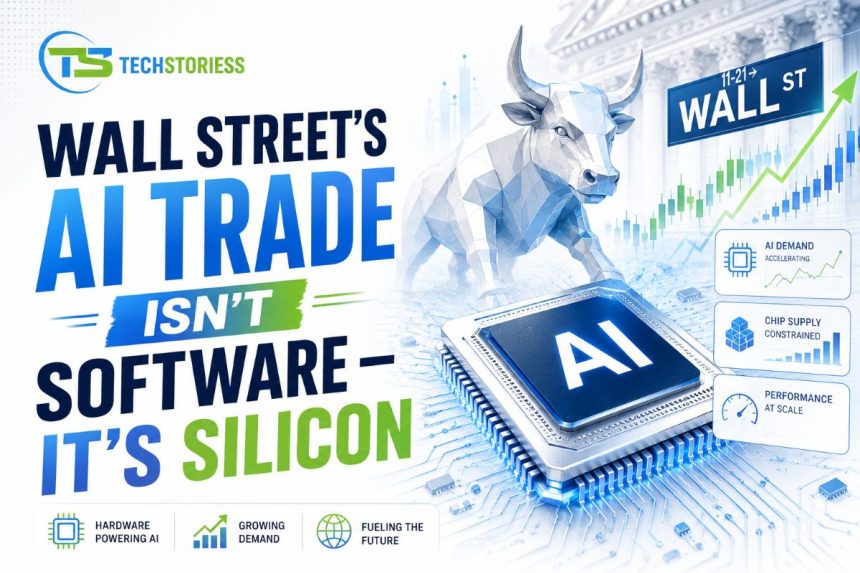
While AI apps and platforms quickly capture investors’ attention, the real AI trade lies in the underlying infrastructure: silicon. It always has.
The Capital Doesn’t Lie
Upon precisely chasing the money, the software narrative begins to fade. Three signals tell the story: where the spending is going, what it reveals about the true nature of the AI economy, and what the market has already priced in.
Where the Money Is Going
In 2026, roughly $450 billion is being invested directly into AI infrastructure – servers, GPUs, high-bandwidth memory, networking equipment, and data center construction. That represents about 75% of the projected $602 billion in aggregate hyperscaler capital expenditure. More than a software procurement cycle, the AI boom is fundamentally a story of physical, manufacturable, supply-constrained hardware. Put differently, nearly three out of every four dollars the world’s largest technology companies are spending on AI is flowing into the infrastructure that powers it.
An Industrial Economy in Tech’s Clothing
Hyperscalers now reinvest 45% to 57% of their revenue into capital expenditure – ratios more commonly associated with industrial companies and utilities than with technology businesses. That structural shift reveals an important reality: at its foundation, the AI economy is increasingly a materials and manufacturing business rather than a software business. Its economics are shaped by the same forces that govern other capital-intensive industries – margin structures, supply constraints, production capacity, and access to critical components.
What the Market Is Already Saying
While the narrative in public markets has lagged this reality, the performance data has not. Software and services are down 14% year-to-date and have returned just 9% over the past twelve months. Semiconductors and semiconductor equipment, by contrast, grew 38% year-to-date and 104% over the past year. That performance gap reflects a fundamental reassessment of where AI value actually accrues.
The Software Exit Is Institutional, Not Retail
This rotation is significant – and institutional money is driving it. Hedge funds reportedly earned approximately $24 billion shorting the software sector through early 2026, with 13-F filings confirming that large funds have been reducing long positions in names like Salesforce, ServiceNow, and Adobe – with Gavin Baker’s Atreides fund, a dedicated technology specialist, divesting from HubSpot and Intuit entirely while reducing its stake in Snowflake.
This is more than a retail panic. These are technology-specialist investors with in-depth understanding of the software sector. They are not selling indiscriminately – these are deliberate, documented exits.
Where the Institutional Money Is Going
As the center of gravity in the AI investment boom visibly shifts, the AI buildout has emerged as one of the most powerful alpha engines in modern markets for hedge funds positioned across the semiconductor and data center supply chain. While software dominates headlines, hardware is increasingly generating returns.
Institutional conviction is visible in the 13-F disclosures. Situational Awareness LP’s latest 13-F disclosed approximately $13.7 billion in reported holdings. Founded by former OpenAI researcher Leopold Aschenbrenner, the fund has constructed a barbell portfolio: $8.46 billion in put exposure against major semiconductor names including Nvidia, Broadcom, and AMD, paired with concentrated long positions in power infrastructure, GPU cloud, and data center operators. The fund’s filings have become a regular reference point for investors tracking where AI capital expenditure is actually flowing – and, notably, where semiconductor valuations may have run ahead of it.
Where Real AI Revenue Is Being Printed
The hardware layer is generating contracted, supply-constrained AI revenue rather than speculative AI narrative. This is a distinction that matters most to capital allocators and increasingly guides institutional positioning.
Power Management: The Infrastructure Behind Every AI Query
In the first quarter of 2026, SK Hynix reported a historic quarter, with revenue up 144% year-over-year to 52.6 trillion won, up 198% year-over-year trillion and an operating margin of 72%. Management declared the memory upcycle structural rather than temporary, with customer demand for the next three years already exceeding planned supply capacity. A 72% operating margin with demand visibly outstripping supply is not just a strong result – it reflects near-monopoly pricing power over a critical input.
Power Management: The Infrastructure Behind Every AI Query
The AI buildout is driving demand not only for processors and memory, but also for the power-delivery systems that convert electricity into usable compute at scale.
Monolithic Power Systems reported Enterprise Data revenue of $262.8 million in Q1 2026, up 97.7% year-over-year, driven specifically by power management solutions for AI and server applications – a function so physically essential to AI data center operation that it cannot be deferred, virtualized, or substituted with software.
While Hardware Compounds, Software Loses the Premium Argument
Meanwhile, broad software indices have declined approximately 25% from twelve-month highs, with average gross retention still holding around 90% but investor confidence having clearly shifted – not on fundamentals, but on the structural question of whether per-seat SaaS models deserve a premium over the broader market when AI agents can perform the same functions at a fraction of the cost.
The Layer Nobody Is Pricing: Below the Chip
The most overlooked yet highly consequential investment story in the entire AI semiconductor complex lies beneath the headline chips – in the physical materials and advanced packaging infrastructure that make AI processors possible.
ABF Film: The Material Bottleneck
Ajinomoto – which controls over 95% of the global market for ABF film, the material used in advanced chip packaging – has announced a 30% price increase effective Q3 2026, as AI chip packaging layers evolve from 3+3 to 11+11 configurations, pushing substrates back into shortage territory. A single company controlling 95% of a critical material and raising prices 30% represents extraordinary pricing power at an early stage of mainstream recognition – and that setup has not yet received meaningful mainstream financial coverage.
Substrates: Capacity No Customer Can Risk Losing
Ibiden holding 70 to 80% share of the highest-complexity substrate manufacturing layer – has committed $3.2 billion in capital expenditure across 2026 to 2028, the largest substrate expansion of its kind in the company’s history. Intel, AMD, and Nvidia have collectively co-funded roughly 50% of the expansion capex at their top four substrate suppliers – behavior indicating that customers believe they have no practical alternative.
Customer-Funded Expansion Signals Durable Pricing Power
When chip designers are funding their own suppliers’ expansion because they cannot risk supply interruption, the pricing power embedded in that relationship is durable in a way that software subscription revenue structurally is not.
The Valuation Warning Embedded in the Rally
None of this guarantees the silicon trade is risk-free. The same supply constraints and pricing power making hardware AI plays compelling also set the conditions for violent corrections when sentiment shifts.
In a single June 2026 session, approximately $1.4 trillion in market value was erased across the AI semiconductor sector, with the Philadelphia Semiconductor Index declining 10%, Broadcom falling 12.6%, and Marvell plunging 17%. The recovery was swift – but the episode illustrated precisely how a concentrated, momentum-driven trade can reprice without warning.
The SOX index sits 60% above its 200-day moving average – a technical extension that historically resolves through either prolonged consolidation or a sharp correction, and that rarely simply continues upward.
The sophisticated investor’s position is not to choose between avoiding and embracing semiconductor valuations, but to distinguish within the silicon layer: between companies with contracted backlogs, physical pricing power, and supply constraints that cannot be replicated by competitors in the near term – and those riding the narrative without the revenue architecture to support it.
The Verdict
The AI economy is being built in physical layers – memory, packaging, substrates, power management, advanced interconnect – that demand prolonged capital investment, operate under genuine supply constraints, and generate revenue that is contracted, measurable, and recurring in ways that most software AI revenue is not.
Wall Street’s institutional money has already moved, as confirmed by 13-F filings, earnings data, and $450 billion flowing into physical AI infrastructure this year.
It doesn’t mean the software narrative is wrong. But it is downstream. Investors mistaking the downstream story for the primary trade price AI at the application layer while the structural value accrues in the silicon underneath it.