


Key Takeaway: In 2026, enterprise synthetic data generation costs range from $20,000 to $100,000 annually for mid-market platforms, scaling to $150,000 to $750,000+ for enterprise-grade solutions requiring formal privacy guarantees. Custom-built infrastructure can exceed $1.5 million in year one. Final pricing is primarily driven by data modality (tabular vs. multimodal), compute volume, and industry compliance requirements.
Synthetic data has evolved from an experimental technique to a vital pillar of contemporary machine learning. With tightening privacy requirements, a scarcity of high-quality training data, and rising AI development costs, synthetic data generation is now an essential infrastructure investment.
However, executives consistently face one major hurdle: determining the actual cost structure for large organizations. The reality extends well beyond software subscriptions. Enterprises must account for infrastructure management, implementation, governance, model validation, and operational running costs.
This guide breaks down the true cost of enterprise synthetic data in 2026 to help your ML teams build accurate budgets and make informed purchasing decisions.
What Is Synthetic Data and Why Does Cost Matter?
Synthetic data is artificially generated information that statistically mirrors real-world data without containing identifiable personal information. According to IBM’s overview of synthetic data, it is typically created using generative adversarial networks (GANs), variational autoencoders (VAEs), or large language models (LLMs).
The generation of synthetic data is no longer just an engineering talking point; it is a board-level priority. This shift is driven by three forces:
- Tightening global privacy laws (EU, US, and Asia).
- The massive data appetite of foundation models.
- The soaring cost of collecting, cleaning, and licensing real-world data.
Enterprise ML teams now treat synthetic data as a core infrastructure expense. Compared with traditional data acquisition, synthetic investments bundle software, compute, governance, and operational costs.
Key Factors Influencing Generation Costs
Understanding what drives your final bill accelerates time-to-value and prevents budget overruns. Several variables dictate your total spend:
- Data Type and Complexity: Tabular (structured) data is highly cost-effective. Multimodal data, such as high-fidelity 3D simulations for autonomous vehicles, requires massive compute and is significantly more expensive.
- Volume and Scale: While small pilots can survive on metered usage, enterprise-scale generation (millions of complex records) requires flat-rate enterprise tiers.
- Privacy and Compliance: Features like differential privacy or auditable output typically command a 30–50% premium.
- Deployment Model: Cloud SaaS is pay-as-you-go, whereas on-premise or hybrid models require higher upfront capital but can lower long-term unit economics.
How Pricing Models Actually Work
Vendor pricing typically falls into four structures. Selecting the right one for your data workload changes everything about your final bill.
| Pricing Model | Cost Range | Best For |
| Per-Record / Sample | $0.001 – $0.05 per row ($5+ for video) | Small teams, low-volume tabular data, predictable POCs. |
| Platform Licensing | $50,000 – $500,000+ annually | Medium to large enterprises needing predictable billing and integration. |
| Compute-Based | $2 – $15 per GPU hour | Highly complex image/video synthesis (GANs, diffusion models). |
| Custom Enterprise | $80,000 – $250,000+ annually (self-hosted) | Heavily regulated organizations with dedicated MLOps teams. |
Full Pricing Breakdown by Vendor Tier
Understanding the market becomes much easier when you categorize vendors into distinct operational tiers.
| Vendor Tier | Estimated Annual Cost | Key Characteristics |
| Tier 1: Open-Source | $80,000 – $250,000 (Internal engineering costs) | Zero licensing fees, but requires heavy cloud compute and dedicated ML engineers. |
| Tier 2: Mid-Market SaaS | $20,000 – $100,000 | Speed-focused platforms for growing teams. Basic compliance reporting included. |
| Tier 3: Enterprise-Grade | $150,000 – $750,000 | Formal privacy guarantees, multi-modal generation, strict SLAs, and dedicated support. |
| Tier 4: Custom-Built | $500,000 – $3,000,000 (Initial build) | Proprietary engines for Fortune 500 scale. High upfront cost, lower marginal cost. |
Leading Platform Snapshots (2026 Estimates)
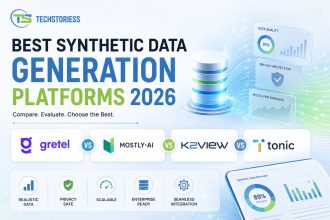
- Tonic.ai: Custom enterprise plans often starting in the low five figures. Exceptional for structured data, software testing, and AI training.
- Gretel.ai: Team plans at ~$295/month for base credits. Enterprise contracts feature higher concurrency and custom SLAs.
- MOSTLY AI: Enterprise licensing spans $50k–$500k depending on scale, focusing heavily on high-fidelity, privacy-safe structured data.
The Hidden Costs Most Budgets Miss
Sticker prices rarely tell the whole story. Synthetic data pipelines quietly expand through line items that teams frequently overlook:
- Data Validation (QA): Validating statistical fidelity against real data requires dedicated tooling. Budget an extra 10–20% of your platform spend for validation.
- Integration Engineering: Connecting pipelines to existing ML infrastructure requires custom API work and data warehouse connectors.
- Privacy Auditing: Regulated industries often require third-party audits (costing $15,000–$60,000) to prove synthetic datasets cannot be reverse-engineered.
- Model Drift Management: Retraining generation models to prevent “stale” outputs adds recurring compute costs.
For additional insights on managing these hidden pipeline expenses, explore the TechStoriess guide to enterprise machine learning infrastructure.
Market Forces Driving Adoption
Why are companies willing to pay these premiums? As highlighted in Gartner’s AI research insights, the landscape of AI development is becoming strictly regulated.
- Stricter Regulations: Frameworks like GDPR, HIPAA, and CCPA make training on real user data a massive liability. Synthetic data removes this risk entirely.
- Data Scarcity: Organizations frequently lack data for rare events, edge cases, or imbalanced demographics.
- Development Costs: Labeling and cleaning real-world data requires thousands of human hours. Synthetic data is generated pre-labeled and perfectly formatted.
Real-World Budget Scenarios
Here is how these costs materialize across different organizational profiles:
- Startup ML Team: $15,000–$40,000 annually (Mid-market SaaS, tabular data).
- Mid-Size Fintech: $200,000–$400,000 annually (Fraud detection models, compliance tooling, privacy certification).
- Large Healthcare System: $500,000–$1.2 million annually (Multi-modal patient simulation, HIPAA-compliant on-premise security).
- Global Enterprise: $1.5M–$3M in year one for custom infrastructure, dropping to $600,000–$900,000 in ongoing maintenance by year three.
Top Recommendations for Enterprise Buyers
To maximize ROI and prevent vendor lock-in, follow these strategic recommendations before signing an enterprise contract:
- Start With High-Value Use Cases: Do not attempt an enterprise-wide rollout on day one. Target high-ROI bottlenecks like predictive maintenance or fraud detection first.
- Audit the Cost of Real Data: You cannot prove the ROI of synthetic data until you know exactly what your team currently spends on acquiring, cleaning, and labeling real data.
- Demand Proof of Fidelity: Require vendors to run a proof-of-concept (POC) on your actual data to prove their statistical validation metrics.
- Buffer Your Budget: Always plan your budget with a 20–30% buffer specifically allocated for cloud compute and custom integration engineering.
Conclusion
The enterprise pricing structure for synthetic data in 2026 reflects a maturing ecosystem. While upfront investments vary drastically based on scale and modality, the downstream benefits—absolute privacy compliance, infinite data abundance, and accelerated AI lifecycles—make it a strategic imperative. By understanding the underlying pricing models and hidden compute costs, ML teams can build resilient AI capabilities without breaking their budgets.
Frequently Asked Questions
What is the typical synthetic data generation cost for enterprise ML teams in 2026?
Entry-level enterprise deployments start around $50,000–$150,000 annually, with full-scale implementations ranging from $175,000 to over $500,000 depending on multimodal requirements and privacy guarantees.
How does synthetic data pricing compare to traditional data collection?
Synthetic approaches generally reduce data-related costs by 25–70%. The savings are realized by eliminating manual data collection, human labeling, and compliance legal review.
How can I calculate ROI for synthetic data adoption?
Compare the total cost of ownership (platform fees + compute + engineering) against traditional methods. Factor in the time saved on data preparation, risk reduction from privacy compliance, and faster model deployment cycles. Most organizations achieve positive ROI within 6 to 12 months.