


Nvidia has quietly stopped being just a GPU company. Over the past twelve months, it has moved into CPUs, PC processors, and networking silicon simultaneously – while also becoming one of Intel’s largest shareholders. The result is a company competing against, investing in, and partnering with the same two rivals at once, and the tech industry is only beginning to grapple with what that means.
The evergreen story underneath the headline
For four decades, the semiconductor industry has run on a simple division of labor: Intel and AMD build the CPUs that run everything from laptops to server racks, and specialist vendors – Nvidia among them – build the accelerators that sit alongside them. That division is now collapsing, and it’s collapsing because of AI.
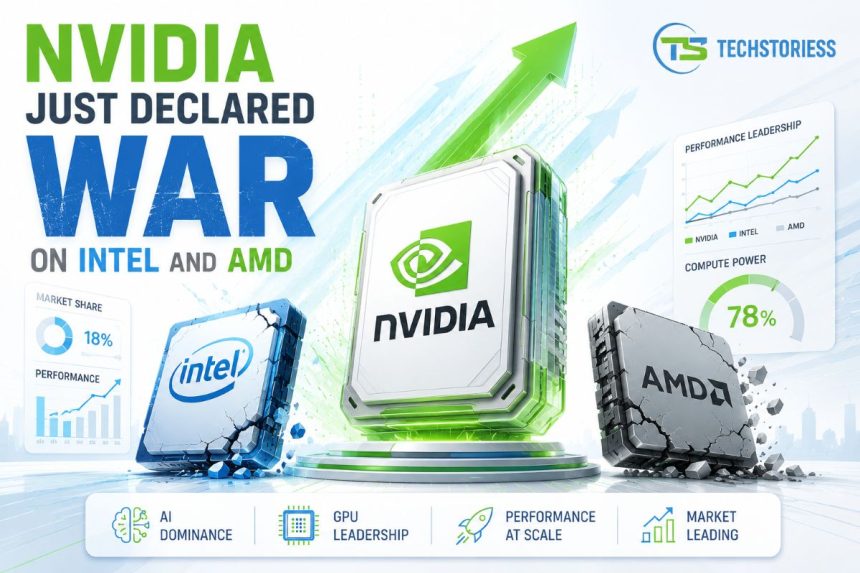
Nvidia’s data center business generated $75.2 billion in revenue for the quarter ended April 26, 2026, up 92% year-over-year, dwarfing AMD’s $5.8 billion and Intel’s $5.1 billion data center results in the same period. Nvidia holds an estimated 75-86% of the AI accelerator market depending on the measure, according to estimates from Silicon Analysts and IDC. That dominance in GPUs gave Nvidia something rare: enough cash and enough customer trust to walk into CPUs, the one category it had never controlled.
The trigger, according to industry analysts, is a shift in what AI workloads actually need. Model training is GPU-hungry. But as enterprises move from building models to running them – deploying autonomous agents that make decisions, call tools, and execute tasks continuously – the bottleneck shifts toward CPU-style processing. That shift is why Meta signed a deal to use Nvidia’s CPUs on a standalone basis, without pairing them with GPUs at all, and why AMD moved quickly to sign its own separate CPU agreement with Meta to defend its position.
What the industry’s own numbers say
The specifics are unusually well documented for a market this new. Nvidia’s server CPU, codenamed Vera, was detailed publicly for the first time in July 2026, giving prospective customers the specifications and benchmarks needed to evaluate it against incumbent chips. Wolfe Research estimated an average selling price near $5,000 per Vera unit and forecast roughly 1.3 million units shipping this year – meaningful volume for a first-generation product entering an entrenched market.
That market is not undefended. AMD currently holds an estimated 33% share of enterprise AI server CPUs, while Intel holds roughly two-thirds, according to Gartner analyst Kevin Knox, who frames AMD – not Intel – as the company Nvidia has to beat first, given AMD’s momentum and its deep relationships with the hyperscalers that buy in bulk.
Nvidia’s CEO has been explicit about the scope of the ambition. At Taiwan’s Computex conference in June, Jensen Huang said Nvidia, working with Microsoft, intends to fundamentally remake the PC. The company’s answer is RTX Spark – a combined processor and graphics chip built with Taiwan’s MediaTek, running Windows on Arm, aimed initially at premium laptops designed to run AI models locally with what Nvidia describes as built-in data controls. Semiconductor analyst Patrick Moorhead called it the first real Windows-ecosystem challenger to the MacBook Pro in years.
The uncomfortable investigative angle
Here is where the story stops being a straightforward horse race and starts raising harder questions. Nvidia is not simply attacking Intel’s CPU business from the outside – it is simultaneously one of Intel’s financial backers. In September 2025, Nvidia committed $5 billion to Intel, buying shares at $23.28 each, as part of an agreement to co-develop chips for both PCs and data centers. Intel, in turn, agreed to license Nvidia’s graphics technology for its own PC chips and to supply processors for data center systems built around Nvidia hardware.
That arrangement blurs a line enterprise buyers, regulators, and competitors have historically relied on to make sense of the market: the distinction between competitor and supplier. Nvidia is now a company that can gain from Intel’s success as a shareholder, gain from Intel’s failure as a rival CPU vendor, and set technical terms for how Intel’s own chips work alongside Nvidia’s hardware – all at the same time. For a CFO or CIO managing multi-year infrastructure commitments, that concentration of leverage in a single vendor across GPUs, CPUs, PC silicon, and now a strategic stake in a would-be rival is not a footnote. It’s a supply-chain dependency question that most procurement teams have not yet priced in.
It also raises the obvious antitrust question that has so far gone largely unasked in mainstream coverage: at what point does an $75-billion-a-quarter accelerator business using its scale to enter adjacent CPU and PC markets – while holding equity in the incumbent it’s displacing – draw regulatory scrutiny similar to what’s already being applied to Big Tech’s cloud and advertising dominance? Nvidia has not been shy about the goal. Huang’s own language – reinventing the PC, taking on every layer of the AI stack – is a statement of intent to control infrastructure end to end, not just win a product cycle.
For enterprise technology buyers, the practical takeaway arrives well before the antitrust question does. Locking a multi-year hardware roadmap to Nvidia across training, inference, and now general-purpose computing means locking pricing power, supply allocation, and roadmap decisions to a single vendor at a moment when component supply – memory chips especially – is already structurally tight. AMD and Intel’s counter-bets, including AMD’s own Arm-based PC chip development and Intel’s foundry turnaround narrative that has helped drive its stock up more than 190% year-to-date in 2026, are not yet proven at scale. Whether either can mount a credible defense, or whether Nvidia’s next move is simply to keep expanding the perimeter of what it controls, is the story worth watching over the next two quarters – not the next headline cycle.