


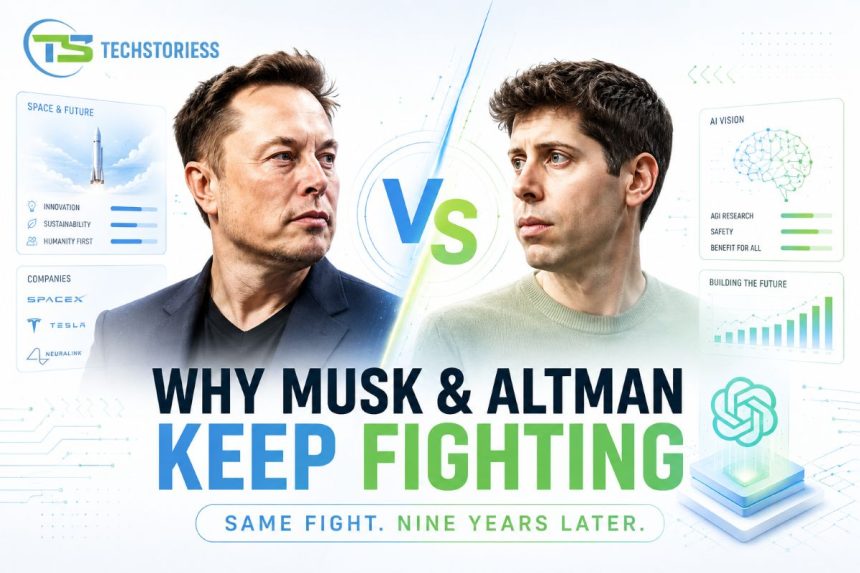
Nine years ago, when OpenAI was founded, two prominent tech figures, Elon Musk and Sam Altman, shared a San Francisco stage and described a shared conviction: that artificial intelligence was too consequential to be controlled by any single corporation or person. On May 18, 2026, they stood on opposite sides of a federal courtroom in Oakland while nine jurors decided, in under two hours, that Musk’s $150 billion lawsuit had been filed too late. It took the jury less time to reach that verdict than it takes to watch a feature film – a strikingly small procedural footnote to a rivalry that has now run for nearly a decade.
The number that matters most is nine years – the distance between OpenAI’s founding in December 2015 and a legal reckoning that changed almost nothing about the underlying feud. Musk has already vowed to appeal, calling the ruling a “calendar technicality.” The fight isn’t over. It has simply moved, again, to new terrain.
A Feud That Outgrew the Courtroom
The financial performance of the two men’s companies has become the fight’s most brutal scoreboard. OpenAI closed a $122 billion funding round in March 2026, pushing its post-money valuation to $852 billion – up sharply from its previous valuation. Amazon, Nvidia, and SoftBank committed $50 billion, $30 billion, and $30 billion respectively.
Musk’s xAI, meanwhile, raised roughly $20 billion before being acquired by SpaceX in an all-stock transaction that valued xAI at $250 billion and the combined company at $1.25 trillion. SpaceX then went public in a record-setting IPO in June 2026, raising $75 billion at a $1.77 trillion valuation. OpenAI had already confidentially filed paperwork for its own eventual listing earlier that month. Two companies that started as allies around a shared concern about concentrated AI power are now racing each other into public markets, a symmetry that would have seemed absurd in 2015.
Even the case’s central dispute was about money and control masquerading as mission. Musk’s suit accused Altman and OpenAI president Greg Brockman of turning a charity into what his lawyers called a “shell,” shifting staff and intellectual property into a for-profit structure as Microsoft became a major investor. OpenAI’s defense, delivered in part by Microsoft CEO Satya Nadella on the stand, was that Musk had pushed for a for-profit structure on the condition that he retain control, and that the lawsuit emerged after the relationship had broken down and Musk had built a direct competitor. The jury ultimately did not reach the merits of those allegations, instead finding that Musk’s claims were brought outside the applicable limitations period.
The Talent and Compute Arms Race
Behind the courtroom drama sits a more mundane but more consequential war: for engineers and for compute. Both OpenAI and Musk’s AI operation have been competing aggressively for scarce frontier-AI talent, while the scale of compute required to train and deploy increasingly capable models has made infrastructure a strategic asset. xAI lost all 11 of its original co-founders by March 2026, even as the company continued to attract substantial capital before its acquisition by SpaceX.
Compute spending has scaled just as dramatically. OpenAI’s Stargate infrastructure initiative was announced with a commitment to invest $500 billion over four years in U.S. AI infrastructure, with subsequent disclosures putting the project on a path toward that target.
The competition is increasingly extending beyond chips and data centers into energy and physical infrastructure. OpenAI has backed projects aimed at expanding the energy supply available to future data centers, while Musk’s companies are pursuing their own vertically integrated approach to computing, power and infrastructure. SpaceX’s post-xAI structure has also brought AI, satellite infrastructure and space systems under one corporate umbrella.
Why the Fight Won’t End
Three structural forces explain why this rivalry persists. First, the legal defeat settled a procedural issue, not the underlying allegations. Judge Yvonne Gonzalez Rogers adopted the jury’s finding that Musk’s claims were filed outside the applicable statute of limitations – the court therefore never ruled on the merits of whether OpenAI’s transition away from its original nonprofit structure violated Musk’s claimed rights. That leaves the underlying grievance legally unresolved and rhetorically inexhaustible; Musk has already signaled an appeal will keep the question alive.
Second, the two men are no longer simply disagreeing about AI safety in the abstract – they are direct commercial competitors with billions of dollars and, increasingly, public-market investors riding on who wins. Grok and ChatGPT now compete on release cycles measured in months and weeks rather than years, while Musk and Altman continue to spar publicly on X. When Apple sued OpenAI in July 2026 over alleged trade-secret theft involving its hardware efforts and former Apple employees, Musk was publicly needling Altman soon afterward – another example of how external events now get absorbed into the personal feud almost instantly.
Third, and most durably, the fight has become identity-defining for both men in a way that makes de-escalation costly. Altman has built his public persona partly around having survived and ultimately returned to lead OpenAI after the board tried to remove him in November 2023. Musk has built his around being the founder who left OpenAI after a power struggle and later launched a rival AI company that now sits inside a trillion-dollar-plus aerospace-and-AI conglomerate. Neither story works quite the same way without the other as antagonist.
Nine years after two allies helped launch an organization built around the idea that advanced AI should benefit humanity rather than be controlled by a single person or institution, the industry they helped shape now revolves substantially around two people who cannot stop fighting each other. The jury’s verdict closed a courtroom chapter. It did not close the account. As long as OpenAI and Musk’s AI operation keep competing for the same frontier – capital, talent, compute, energy, customers and influence – expect the fight that started in 2015 to keep finding new venues: courtrooms, funding rounds, product launches and X threads – through years eleven, twelve and beyond.