


TL;DR
Agentic AI tools are reshaping business operations in 2026. Per Gartner, the AI agent market is projected to grow from $7.6 billion in 2025 to $52 billion by 2030, and over 40% of enterprise applications now embed AI agents, up from under 5% a year earlier. This guide compares the leading platforms — Kore.ai, LangGraph, CrewAI, Cursor, and Salesforce Agentforce among them — around one core principle: match a tool’s capabilities to your specific need, rather than chasing the most autonomous option available.
- TL;DR
- How We Evaluated These Tools
- Understanding Agentic AI Tools in 2026
- What Makes an AI Tool “Agentic”?
- The 2026 Agentic AI Landscape
- Comparing Top Agentic AI Tools: Feature-by-Feature Analysis
- Key Evaluation Criteria for Selecting Agentic AI Tools
- Making Your Decision: A Practical Framework
- Key Takeaways
- Frequently Asked Questions
How We Evaluated These Tools
This guide draws on public benchmark data (SWE-bench, WebArena), vendor documentation and pricing pages, and analyst research from Gartner, McKinsey & Company, and reliability research from Anthropic and Carnegie Mellon University. Pricing and benchmark figures move quickly — verify current numbers on the vendor’s site before deciding.
Understanding Agentic AI Tools in 2026
The agentic AI landscape has matured fast over the past 18 months, moving from experimental chatbots to systems that plan, execute, and adapt across multi-step workflows with far less hand-holding. For the underlying concept, see our companion guide on what are autonomous AI agents before comparing specific platforms below.
Despite the “autonomous AI” hype, most tools today are still co-pilots, not autopilots — they handle research and repetitive tasks but leave key decisions to a human. Co-pilot agents like Cursor and Otter.ai keep a human in the loop at critical points; fully autonomous agents can run end-to-end with minimal intervention, but remain rare in production.
What Makes an AI Tool “Agentic”?
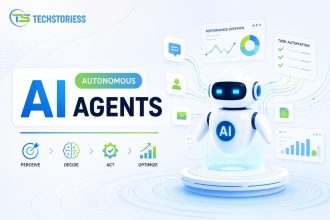
An AI agent goes beyond a single LLM prompt-response cycle — it’s a looping system that uses model output to drive actions, track context, and keep reasoning until a goal is met. Defining characteristics:
- Autonomous decision-making: chooses actions without explicit instructions for every scenario
- Goal-directed behavior: works toward objectives, not just commands
- Memory and context awareness: maintains state across interactions
- Tool use and orchestration: calls APIs and coordinates multiple systems
- Adaptive learning: improves based on feedback and outcomes
Gartner predicts that by 2026, over 40% of enterprise applications will embed role-specific agents — a shift toward agents as a core architectural layer rather than a bolt-on feature.
The 2026 Agentic AI Landscape
Enterprise platforms — built to deploy and govern agents at scale:
- Kore.ai: enterprise-grade orchestration engine that lets multiple agents collaborate and hand off context across the tech stack
- IBM Watsonx Orchestrate: brings IBM’s enterprise AI experience into agent orchestration
- Moveworks: employee support platform integrated with IT/HR systems
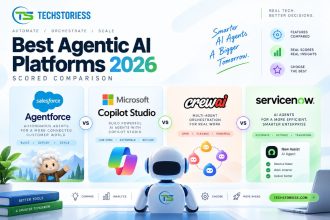
- Salesforce Agentforce 360: pre-built agents for sales, service, marketing, and commerce, powered by the Atlas Reasoning Engine — fastest path to production for existing Salesforce shops
Developer frameworks — for teams building custom agents:
- LangGraph: graph-based, stateful agents with fine-grained control; LLM is invoked only at ambiguous decision nodes
- CrewAI: role-based “crews” of agents that split tasks; 32,000+ GitHub stars, popular for customer service and marketing automation
- AutoGen (Microsoft Research): multi-agent conversation framework suited to negotiation and collaborative problem-solving
Coding-specific tools:
- Cursor: best IDE integration, $20/month; background agents handle refactoring, tests, and bug fixes
- Claude Code: the accuracy benchmark — 80.9% on SWE-bench with Opus 4.5
- GitHub Copilot Pro+: $39/month, best value with multi-model access
- Devin AI: most autonomous coding agent; strong for well-defined, repetitive tasks, weak for ambiguous one-off work
Specialized business agents:
- Sierra: autonomous customer service (refunds, account changes, subscriptions)
- Moveworks: employee/IT service management
- HockeyStack: agentic marketing analytics and attribution
Comparing Top Agentic AI Tools: Feature-by-Feature Analysis
Autonomy Levels
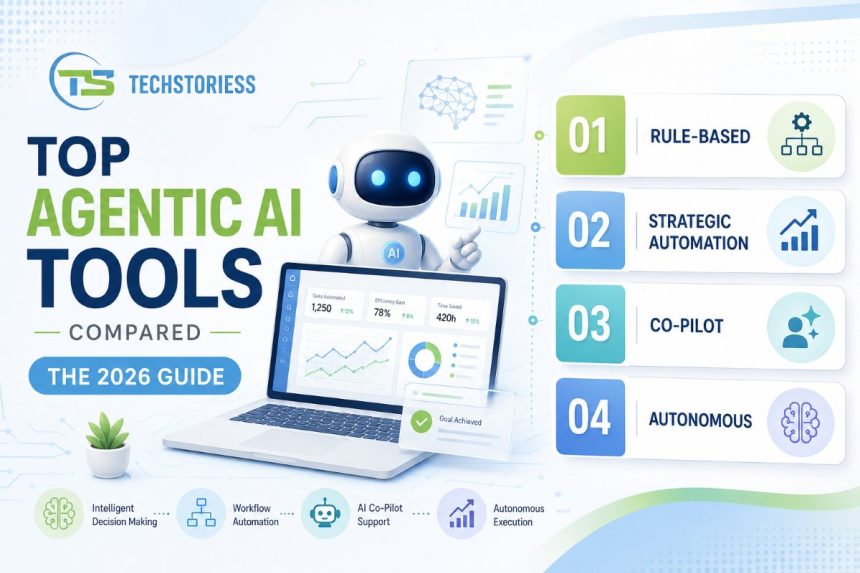
| Level | Description | Example Tools | Best For |
|---|---|---|---|
| 1: Rule-Based | Deterministic, predefined workflows | n8n, Make, Celonis | Reliable, repeatable processes |
| 2: Strategic Automation | Context-aware, limited decisions | Zapier AI, basic RPA | Structured work with some variability |
| 3: Co-Pilot | Human-in-the-loop for critical decisions | Cursor, GitHub Copilot, Otter.ai | High-stakes oversight needs |
| 4: Autonomous | Independent execution over time | Devin AI, advanced ChatGPT Agent | Well-defined, lower-risk tasks |
Higher autonomy isn’t automatically better — match the level to your risk tolerance and process complexity.
Multi-Agent Orchestration
Gartner reports a 1,445% surge in multi-agent system inquiries (Q1 2024–Q2 2025).
- ✅ Strong: Kore.ai, LangGraph, CrewAI, AutoGen
- ❌ Limited: Sierra, Cursor, most vertical-specific tools (single-agent by design)
Multi-agent setups earn their complexity when you need specialized subtask expertise, parallel workstreams, or agent-to-agent verification.
Integration Ecosystems
An agent’s value is proportional to what it can reach. Kore.ai offers 200+ pre-built connectors (Salesforce, ServiceNow, SAP, Microsoft 365) plus a universal API adapter. Salesforce Agentforce integrates natively with Salesforce and third-party apps via MuleSoft. LangGraph/LangChain supports the broadest range of LLM providers and vector databases through its open-source ecosystem.
| Integration Type | Look For |
|---|---|
| CRM | Native Salesforce, HubSpot, Dynamics connectors |
| Communication | Slack, Teams, email, SMS |
| Data sources | Database connectors, API access |
| Action systems | API execution, workflow triggers |
Cost Structures
| Model | Examples |
|---|---|
| Subscription | Cursor ($20/mo), Copilot Pro+ ($39/mo), ChatGPT Plus/Pro ($20–$200/mo) |
| Usage-based | LangGraph (free + LLM costs), Kore.ai (volume licensing), OpenAI API |
| Outcome-based | Sierra (billed on results) |
| Hybrid | Devin AI ($20/mo with usage caps, down from $500/mo in 2025) |
Watch for hidden costs: agentic workflows can burn 10–50x more tokens than simple chat, plus costs from failed attempts, long context windows, and tool-execution fees.
Performance Benchmarks
Claude Code’s 80.9% SWE-bench score (Opus 4.5) sets the current bar for coding agents; mid-tier assistants typically land at 40–60%. The top WebArena performer hit 71.2% on browser-navigation tasks. Compare on first-pass accuracy, task completion rate, error recovery, and context retention — and expect human oversight to stay essential for high-stakes work regardless of benchmark scores.
Key Evaluation Criteria for Selecting Agentic AI Tools
Match tool type to need:
- Enterprise platforms (Kore.ai, Agentforce) — multi-department deployment, heavy compliance, deep integration needs
- Developer frameworks (LangGraph, CrewAI, AutoGen) — custom workflows, technical resources, self-hosting
- Specialized agents (Sierra, Moveworks, coding tools) — well-defined use case, fast time-to-value
Security and governance: Confirm data residency and self-hosting options, role-based access controls, audit trails, action boundaries, and compliance (HIPAA, SOC 2, GDPR). Enterprise platforms tend to have these built in; developer frameworks leave them to you.
Scalability: Roughly two-thirds of organizations are experimenting with agents, but fewer than one in four have scaled to production. Before committing, confirm observability, error handling, version control, load management, and cost controls.
Ease of use:
| Tier | Examples | Learning Curve |
|---|---|---|
| No-code | Gumloop, Stack AI, n8n, Agentforce (Salesforce users) | Fastest |
| Developer-friendly | CrewAI, LangGraph, Cursor | Moderate |
| Expert-level | AutoGen, custom LangChain, self-hosted frameworks | Steepest |
Making Your Decision: A Practical Framework
- Define the use case precisely — “cut response time from 4 hours to 15 minutes,” not “we need AI agents.”
- Assess technical capacity honestly — strong engineering → frameworks; limited capacity → no-code/turnkey.
- List every required integration and eliminate platforms that can’t meet them.
- Match autonomy to risk tolerance — co-pilot for high stakes, autonomous for lower-risk, monitored workflows.
- Calculate total cost of ownership — platform fees plus integration, training, and monitoring costs, not just the sticker price.
- Run a 30–60 day pilot on one or two workflows before scaling.
Key Takeaways
- The agent market is climbing from $7.6B (2025) toward $52B (2030) — real budget commitment, not just hype
- Over 40% of enterprise apps now embed AI agents, per Gartner, up from under 5% a year earlier
- No single “best” tool exists — fit depends on your needs, technical capacity, and risk tolerance
- Autonomy is a spectrum: co-pilot agents often outperform autonomous ones on high-stakes work
- Integration determines real-world value more than raw model capability
- Fewer than one in four organizations have scaled agents to production — that’s the real bottleneck
- Enterprise: Kore.ai, Salesforce Agentforce. Custom build: LangGraph. Fast deployment: CrewAI. Coding: Cursor (integration), Claude Code (accuracy).
Frequently Asked Questions
What’s the difference between agentic AI and traditional chatbots?
Chatbots react to commands within a scripted flow. Agentic AI plans multi-step workflows, makes autonomous decisions, uses external tools, and adapts based on outcomes.
How much does it cost to implement agentic AI tools?
Individual tools like Cursor start at $20/month; enterprise platforms use custom licensing. Budget $50,000–$500,000 for a full enterprise deployment once integration and training are included.
Are agentic AI tools secure enough for enterprise use?
Enterprise platforms (Kore.ai, IBM Watsonx, Salesforce Agentforce) offer built-in access controls, audit trails, and compliance certifications (SOC 2, HIPAA, GDPR). Open-source frameworks leave security controls to you.
Can agentic AI tools integrate with our existing systems?
Usually, but verify first. Kore.ai offers 200+ pre-built connectors; LangGraph offers flexible API integration but needs custom development. List required integrations before choosing.
What’s the learning curve?
No-code tools (Gumloop, Stack AI) enable agent creation in under an hour. Frameworks like LangGraph and CrewAI need Python skills and 1–2 weeks. Enterprise platforms need 2–4 weeks of admin training.
Should I build custom agents or use pre-built solutions?
Pre-built for common use cases (support, sales, coding) when time-to-value matters. Custom builds for unique workflows, strong engineering capacity, or integrations no commercial platform covers. Many teams do both.
What are the biggest risks?
Incorrect agent decisions, security exposure from autonomous system access, runaway token costs, integration failures, and user resistance. Mitigate with phased rollouts, monitoring, governance, and human oversight on critical decisions.