


On June 30, Jim Keller stood in front of a room of reporters in Tokyo and said something that should have marked the end of a story. Tenstorrent, he said, was not in acquisition talks with Qualcomm. There was No deal. Just a company built on IP licensing and scalable AI work, going about its business.
Two weeks earlier, The Information had reported the opposite: Qualcomm was in advanced negotiations to acquire Tenstorrent for $8 to $10 billion, nearly 3X the number the startup had sought funding just months before. Reuters had independently corroborated the outline of the talks. Qualcomm’s stock had jumped 3 to 4 percent on the news. Analysts had spent a week debating what the deal would mean for the AI hardware market.
Then the man whose name was attached to the entire premise said it wasn’t happening.
That denial is where most coverage of this story stopped. It shouldn’t be. Twenty-five years of watching semiconductor deals rise, get denied, and then close anyway teaches you one thing: a public denial from a startup CEO mid-negotiation is not evidence a deal is dead. It is often evidence a deal is still being priced.
What actually happened, in order
Strip away the noise and the sequence is precise. Qualcomm won its lawsuit against Arm in December 2024, freeing itself from a licensing dispute that had constrained its chip architecture options. A year later, in December 2025, it acquired Ventana Micro Systems, a RISC-V server chip designer. It followed that with a $2.4 billion purchase of Alphawave Semi, a high-speed interconnect supplier – the kind of company nobody outside the industry notices, and everybody inside it recognizes as data-center plumbing. Then, at its June 24 Investor Day – the exact event where analysts expected a Tenstorrent announcement – Qualcomm instead confirmed something else: a $3.9 billion all-stock acquisition of Modular, an AI inference software startup building a hardware-agnostic compiler.
Read that sequence again. RISC-V cores. Interconnect. Inference compiler. Every piece Qualcomm has bought in the past eighteen months is a component of an end-to-end AI accelerator stack – except the accelerator itself. That is the piece Tenstorrent supplies. Jim Keller’s company builds RISC-V-based AI processors under an architecture called Tensix, and in April 2026 it shipped its Galaxy Blackhole platform to general availability, giving the startup something it hadn’t had during earlier funding rounds: a verifiable, shipping product with real performance numbers instead of a roadmap.
That’s what changed Tenstorrent’s price. A company that was seeking $800 million at a $3.2 billion valuation in late 2025 was suddenly worth up to $10 billion to Qualcomm seven months later. Scarcity plus proof of execution. That is not the pricing behavior of two companies with no relationship.
The theory the industry has held for a decade
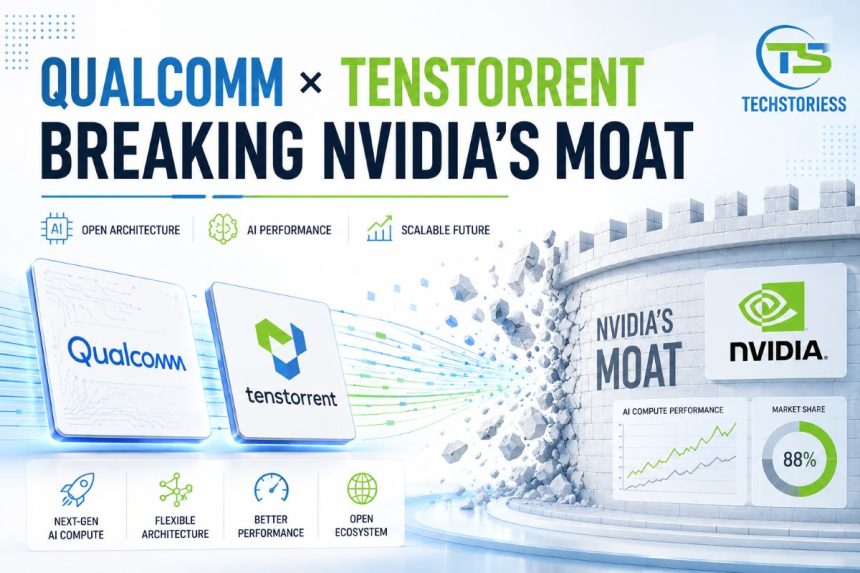
Here is the long-held theory this story actually tests: that no single company will break Nvidia’s grip on AI compute through better silicon alone, because Nvidia’s moat was never really about chips. It’s CUDA – the software layer that took fifteen years to build and that every AI lab, every framework, and every enterprise procurement pipeline is now dependent on. You can design a faster chip. Getting the world’s developers to rewrite their code for it is a different problem, and it’s the one that has killed every credible Nvidia challenger since 2016.
Qualcomm’s assembled strategy is a direct answer to that theory, not an exception to it. RISC-V removes the licensing toll and gives Qualcomm architectural freedom Arm never would. Tenstorrent’s Tensix architecture is specifically designed to compete on inference workloads – the AI compute segment that is rapidly overtaking training as the dominant cost center, and the segment where Nvidia’s advantage is least entrenched because it’s newer, more fragmented, and less uniformly built around CUDA. And Modular’s compiler is the part that actually matters most: a hardware-agnostic layer that lets developers run existing AI models without rewriting them for a new chip’s instruction set. That’s the software moat-breaker. The chip is almost secondary.
Put plainly: Qualcomm isn’t trying to out-engineer Nvidia. It’s trying to make the switching cost disappear.
Why Keller’s denial doesn’t settle it
Wall Street analyst Rasgon’s read on the Jim Keller factor is worth sitting with: obtaining Keller would be “a coup for any company,” but his documented pattern – AMD, Apple, Tesla, Intel, each for two to four years – means the acquisition price is buying an architecture and a moment in time, not a person who intends to stay. That calculus doesn’t change based on what Keller says in a press conference in Tokyo. If anything, it explains why a founder with his track record might publicly downplay talks that are still live: preserving negotiating leverage, managing his own team’s morale mid-negotiation, or simply describing the state of talks accurately at that specific moment, three days after Qualcomm’s Investor Day passed without an announcement.
None of the original reporting – The Information’s sourcing, Reuters’ independent confirmation – has been retracted. What’s on the record is a denial that a deal is happening right now, not a denial that talks occurred, and not a claim that Qualcomm has walked away. Companies routinely deny live negotiations until the moment they sign. Intel, notably, has also reportedly expressed interest in Tenstorrent, which means even if the specific Qualcomm number cools, the asset itself isn’t going to stop being valuable.
What to actually watch
The Tenstorrent deal, whether it closes at $10 billion, closes lower, or never closes at all, is not really the story. The story is that Qualcomm has spent eighteen months methodically assembling every non-chip component of an Nvidia-alternative stack, and did so quietly enough that most coverage treated each acquisition as a standalone event rather than a pattern. Ventana. Alphawave. Modular. The Tenstorrent talks, confirmed or denied, are the most visible data point in a strategy that was never contingent on any single deal.
For CTOs and infrastructure buyers, the practical question isn’t whether Keller sells his company. It’s whether a viable inference alternative to CUDA lock-in is coming from anywhere, on any timeline, because that changes procurement leverage against Nvidia regardless of who owns Tenstorrent’s silicon a year from now. Qualcomm’s public denial dance with a startup CEO is a sideshow. The RISC-V stack quietly assembled underneath it is the story that deserved the headline in the first place.