


Autonomous vehicles generate massive amounts of data and require instant decision-making for safe navigation. Traditional cloud-dependent systems cannot keep up with these millisecond-level demands. This is why Edge AI—processing intelligence directly inside the vehicle—is becoming indispensable.
- Edge AI in Autonomous Vehicles: What It Is and How It Works?
- Edge AI Market Growth and Technical Statistics
- Real-Time Object Detection and Tracking With Edge AI
- Predictive Maintenance and Vehicle Diagnostics
- Edge AI for ADAS and Driver Assistance Features
- Environmental Interpretation and Traffic Intelligence
- Driver & Passenger Monitoring Through Edge AI
- Sensor Fusion and Lane Detection (Improved Summary)
- Key Advantages of Edge AI for Autonomous Vehicles
- Edge AI vs Cloud AI in Self-Driving Cars
- Conclusion
Infographics
In this article we will discuss the key features and benefits of Edge AI in modern self-driving systems.
Edge AI in Autonomous Vehicles: What It Is and How It Works?
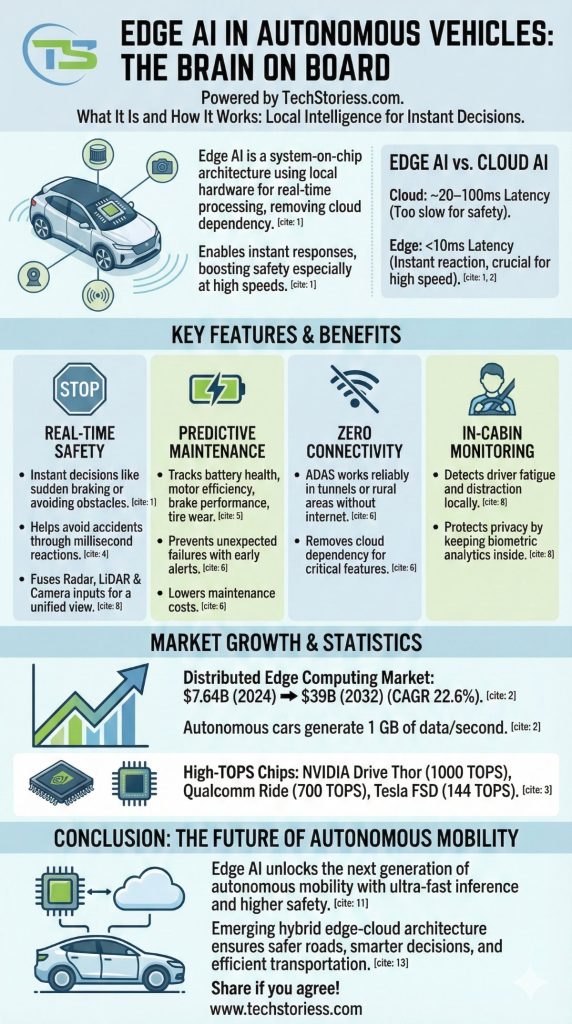
Edge AI is a system-on-chip architecture that uses local hardware to run AI models, removing the dependency on cloud servers. Onboard chips process data from LiDAR, GPS, radar, and multiple sensors in real time, enabling instant responses while driving. This boosts perception, reaction capabilities, and safety, especially at high speeds. Modern vehicles use advanced chips such as Intel Mobileye EyeQ, Tesla FSD, and NVIDIA Drive AGX to handle multiple sensor streams efficiently without overheating or excess power usage.
Key features and benefits
- Local inference drastically reduces delays compared to cloud round-trips.
- Highway driving safety improves due to faster reaction times.
- Modern automotive SoCs are optimized for energy efficiency and thermal stability.
Edge AI Market Growth and Technical Statistics
The global distributed edge computing market was valued at $7.64 billion in 2024 and is projected to surpass $39 billion by 2032 with a CAGR of 22.6%, reflecting the rising demand for intelligent autonomous vehicles. Since autonomous cars generate nearly 1 GB of data per second, cloud-only processing is impractical. Edge AI reduces reliance on cloud networks and keeps latency consistently under 10 ms—critical for high-speed driving. Manufacturers like Tesla, GM, and Mercedes-Benz are adopting high-TOPS chips like NVIDIA Drive Thor (1000 TOPS), Qualcomm Ride (700 TOPS), and Tesla FSD (144 TOPS).
Key features and benefits
- Cloud inference (20–100 ms) is too slow for safety-critical scenarios.
- Local processing avoids bandwidth overloads and transmission failures.
- High-TOPS chips support advanced perception and real-time planning.
Real-Time Object Detection and Tracking With Edge AI
Edge AI enables rapid processing of camera feeds, helping vehicles take safe actions in real time — such as braking, accelerating, or steering away from obstacles. CNNs used by Tesla FSD and NVIDIA Drive analyze multiple angles simultaneously for highly precise detection and motion forecasting.
Key features and benefits
- Helps avoid accidents through millisecond-level reactions.
- Multi-camera inference improves situational awareness.
- Predictive tracking enhances safety at intersections and turns.
Predictive Maintenance and Vehicle Diagnostics
Edge AI improves road safety and driving performance while monitoring critical vehicle components. It tracks battery health, motor efficiency, brake performance, tire wear, and other anomalies. Using predictive algorithms, premium brands like BMW reduce breakdown risks and optimize fleet maintenance schedules.
Key features and benefits
- Prevents unexpected failures through early alerts.
- Lowers maintenance costs for large fleets.
- Enhances long-term reliability of batteries and EV components.
Edge AI for ADAS and Driver Assistance Features
Systems like adaptive cruise control, lane-keep assist, and emergency braking rely on edge inference for real-time accuracy. Since edge AI has zero cloud dependency, these features work even in low-connectivity areas. Platforms like Snapdragon Ride and Mobileye EyeQ are optimized to deliver reliable, energy-efficient ADAS functions.
Key features and benefits
- Improves consistency in harsh weather or rural regions.
- Reduces energy consumption through on-device optimization.
- Supports Level 2+ to Level 4 autonomous capabilities.
Environmental Interpretation and Traffic Intelligence
Edge AI assesses traffic density, road conditions, weather, and dynamic surroundings. V2X-powered countries like Germany and South Korea use roadside units to send real-time inputs to AVs, improving route planning and safety.
Key features and benefits
- Enhances adaptive route selection and fuel efficiency.
- Helps vehicles anticipate hazards like congestion or construction.
- Merges environmental data with sensor inputs for better situational awareness.
Driver & Passenger Monitoring Through Edge AI
In-cabin edge AI detects fatigue, drowsiness, or inattention using facial recognition and behavior monitoring. All data is processed locally, ensuring privacy while enabling instant alerts. Fleet and rideshare operators use edge analytics to elevate passenger comfort and safety.
Key features and benefits
- Prevents accidents caused by driver fatigue.
- Improves comfort through personalized cabin settings.
- Protects privacy by keeping biometric analytics inside the vehicle.
Sensor Fusion and Lane Detection (Improved Summary)
Edge AI fuses radar, LiDAR, and camera inputs to form a unified view of the surroundings within milliseconds. This helps maintain accuracy even if one sensor is obstructed. Vehicles like those using Mercedes-Benz MBUX achieve stable lane control even in low-visibility or poorly marked roads.
Key features and benefits
- Increases reliability via multi-sensor redundancy.
- Improves steering accuracy in complex environments.
- Ensures continuity of autonomy even in sensor-drop scenarios.
Key Advantages of Edge AI for Autonomous Vehicles
Edge AI minimizes latency, enabling instant decisions like sudden braking or obstacle avoidance. Cloud processing often takes 20–100 ms, while edge inference responds in just a few milliseconds. Edge systems continue to operate even in low or zero connectivity zones, offering strong reliability. Processing data locally also reduces bandwidth costs and enhances compliance with global privacy laws like GDPR and CCPA.
Key features and benefits
- Improves road safety by reducing reaction time to near-zero.
- Cuts cloud and network infrastructure costs significantly.
- Enhances consumer confidence via privacy-by-design systems.
Edge AI vs Cloud AI in Self-Driving Cars
Edge AI dominates real-time driving tasks due to low latency and offline reliability. Cloud AI remains essential for large-scale analytics, HD map updates, and training neural networks. The future of autonomous systems depends on a hybrid edge-cloud architecture that blends on-device intelligence with centralized scalability.
Key features and benefits
- Edge handles safety-critical decisions; cloud manages long-term learning.
- Hybrid systems improve efficiency and reduce operational costs.
- Fleet operators benefit from centralized analytics + local autonomy.
Conclusion
Edge AI is unlocking the next generation of autonomous mobility by delivering ultra-fast inference, higher safety, and reduced cloud dependency. As automotive SoCs become even more powerful, autonomous vehicles will rely increasingly on onboard intelligence. A combined edge-cloud architecture is emerging as the global standard, ensuring safer roads, smarter decision-making, and more efficient transportation ecosystems.