


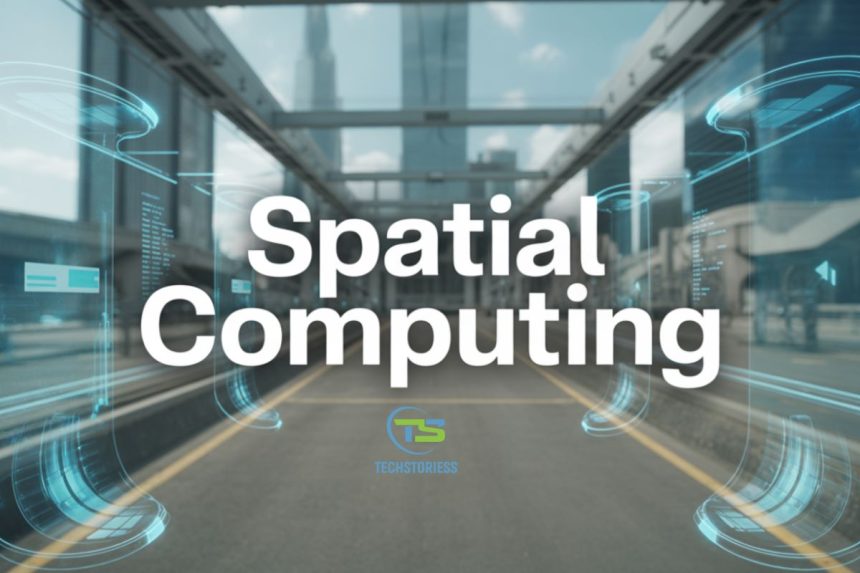
As computing moves beyond flat screens into real-world environments, the interaction between humans and machines is becoming increasingly spatial, immersive, and context-aware. Spatial computing enables digital systems to understand physical space, objects, and movement, while extended reality (XR) acts as the experiential layer that makes this understanding visible and actionable for users. Together, spatial computing and XR form a powerful combination—where spatial intelligence drives accuracy and context, and XR translates that intelligence into intuitive, human-centered experiences. This synergy is redefining how information is visualized, decisions are made, and tasks are performed across industries.
What Is Spatial Computing?
Spatial computing refers to a computing paradigm in which digital systems perceive, interpret, and interact with the physical world in three dimensions. It combines technologies such as computer vision, spatial mapping, sensors, AI, and real-time data processing to understand spatial relationships, object behavior, and environmental context. Spatial computing focuses on machine-level spatial understanding—enabling systems to reason about space, depth, motion, and physical constraints rather than operating solely on abstract data or flat interfaces.
What Is Extended Reality (XR)?
Extended reality (XR) is an umbrella term that includes augmented reality (AR), virtual reality (VR), and mixed reality (MR). XR focuses on human-level experience and interaction, allowing users to visualize, engage with, and manipulate digital content in immersive ways. While XR does not inherently require spatial intelligence, its true value emerges when combined with spatial computing—where virtual elements can align with real-world geometry, respond to environmental changes, and interact naturally with physical objects and user actions.
How are XR and Spatial computing related?
Spatial computing is an umbrella term that encompasses a range of technologies that enable computers to perceive, understand, and interact with the physical world in three dimensions. It integrates elements of extended reality (XR)—including augmented reality (AR), virtual reality (VR), and mixed reality (MR)—along with computer vision, spatial mapping, sensors, and artificial intelligence (AI) to create immersive and context-aware experiences. Spatial computing allows devices to understand spatial relationships, interact with physical objects, and respond intelligently to real-world conditions, significantly enhancing how humans interact with digital systems.
Key Components of Spatial Computing
To gain a deeper understanding of spatial computing it is vital to know about its key components and how they contribute to enhancing the efficiency of Spatial Computing.
Computer Vision
Computer vision refers to the capability that allows computers to recognize visual objects, interpret scenes, and analyze motion and depth. In spatial computing and XR systems, computer vision enables devices to understand, map, and interact with the physical environment, forming the foundation for accurate AR overlays, MR interactions, and spatial awareness in VR experiences.
Augmented Reality (AR)
AR enables users to experience digital content in an immersive way by seamlessly overlaying virtual elements onto the real world. AR applications range from simple informational overlays to complex, interactive XR experiences. Within spatial computing, AR allows virtual objects to align, respond, and interact with real-world surfaces, objects, and movements, making digital content contextually relevant to the physical environment.
Virtual Reality (VR)
VR creates fully digital, computer-generated environments that allow users to actively interact within immersive spaces. While VR typically operates in a fully virtual setting, spatial computing enhances VR by introducing real-world spatial logic, realistic movement tracking, and environmental awareness. This enables users to transition more naturally between fully virtual XR environments and real-world contexts, especially in training, simulation, and design use cases.
Mixed Reality (MR)
Mixed reality bridges AR and VR by enabling real-time interaction between physical and digital objects. MR allows virtual elements to respond dynamically to user actions and environmental changes, creating deeply immersive XR experiences. Through spatial computing, MR systems ensure that digital objects understand physical constraints such as surfaces, depth, lighting, and occlusion.
Spatial Mapping
Spatial mapping creates detailed 3D models of real-world environments to understand spatial layout and geometry. This allows XR-enabled devices to place virtual objects accurately within physical spaces and define how those objects will behave and interact. Technologies such as LiDAR and depth cameras play a key role in enabling precise spatial mapping for AR and MR experiences.
Sensor Fusion
Sensor fusion builds a comprehensive understanding of the environment by combining data from multiple sensors such as cameras, IMUs, GPS, and depth sensors. In spatial computing and XR systems, this integration improves accuracy, reliability, and responsiveness by synchronizing motion, position, and orientation data across devices and environments.
Artificial Intelligence (AI)
Spatial computing systems generate large volumes of real-time spatial and sensory data. AI and machine learning play a critical role in interpreting this data to extract insights, recognize patterns, make predictions, and deliver context-aware responses. AI enhances XR experiences by enabling intelligent object recognition, environment understanding, and adaptive user interactions.
Advantages of Spatial Computing
The real advantage of spatial computing lies in the way it empowers users to actively interact with the real life environment and preview realistic future outcomes. Here are some of the specific benefits of Spatial Computing:
Enhanced Interaction
Spatial computing transforms passive digital interactions into active, intuitive experiences through XR-enabled gestures, voice commands, and physical movement. This significantly improves user engagement, accessibility, and overall experience quality.
Immersive Experiences
Highly immersive XR-driven experiences deliver enhanced engagement across applications such as entertainment, gaming, professional training, education, and simulation, making interactions more realistic and impactful.
Increased Efficiency
Spatial computing enables real-time insights and interactive previews of environments, products, or processes. By identifying discrepancies early, organizations can optimize workflows, reduce errors, and save time and costs associated with rework.
Industries such as manufacturing, construction, and healthcare benefit significantly by integrating XR-powered spatial computing into daily operations.
Improved Decision-Making
Spatial computing improves decision-making through context-aware visualization. Architects can virtually walk through designs before construction, while doctors can plan and rehearse complex surgical procedures using XR simulations for improved precision.
Personalization
Powered by AI, spatial computing systems learn user behavior and preferences to deliver personalized XR experiences. This enhances user satisfaction and makes applications such as smart homes, retail, and training systems more engaging and relevant.
Applications of Spatial Computing
Right from entertainment to education, Spatial computing, equipped with strong features like XR can play a significant role.
Healthcare
In healthcare, spatial computing plays a transformative role by improving clinical visualization and decision-making. XR-enabled applications support activities such as surgical planning, medical training, and navigation. AR allows surgeons to visualize anatomical structures during operations, improving precision and reducing risk, while VR and MR support simulation-based training and remote diagnostics.
Education
Spatial computing reshapes education by making learning more experiential and engaging through XR. Students remain actively involved through immersive and interactive educational experiences, including 3D models, virtual field trips, historical reconstructions, and interactive simulations. This adds depth and realism, turning abstract or complex subjects into intuitive learning experiences.
Architecture and Construction
Architects and construction professionals use AR and MR to identify design issues early by visualizing digital models directly within real-world sites. Spatial computing enables teams to assess scale, alignment, and feasibility before construction begins, helping prevent future engineering issues by offering a realistic preview of structures. XR also accelerates construction workflows through guided visualization and on-site assistance.
Retail and E-commerce
Modern digital buyers are more informed and expect greater confidence before making purchase decisions. Spatial computing enables XR-powered product visualization, allowing customers to view products within their real environment. This provides a realistic understanding of scale, fit, and aesthetics—for example, how an outfit will look when worn or how a specific wallpaper will appear in a living space.
Entertainment and Gaming
XR technologies play a vital role in the gaming and entertainment industry. Spatial computing enhances experiences by enabling immersive gaming environments, virtual concerts, and interactive storytelling. These experiences captivate users by seamlessly blending physical and digital worlds, increasing realism, engagement, and emotional connection.
Manufacturing and Industry
In manufacturing, spatial computing supports process optimization, workforce training, and equipment maintenance. AR delivers real-time instructions and visual guidance to workers, reducing errors and improving efficiency. XR also enables remote assistance and troubleshooting, minimizing downtime and operational costs.
Smart Cities and Urban Planning
Spatial computing aids in the design and management of smart cities by generating accurate 3D urban models and simulations. XR-enabled visualization supports infrastructure planning, traffic flow analysis, public safety strategies, and emergency response planning, enabling more informed urban decision-making.
Autonomous Vehicles
Autonomous vehicles rely on spatial computing to perceive and interact with their surroundings. Sensor data combined with AI creates real-time environmental maps, enabling vehicles to detect obstacles, navigate routes, and make intelligent driving decisions.
Conclusion
Spatial computing provides the intelligence that allows machines to understand the physical world, while XR provides the interface through which humans experience and interact with that intelligence. When combined, XR acts as a force multiplier for spatial computing—transforming raw spatial data into meaningful, immersive, and actionable experiences. This integration enables more precise visualization, better decision-making, and higher operational efficiency across domains such as healthcare, education, manufacturing, retail, and urban planning. As AI, sensors, and XR hardware continue to mature, the convergence of spatial computing and XR will become a foundational layer of next-generation human–computer interaction.