


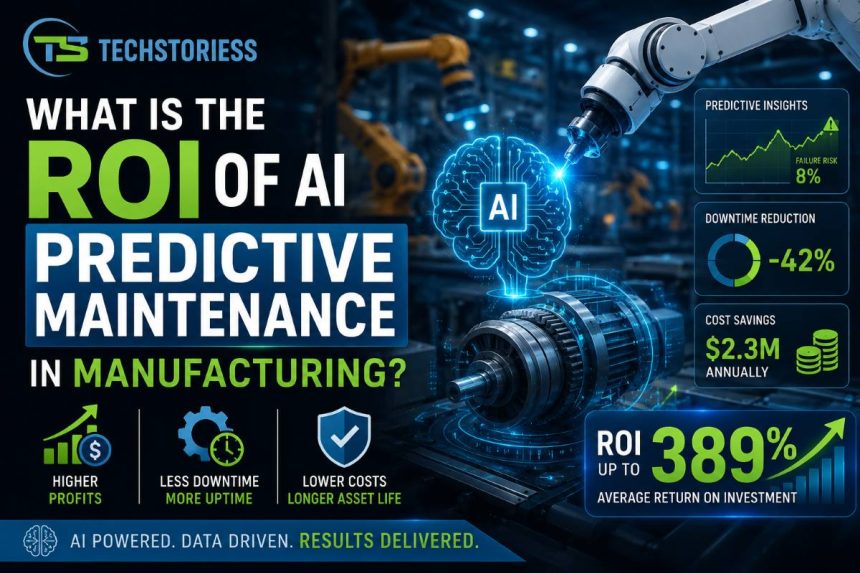
The manufacturing industry today is going through a consistent challenge: unplanned equipment downtime costs American manufacturers $2 trillion every year. However, 60% of manufacturers still depend on reactive, break-fix maintenance models. Here the AI predictive maintenance ROI becomes not just relevant, but essential.
By adopting AI-driven predictive maintenance manufacturers can reduce maintenance costs by 25-40% while cutting down unexpected downtime by up to 50%. But the question every Industrial IoT Engineer and plant manager asks remains the same: What’s the actual return on investment?
In this guide we walk you through calculating, measuring, and maximizing the ROI of AI predictive maintenance systems—backed by real numbers, actionable frameworks, and industry benchmarks.
What is AI Predictive Maintenance?
Before coming to ROI calculations, let’s understand what we are going to measure. AI predictive maintenance uses machine learning algorithms and IoT predictive analytics to predict equipment failures before they happen. Instead of maintaining equipment on a fixed routine (preventive maintenance) or waiting for it to break (reactive maintenance), AI systems assess real-time sensor data to forecast when maintenance is actually needed.
Advanced implementations now embed digital twin simulation factory technology, enabling engineers to test maintenance strategies virtually before deployment. This convergence of AI, IoT, and simulation has fundamentally changed how manufacturers approach equipment reliability.
The Current Manufacturing Maintenance Landscape
Let’s establish a baseline. Manufacturers spend approximately 15-40% of their production costs on maintenance alone. To understand it at a granular level let us break down maintenance approaches:
- Reactive maintenance: 55% of manufacturers (highest cost, 7-10x more expensive than planned maintenance)
- Preventive maintenance: 35% of manufacturers (moderate cost, based on fixed schedules)
- Predictive maintenance (AI-powered): 10% of manufacturers (lowest long-term cost, requires upfront investment)
It reflects a significant gap. The majority of manufacturers- 90% to be precise- are leaving substantial value on the table.
Understanding the ROI Formula
Here is the fundamental formula for ROI calculation for AI predictive maintenance:
ROI (%) = [(Total Benefits – Total Costs) / Total Costs] × 100
For predictive maintenance, this translates to:
ROI = [(Downtime Cost Reduction + Labor Savings + Parts Optimization + Energy Efficiency) – (Software + Hardware + Implementation + Training)] / Total Costs × 100
Let’s break down each component with realistic numbers.
Key Cost Components
1. Implementation and Software Costs
- In AI predictive maintenance system the upfront investment typically includes:
- Sensor infrastructure and IoT devices: $10,000-$50,000 (depending on facility size)
- AI platform software (annual subscription): $15,000-$100,000
- System integration and deployment: $20,000-$80,000
- Training and change management: $5,000-$15,000
- Initial data collection period: 2-6 months
- Total Year 1 investment: $50,000-$245,000 for a mid-size manufacturing facility
In the environment of larger enterprises implementing digital twin simulation factory capabilities alongside predictive maintenance, costs can reach $500,000-$2 million. However, the benefits also scale proportionally.
2. Hardware and Infrastructure
An Industrial IoT Engineer will specify:
- Sensors (vibration, temperature, acoustic): $200-$1,000 per equipment unit
- Edge computing devices: $3,000-$15,000
- Network infrastructure: $5,000-$30,000
- Data storage and cloud services: $500-$5,000/month
- Revenue and Savings Components
3. Downtime Cost Reduction (Largest Benefit)
- At this point the math becomes compelling. Unplanned downtime costs manufacturers:
- Large facilities: $20,000-$50,000 per hour
- Medium facilities: $5,000-$15,000 per hour
- Small facilities: $1,000-$5,000 per hour
AI predictive maintenance minimizes unplanned downtime by 45-50%. On a conservative scale a facility experiences just 10 hours of unplanned downtime annually, and rectifies it through predictive maintenance:
Downtime savings = 10 hours × $15,000/hour × 50% reduction = $75,000 annually
4. Labor and Maintenance Optimization
Here are some of the key benefits of this approach:
- Planned vs. reactive labor: Technicians working on scheduled maintenance complete jobs 30-40% faster
- Unnecessary maintenance elimination: Predictive systems eliminate 20-30% of preventive maintenance tasks
- Cross-training efficiency: Mechanics can handle more equipment with advanced scheduling
- Labor savings: Current maintenance staff: 5 technicians at $80,000/year = $400,000/year
Efficiency improvement: 25% = $100,000 annual savings
5. Parts and Inventory Optimization
- IoT predictive analytics offers a clear, precise data on when components actually fail, enabling:
- Just-in-time parts ordering: Reduces parts inventory carrying costs by 30-35%
- Reduced emergency procurement: Eliminates costly expedited shipping
- Warranty management: Better tracking of component reliability
Parts optimization savings: $30,000-$80,000 annually (facility-dependent)
6. Energy Efficiency
Degraded equipment consumes 15-20% more energy. With the help of predictive insights organizations can maintain optimal equipment performance to recover these losses.
Energy savings: $10,000-$25,000 annually
Real-World ROI Example: Mid-Size Automotive Components Manufacturer
Let us understand this through a real world example to make things more lucid and specific. Here we take an example of a mid level automotive components manufacturer.
Facility Profile
- 45 critical pieces of equipment
- 12 maintenance staff
- Current downtime: 18 hours/year unplanned
- Average downtime cost: $12,000/hour
- Year 1 Implementation Costs
- AI software platform: $35,000
- Sensors and IoT devices: $30,000
- Integration services: $40,000
- Training: $8,000
Total Year 1 Cost: $113,000
Year 1-3 Annual Benefits
Downtime reduction (50% of 18 hours): 9 hours × $12,000 × 1 year = $108,000
- Labor optimization (20% efficiency): $80,000
- Parts inventory reduction: $45,000
- Energy efficiency: $18,000
- Total Annual Benefits: $251,000
- ROI Calculation
Year 1: [(251,000 – 113,000) / 113,000] × 100 = 122% ROI
Year 2+: [(251,000 – 35,000) / 35,000] × 100 = 617% ROI (software subscription only)
Payback period: 5.4 months
7.Advanced ROI: Including Digital Twin Simulation Benefits
The manufacturers can further multiply the overall RoI by integrating digital twin simulation factory technology with AI battery storage management systems (common in renewable-powered facilities).
- Scenario testing without production impact: Validate maintenance strategies virtually
- Energy optimization simulation: Test battery charging/discharging strategies
- Downtime prediction: Model cascading failures before they occur
These advanced capabilities add 15-25% additional ROI improvement.
Industry Benchmarks and Realistic Expectations
Let us take a look at Real-world data from manufacturers implementing AI predictive maintenance:
- Metric
- Reported Range
- Industry Average
ROI of AI Predictive Maintenance performance Metrics
| Metric | Reported Range | Industry Average |
| Downtime reduction | 40–60% | 50% |
| Maintenance cost savings | 20–35% | 27% |
| Equipment lifespan extension | 10–25% | 18% |
| Labor productivity increase | 15–30% | 22% |
| Payback period | 4–18 months | 9 months |
| 3-year ROI | 200–600% | 380% |
Critical Success Factors for Maximum ROI
To mximize the ROI of AI the organizations need to focus on some crucial factors such as:
1. Data Quality and Infrastructure
Unstructured and unreliable data leads to flawed outputs and discrepancies. So, make sure that your IoT predictive analytics implementation includes:
- Properly calibrated sensors
- Clean, reliable data transmission
- Adequate edge computing for real-time analysis
- Historical data from at least 3-6 months
2. Change Management
An Industrial IoT Engineer can develop a perfect system. However it doesn’t guarantee success. That is determined by adoption. Here are some of the essential steps:
- Executive buy-in and clear communication
- Technician training on new workflows
- Gradual rollout with pilot programs
- Feedback loops for continuous improvement
3. Realistic Initial Expectations
The RoI may appear modest in year 1. However, It starts increasing in years 2-3. This is normal. What happens is that the system learns from your specific equipment, environment, and failure patterns. So, with time its understanding deepens and so does its efficiency, which is reflected in higher ROI. So, set expectations accordingly.
4. Continuous Optimization
As mentioned, the AI models improve with time. So, you need to reasonably allocate resources :
- Quarterly algorithm retraining
- Feedback from maintenance teams
- Regular sensor calibration
- Integration of new equipment and data sources
Common Pitfalls That Diminish ROI
Here are some of the common pitfalls that hurt the overall benefits and reduce tge RoI:
Pitfall 1: Underestimating change management costs
You need to preserve 10-15% of implementation costs for training and organizational change. Skipping this can hurt the adoption.
Pitfall 2: Insufficient sensor coverage
To ensure proper adoption in the key areas you need to expand implementation for expanding visibility. Do, commit to comprehensive coverage for optimal ROI.
Pitfall 3: Ignoring integration complexity
Legacy systems demand custom integration. By budgeting accordingly you can involve IT early.
Pitfall 4: Short-term thinking
Predictive maintenance ROI generally needs 3-4 years to peak. So, avoid expecting immediate dramatic returns.
Future Trends: AI Predictive Maintenance in 2026 and Beyond
The accelerating convergence of AI, IoT, and simulation is leading to many positive changes:
- Autonomous maintenance robots: Automated corrective actions without human intervention
- Federated learning: Sharing insights across facilities without exposing proprietary data
- Quantum-enhanced optimization: More sophisticated failure prediction models
- Integrated sustainability: AI predictive maintenance reducing waste and carbon footprint
For early AI adopters these emerging capabilities promise even higher ROI multipliers.
Key Takeaways
Let us now summarize the key takeaways of the article to help you gain a quick overview of what we have discussed so far:
- AI predictive maintenance ROI: Produces 120-200% ROI in year one
- Payback period: Averages 9 months
- Downtime impact: Reduction alone justifies investment for most facilities
- Advanced integration: ROI multiplies further when Combined with digital twin simulation and IoT analytics.
- Success requirements: Data quality, change management, and realistic timelines essential
Conclusion
AI predictive maintenance delivers exceptional ROI—typically 120–200% in year one, rising to 400–600% by year three. With an average payback period of just 9 months, most facilities recover their investment even before the first anniversary
But numbers tell only half of the story. Beyond ROI, manufacturers gain:
- Increased production uptime and capacity
- Safer working environments
- Reduced environmental impact
- Competitive advantage in reliability
The real question isn’t whether you should go for AI predictive maintenance. It’s what are the right approaches to implement it and run it smoothly.
The forward thinking Industrial IoT Engineers and plant managers interested in staying ahead of the curve must invest in AI predictive maintenance to transition from reactive, cost-draining maintenance approaches, to adopting proactive approach. This shift is justified by ROI proved by data and demanded by competitive advantage.
To ensure a sustainable, balanced approach start with a pilot program on your most critical equipment. Carefully Measure results across well defined metrics. Scale what delivers real value. It will help you a great deal in accelerating your bottom line.