


One of the greatest challenges that Artificial intelligence systems are increasingly beginning to encounter is the shortage of high-quality training data. For many years, enterprises have been heavily emphasizing GPU clusters, compute infrastructure, and foundation model experimentation. However, with generative AI adoption widening its presence across diverse industries, enterprises have quietly encountered a problem that is steadily intensifying: it is about obtaining diverse, scalable, compliant, and unbiased datasets that align with the requirements of modern AI training pipelines.
- Why Synthetic Data Generation Tools Is Becoming Critical for Enterprise AI
- What Separates Modern Synthetic Data Platforms From Traditional Data Augmentation
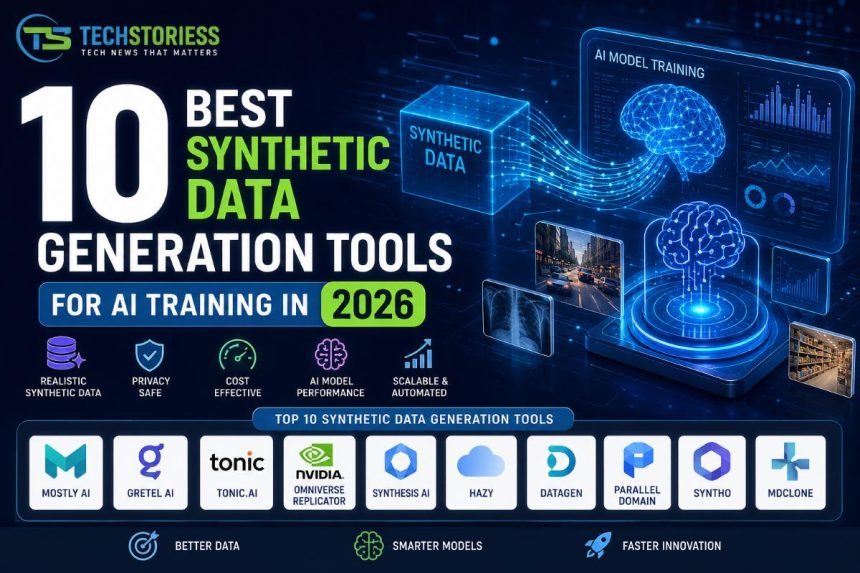
- Mostly AI – Best Overall Enterprise Synthetic Data Platform
- Gretel AI – Best for Generative AI and LLM Training Pipelines
- Tonic.ai – Best for Enterprise DevOps and Testing Environments
- NVIDIA Omniverse Replicator – Best for Industrial and Robotics AI
- Synthesis AI – Best for Computer Vision AI Training
- Hazy – Best for Financial and Regulatory Environments
- Datagen – Best for Human-Centric AI Training Data
- Parallel Domain – Best for Autonomous Systems and Simulation
- Syntho – Best Privacy-First Synthetic Enterprise Data Platform
- MDClone – Best for Healthcare AI and Clinical Research
- Why Synthetic Data Is Becoming a Strategic Enterprise Asset
- Conclusion
This challenge is consistently pushing enterprises toward a fast emerging segment of the AI infrastructure market – synthetic data generation tools AI training 2026.
Behind this shift there is substantial momentum. According to industry analysts the synthetic data market is projected to reach $3.7B by 2030. Gartner notes that in the near future 60% of AI training data will be synthetic. A growing number of global enterprises realize that along with improving scalability synthetic datasets also free them from critical governance and compliance concerns regarding sensitive real-world information. It offers significant cost benefits too. To be precise synthetic data reduces data collection costs by 70% in many enterprise environments, while simultaneously helping them eliminate privacy risks associated with personally identifiable information. One remarkable point here is that recent advancements in simulation and generative modeling have significantly improved realism – the key concern surrounding synthetic datasets for many years. Industry research proves that synthetic data achieves 94% accuracy parity with real data in vision tasks.
By strategically combining scalability, economics, and compliance synthetic data has transitioned from an experimental AI research concept into foundational enterprise infrastructure that supports large-scale AI development.
This represents an important shift as in modern enterprises AI systems are not just trained for specific tasks, but take on a broader operational role. A substantial number of AI deployments leverage a range of applications like autonomous systems, enterprise copilots, predictive analytics, industrial robotics, cybersecurity detection models, multimodal generative AI, and intelligent workflow orchestration. To operate effectively these systems demand massive volumes of high-quality data across numerous edge cases that are often hard to obtain from real environments due to rarity, high costs, or legal risks involved.
Synthetic data offers an ideal solution to this challenge.
With synthetic datasets enterprises are no longer constrained by solely relying on historical enterprise datasets. They can now leverage realistic artificial datasets that can be generated at scale with the help of simulation engines, diffusion models, generative adversarial networks, digital twin environments, and behavioral modeling systems. It leads to a new generation of synthetic dataset platforms that can efficiently produce customizable, scalable, and privacy-safe training data for modern AI systems.
Why Synthetic Data Generation Tools Is Becoming Critical for Enterprise AI
An increasing number of enterprise leaders are now realizing that data scarcity is no longer simply a storage problem but a governance problem.
Using sensitive customer information has always been a challenge in regulated industries such as healthcare, finance, insurance, defense, and telecommunications due to enormous restrictions and compliance requirements. They no longer want to expose themselves to legal, operational, and reputational risks introduced by training large AI systems on real production datasets.
This scenario adds strategic importance to privacy-preserving AI data.
With the help of synthetic datasets organizations can replicate statistical properties, behavioral patterns, and operational structures without exposing real-world identities or proprietary business records. That distinction significantly narrows compliance exposure associated with regulations such as HIPAA, GDPR, PCI DSS, and global AI governance frameworks that are rapidly evolving.
Synthetic data also solves one of the most consistent operational challenges in AI development: rare event scarcity.
In many industries and use cases like fraud detection systems, autonomous vehicles, industrial robotics, cybersecurity anomaly detection models, and medical imaging AI, the training demands data with sufficient exposure to edge-case scenarios that are not frequent in real life. Such conditions often remain under-represented by conventional datasets. With synthetic generation systems enterprises can intentionally create those scenarios at scale.
Along with increasing the volume of data it also ensures better-controlled training environments.
What Separates Modern Synthetic Data Platforms From Traditional Data Augmentation
Though created artificially, synthetic data generation is distinctly different from older forms of dataset augmentation.
Traditional data augmentation tools simply manipulate existing data through methods like scaling, noise injection, cropping, rotation, masking, or transformation techniques. Though playing a useful role those approaches still rely heavily on real-world source datasets. In other words it only partially solves the data scarcity problem.
Modern synthetic generation systems represent a fundamentally different approach.
Sophisticated GAN-based data generation frameworks, diffusion architectures, simulation engines, and neural rendering systems can generate entirely artificial datasets from scratch without compromising realistic statistical distributions and environmental behaviors. These systems can generate a wide variety of datasets including:
- photorealistic imagery
- structured enterprise datasets
- conversational language samples
- medical records
- financial transactions
- industrial sensor telemetry
- digital twin simulations
- cybersecurity attack scenarios
For generative AI training this evolution is particularly important as enterprises increasingly require large-scale datasets that simply do not exist naturally.
Mostly AI – Best Overall Enterprise Synthetic Data Platform
Mostly AI Official Website
Mostly AI is counted among the strongest enterprise-grade synthetic dataset platforms in the market as it understands an often-ignored reality: enterprise AI adoption depends heavily on trust, governance, and compliance.
One of the key strengths of the platform is generating synthetic structured data for highly regulated industries, such as healthcare, banking, insurance, and telecommunications. It specializes in preserving statistical realism without directly reconstructing sensitive records.
Such balance is highly useful for enterprises that want to operationalize AI initiatives while preserving customer identities or confidential operational information.
Mostly AI is particularly effective for use cases like:
- customer analytics
- fraud detection training
- financial modeling
- healthcare research
- enterprise testing environments
Due to its privacy-preserving architecture Mostly AI is especially ideal for organizations navigating increasingly strict global data regulations.
The biggest benefit of the platform is preserving realism within structured enterprise datasets. In contrast to experimental AI tools that typically emphasize generative novelty, Mostly AI focuses on operational usability and regulatory compliance.
Gretel AI – Best for Generative AI and LLM Training Pipelines
Emerging as one of the most visible players in synthetic enterprise data, Gretel AI focuses on scalable generative AI infrastructure.
The platform is capable of supporting different data environments offering synthetic generation across structured text, tabular, time-series, and multimodal datasets. This versatility makes it especially useful for enterprises aiming to build large-scale AI systems and internal copilots.
Gretel places strong emphasis on safe AI experimentation. It allows enterprises to rapidly generate realistic datasets for training, optimizing, and testing AI systems without revealing sensitive production information.
Due to its synthetic language generation capabilities the platform creates significant value for enterprises seeking AI training data alternatives for internal LLM deployments.
Gretel also performs well in areas like:
- API-driven data generation
- developer-centric workflows
- cloud-native AI pipelines
- scalable dataset augmentation
- privacy testing environments
For enterprises that want to scale generative AI responsibly, Gretel is among the more mature enterprise-ready options available today.
Tonic.ai – Best for Enterprise DevOps and Testing Environments
Tonic.ai approaches synthetic data from a practical operational perspective that prioritizes enterprise usability.
The platform is especially effective for sandbox development, secure software testing, and QA workflows by employing realistic but de-identified enterprise datasets.
A number of AI deployments fail during integration, testing, and production rollout phases. By maintaining a strong operational orientation the platform helps enterprises reduce those implementation bottlenecks.
Tonic.ai assists organizations in producing realistic testing environments without directly replicating sensitive production data. This approach maintains workflow realism without exposing organizations to compliance risks.
The platform is especially relevant for:
- DevOps environments
- application testing
- secure AI prototyping
- financial systems testing
- SaaS product development
Its keen focus on enterprise operational usability makes it an ideal option for large engineering organizations.
NVIDIA Omniverse Replicator – Best for Industrial and Robotics AI
NVIDIA’s Omniverse Replicator platform is a fine example of how synthetic data is increasingly merging with simulation infrastructure.
Unlike many traditional synthetic dataset platforms, Omniverse doesn’t generate isolated datasets, but enables enterprises to create entire virtual environments capable of producing photorealistic synthetic training scenarios for industrial automation, robotics, computer vision systems, and autonomous vehicles.
More significantly it can easily integrate with digital twins.
Before deploying AI systems into physical operations industrial enterprises want to sufficiently train AI systems in simulated environments. It significantly accelerates iteration cycles while minimizing real-world risks.
Omniverse Replicator is specifically relevant for applications like:
- robotics training
- warehouse automation
- industrial vision AI
- autonomous navigation
- manufacturing simulations
Environmental realism at enterprise scale is its biggest strength.
Synthesis AI – Best for Computer Vision AI Training
Synthesis AI Official Website
Synthesis AI focuses on designing synthetic visual datasets purpose-built for modern computer vision systems.
The platform leverages advanced neural rendering and procedural generation systems to produce highly realistic synthetic imagery for use cases like facial recognition, autonomous systems, smart surveillance, robotics, and AR/VR applications.
At this point GAN-based data generation gains high importance.
Vision AI models often demand massive volumes of annotated imagery across diverse environments, lighting conditions, demographics, and edge cases. At that scale real-world collection not only becomes prohibitively expensive but also increasingly difficult to obtain due to regulatory restrictions.
Synthesis AI is particularly appealing to enterprises as its generated datasets closely approach real-world training performance benchmarks. This significant progress explains why synthetic data achieves 94% accuracy parity with real data in vision tasks.
Hazy – Best for Financial and Regulatory Environments
Hazy is specifically built to support regulated enterprise environments where AI deployment decisions are shaped primarily by privacy and governance concerns.
Its platform can produce synthetic insurance, financial, healthcare, and operational datasets while preserving statistical utility needed for analytics and machine learning workflows.
Explainability around privacy preservation is one of the greatest strengths of Hazy.
One of the major concerns of enterprises is black-box synthetic generation systems. Hazy addresses this concern by focusing on measurable privacy guarantees alongside dataset utility validation which strengthens enterprise trust and governance transparency.
The platform offers an excellent fit in:
banking AI
- Insurance analytics
- Compliance testing
- Financial risk modeling
- Enterprise data sharing
Hazy ranks as a strategically disciplined platform ideal for organizations that prioritize governance maturity.
Datagen – Best for Human-Centric AI Training Data
The key strength of Datagen includes synthetic human imagery and behavioral datasets for computer vision AI systems.
With the help of Datagen enterprises can generate highly customizable human datasets with diverse environments, poses, clothing, demographics, gestures, and lighting conditions.
This capability is increasingly important for:
- Biometric systems
- Retail analytics
- Human-machine interaction
- Surveillance AI
- Smart environments
During recent years Datagen’s realism quality has substantially improved. It makes the platform a strong contender in enterprise computer vision training environments.
Parallel Domain – Best for Autonomous Systems and Simulation
Parallel Domain strategically combines synthetic generation with simulation realism making it a highly regarded platform in autonomous systems development.
The company’s platform enables enterprises to generate large-scale industrial automation simulations, driving scenarios, robotics environments, and sensor-rich synthetic ecosystems for AI training.
Autonomous systems demand exposure to massive and diverse combinations of environmental variables, rare edge cases, and even hazardous conditions that are rare or risky to capture in real life.
That problem can be solved elegantly by synthetic data platforms like Parallel Domain.
Parallel Domain is especially useful for:
- autonomous mobility
- Drone AI
- Industrial robotics
- Sensor fusion systems
- Digital twin environments
Syntho – Best Privacy-First Synthetic Enterprise Data Platform
Syntho positions itself as a strong player in privacy-safe AI innovation, which strongly resonates with enterprises navigating increasing regulatory pressure.
With this platform organizations can create realistic synthetic enterprise datasets while reducing exposure to personally identifiable information and confidential operational records.
It helps enterprises accelerate their AI experimentation without triggering legal implications or compliance delays.
With fast intensifying enterprise AI competition this operational agility is becoming increasingly important.
MDClone – Best for Healthcare AI and Clinical Research
Healthcare ranks among the most challenging sectors for AI training as privacy regulations around patient data significantly restrict dataset accessibility.
MDClone reliably addresses this challenge by generating realistic synthetic healthcare datasets ideal for research, predictive modeling, analytics, and AI development without revealing real patient identities.
As a healthcare-focused synthetic data platform this platform has gained substantial traction among:
- Hospitals
- Clinical researchers
- Pharmaceutical organizations
- Medical AI startups
- Population health analytics teams
For synthetic data platforms healthcare AI is likely to remain one of the largest growth segments over the next decade.
Why Synthetic Data Is Becoming a Strategic Enterprise Asset
The synthetic data conversation has moved beyond AI researchers and data scientists to become a boardroom issue.
An increasing number of enterprises now recognize that AI competitiveness depends heavily on access to scalable, compliant, high-quality training data. Real-world data acquisition is becoming slower, more expensive, and more legally constrained in many industries – especially regulated environments.
With synthetic generation the economics of AI development can fundamentally be reshaped.
- Organizations can now:
- Simulate rare events
- Accelerate AI testing
- Reduce privacy exposure
- Scale model training faster
- Improve dataset diversity
- lower operational data costs
- Reduce annotation burdens
That is why privacy-preserving AI data is fast transitioning from an experimental niche into core enterprise infrastructure strategy.
Conclusion
AI development is fast approaching a phase where it depends less on raw model scale and more on training data quality, diversity, realism, and governance.
With many multimodal AI systems gaining more autonomy and context-awareness, the demand for scalable synthetic generation environments will substantially increase.
Enterprises are already building a broader infrastructure stack to integrate:
- Simulation engines
- Digital twins
- Generative AI
- Procedural modeling
- Reinforcement learning environments
- Synthetic augmentation systems
To gain a competitive edge in their domain, organizations need to build capabilities around generating the most adaptive, privacy-safe, and operationally realistic synthetic environments at scale.