


Quantum computing has been a subject of intense curiosity across tech circles for many years. However, it has also faced commercial skepticism. For the better part of the last decade, it was largely viewed as a futuristic technology – impressive research lab results that never quite translated to measurable commercial value. However, with rapid developments in quantum computing, this perception is changing.
- Why Finance and Healthcare Are Leading Quantum Adoption
- Quantum Algorithms for Drug Discovery
- Quantum Machine Learning for Fraud Detection
- Personalized Treatment Planning in Healthcare
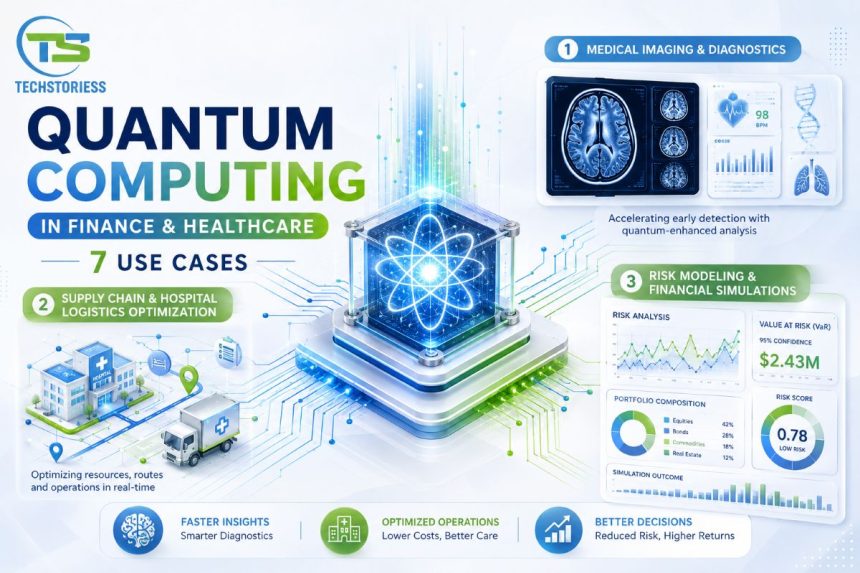
- Risk Modeling and Financial Simulations
- Medical Imaging and Diagnostics
- Supply Chain and Hospital Logistics Optimization
- The Rise of Hybrid Quantum-Classical Infrastructure
- Challenges Slowing Enterprise Quantum Adoption
- Conclusion
The latest achievements by companies like IBM and Google Quantum AI suggest that the industry is gradually moving towards an era where quantum systems will start solving narrowly defined but commercially valuable problems massively faster than classical systems with unmatched efficiency. IBM has publicly announced that it will demonstrate quantum advantage by the end of 2026, while Willow chip demonstrations by Google have intensified discussions around computational tasks that classical supercomputers struggle to simulate efficiently.
Unlike conventional systems that process bits as either 0 or 1, quantum computers use qubits – a computational unit that exists in multiple states simultaneously through superposition and entanglement. This gives a fundamental architectural advantage, allowing certain quantum algorithms to explore highly complex optimization and simulation problems exponentially faster than classical approaches under the right conditions.
For industries primarily focused on probabilistic modeling, molecular simulation, risk forecasting, and large-scale optimization, the implications are particularly significant. Sectors like finance, healthcare, pharmaceuticals, and logistics are widely regarded as first-adoption industries for practical quantum computing use cases.
Multiple market forecasts suggest that the global quantum computing market could exceed $450 billion by 2030 as enterprises begin integrating hybrid quantum-classical workflows into existing AI and HPC infrastructure. Among other benefits, energy efficiency is one emerging advantage already attracting enterprise attention: hybrid quantum-classical architectures have a remarkable potential to reduce AI training energy consumption by nearly 30% in highly specialized workloads.
As opposed to common notion, quantum computing is not limited to theoretical supremacy claims alone. It is fast emerging as a source of practical, real-world use cases that solve measurable enterprise problems.
Why Finance and Healthcare Are Leading Quantum Adoption
Quantum computing is not a ubiquitous solution for every industry. Quantum systems deliver the best results in environments that involve:
- Massive combinatorial complexity
- Molecular and chemical simulations
- High-dimensional optimization
- Probabilistic forecasting
- Dynamic pattern recognition
- Multi-variable risk analysis
Finance and healthcare naturally fit these characteristics.
Banks constantly process enormous datasets that involve portfolio optimization, derivatives pricing, fraud detection, and market simulations. Similarly, pharmaceutical companies invest massively in modeling molecular interactions for drug discovery and clinical research.
Conventional supercomputers remain extraordinarily powerful, but certain optimization and simulation tasks scale so aggressively that classical architectures prove increasingly inefficient both computationally and energetically. Quantum computing can largely reduce those bottlenecks.
This leads to a growing enterprise focus on hybrid quantum-classical systems rather than a full transition to quantum-native infrastructure. In practice, most organizations are augmenting classical computing with quantum accelerators to accomplish highly specialized tasks.
Quantum Portfolio Optimization
In the finance sector, one of the most commercially viable quantum computing use cases is portfolio optimization.
Modern investment portfolios track thousands of variables with different risk and return characteristics, including:
- Asset correlations
- Market volatility
- Liquidity constraints
- Regulatory exposure
- Macroeconomic scenarios
- ESG risk factors
Classical systems typically use heuristic methods to approximate optimal allocations, as it is computationally impractical to evaluate every possible portfolio combination at scale.
By leveraging quantum algorithms such as the Quantum Approximate Optimization Algorithm (QAOA), quantum portfolio optimization is able to analyze massive combinations simultaneously. It not only speeds up the task but also improves optimization quality under highly dynamic market conditions.
Major financial institutions like JPMorgan Chase, Goldman Sachs, and HSBC have already started experimenting with hybrid quantum-classical portfolio models.
In practical deployment scenarios, quantum systems are generally used to support:
- Faster rebalancing strategies
- Real-time market risk adjustments
- Improved derivatives pricing
- More accurate stress testing
- Reduced computational overhead
For hedge funds and institutional investors operating in highly dynamic environments where conditions change in milliseconds, even marginal improvements in optimization can translate into significant competitive advantages.
Quantum Algorithms for Drug Discovery
The most transformative healthcare application of quantum computing is drug discovery.
Conventional pharmaceutical research is not only slow but very expensive too. Simulating molecular interactions accurately – one of the most effective ways to improve speed and reduce costs – often exceeds the capabilities of classical systems, as molecules themselves operate according to quantum mechanical principles.
This is precisely where quantum algorithms for drug discovery become strategically important.
Quantum computers are theoretically capable of modeling molecular structures, protein folding behaviors, and chemical interactions with far greater precision than classical approximations. This simulation capability can significantly cut down the time required to identify viable compounds.
Organizations such as Pfizer, Roche, and Moderna are actively exploring quantum-assisted pharmaceutical research partnerships.
The strategic benefits include:
- Faster candidate molecule identification
- Reduced clinical trial failures
- More precise biomarker targeting
- Personalized medicine development
- Accelerated vaccine research
Rather than screening millions of compounds experimentally – a time-consuming and costly process – quantum-enhanced simulation environments may enable researchers to digitally predict molecular viability before laboratory testing begins.
This capability could fundamentally redefine pharmaceutical economics over the next decade.
Quantum Machine Learning for Fraud Detection
The success of fraud detection systems largely depends on detecting subtle anomalies across massive transactional datasets.
Conventional AI systems are already proving capable in this domain, but quantum machine learning adds new possibilities for tackling highly dimensional data structures and probabilistic relationships more efficiently.
Enterprises are exploring quantum machine learning models for:
- Credit card fraud detection
- Insurance fraud analysis
- Anti-money laundering systems
- Cybersecurity threat intelligence
- Behavioral anomaly detection
One of the key benefits is the ability of quantum-enhanced systems to simultaneously assess highly interconnected variables rather than relying on sequential processing methods that introduce latency and reduce detection accuracy.
Financial institutions are especially showing active interest in hybrid quantum-classical fraud detection pipelines where quantum systems handle feature extraction and optimization while classical AI manages deployment-scale inference.
This hybrid approach offers greater practical viability as existing quantum hardware remains noisy and limited in qubit stability, making it unsuitable for standalone deployment at production scale.
That said, it presents substantial long-term potential. Fraud systems currently demanding hours of high-performance computing could eventually be processed as near-real-time probabilistic analysis at significantly larger scale – meaningfully improving both detection speed and accuracy.
Personalized Treatment Planning in Healthcare
One of the major challenges in the healthcare sector is large-scale optimization. It is generally difficult to achieve genuine personalization at population scale due to the sheer complexity and variability of individual patient profiles.
Every patient represents a radically unique case in terms of:
- Genetics
- Medical history
- Biomarkers
- Medication interactions
- Environmental influences
- Lifestyle variables
Classical systems are not fully capable of dynamically evaluating all possible treatment pathways at population scale. They can only approximate solutions within computationally manageable boundaries.
Quantum computing may enable healthcare providers to generate more precise and personalized treatment recommendations by accurately modeling highly complex biological interactions simultaneously.
Potentially viable applications include:
- Precision oncology
- Genomic analysis
- Treatment-response prediction
- Radiotherapy optimization
- Drug interaction modeling
Global researchers have started exploring quantum-enhanced genomic sequencing and protein interaction modeling to overcome classical computational limits that often slow therapeutic discovery.
Clinical deployments are still at their initial stage, but healthcare systems increasingly believe that quantum computing can play a vital role in advancing long-term predictive and preventive medicine.
Risk Modeling and Financial Simulations
Financial markets are inherently probabilistic systems influenced by a number of unpredictable variables.
Every year, banks and insurers spend enormous computational resources running Monte Carlo simulations for applications like:
- Market risk forecasting
- Liquidity modeling
- Credit exposure analysis
- Catastrophe modeling
- Regulatory compliance stress testing
Quantum computing has extensive theoretical potential for accelerating these simulations, thus reducing both processing time and infrastructure costs.
Quantum amplitude estimation algorithms, for instance, could significantly reduce the number of simulations needed to achieve comparable statistical accuracy.
This matters substantially as enterprise-scale risk modeling currently demands enormous energy and infrastructure resources. Through hybrid quantum-classical environments, enterprises could eventually reduce both processing time and operational cost.
With regulatory scrutiny intensifying globally, quicker and more precise risk modeling may be among the earliest commercially viable quantum advantage applications in finance.
Medical Imaging and Diagnostics
Medical imaging systems produce extraordinarily large and complex datasets.
MRI scans, CT imaging, pathology slides, and radiology workflows increasingly rely on AI-driven analysis to inform clinical decisions. Quantum-enhanced machine learning models could meaningfully improve pattern recognition capabilities in high-dimensional imaging datasets.
Possible applications include:
- Earlier cancer detection
- Improved neurological disorder diagnosis
- Faster radiology analysis
- Enhanced image reconstruction
- Predictive disease progression modeling
Quantum computing is unlikely to replace classical AI in diagnostics. However, hybrid quantum-classical systems could accelerate specific computationally intensive workloads.
In this field, the larger opportunity lies in diagnostic accuracy.
Considering the global burden of disease, even modest improvements in early detection rates for serious conditions could produce enormous healthcare and economic benefits.
Supply Chain and Hospital Logistics Optimization
Healthcare systems and financial enterprises share a common challenge – both operate highly complex logistical networks that demand continuous real-time optimization.
Hospitals constantly optimize:
- Staff scheduling
- Bed allocation
- Surgical planning
- Medical inventory
- Emergency response routing
Similarly, financial institutions need to continuously optimize across multiple dimensions including transaction routing, infrastructure allocation, and operational resource management.
Quantum optimization algorithms present relevant solutions to these large-scale combinatorial challenges.
During periods of crisis – like pandemics or supply chain disruptions – dynamically recalculating optimal logistical decisions in near real time could make a decisive operational difference.
For this reason, logistics continues to rank among the first-adoption industries for enterprise quantum deployment alongside finance and pharmaceuticals.
The Rise of Hybrid Quantum-Classical Infrastructure
Contrary to popular assumption, quantum computing cannot replace classical computing entirely. Each excels in fundamentally different problem domains and the two are more complementary than competitive.
What is more viable in the foreseeable future is hybrid quantum-classical infrastructure, where organizations will employ quantum systems selectively for highly specialized workloads while using traditional cloud and AI systems to handle general computation.
This hybrid architecture provides multiple benefits:
- General-purpose computing: Classical systems excel at this wjile quantum systems remain limited.
- Molecular simulation: Classical systems are computationally expensive while quantum systems show potentially superior capability.
- Large-scale optimization: Classical systems slow down at extreme scale Quantum systems offer strong potential.
- AI training efficiency: Classical AI training is energy intensive. Quantum systems may enable hybrid acceleration.
- Enterprise deployment maturity: Classical infrastructure is fully mature. Quantum deployment is still emerging.
Near-term winners will be defined by their ability to strategically integrate quantum accelerators into existing AI and cloud ecosystems rather than pursuing full-scale migration – which is not only premature but operationally impractical at current hardware maturity levels.
For that reason, major cloud providers including Microsoft Azure Quantum, Amazon Braket, and IBM Quantum Platform are actively investing in cloud-accessible hybrid quantum environments.
Challenges Slowing Enterprise Quantum Adoption
While the momentum is building, several barriers continue limiting large-scale enterprise deployment.
Hardware Stability
Current qubit technologies are acutely sensitive to environmental noise, temperature fluctuations, and decoherence – requiring operation at temperatures colder than deep space and precise electromagnetic shielding that makes deployment complex and expensive.
Error Correction Complexity
Current quantum computers still experience relatively high error rates that constrain reliability and limit circuit depth for practical workloads.
Talent Shortage
Being still in its maturing stage, there is an enormous gap between enterprise demand and talented professionals skilled in:
- Quantum algorithms
- Quantum physics
- Quantum software engineering
- Hybrid infrastructure design
Commercial ROI Uncertainty
Many enterprises are still unsure about their current quantum investments translating into measurable business value in the near term.
For this reason, most organizations prefer to remain in pilot and experimentation phases rather than graduating to production-scale deployment.
Conclusion
Quantum computing has moved beyond being merely a theoretical conversation reserved for physicists and research labs to become a subject of practical enterprise experimentation. Especially across crucial sectors like finance and healthcare – which struggle with complex optimization and simulation challenges – quantum computing is beginning to demonstrate tangible relevance.
Adopting quantum computing does not mean a complete replacement of classical computing. The most realistic short-term scenario is the gradual, well-phased emergence of hybrid quantum-classical systems that augment the existing capabilities of AI and cloud infrastructure.
That shift has already begun.
The most relevant and commercially promising use cases for quantum computing are quantum portfolio optimization, quantum algorithms for drug discovery, quantum machine learning, medical diagnostics, and large-scale risk simulations.
To unlock maximum benefits from their quantum investments, organizations need to understand the areas where quantum architectures genuinely outperform classical systems – and strategically integrate them into real-world business workflows. How early organizations move from experimentation to structured deployment will determine their position in the industry relative to their competitors.