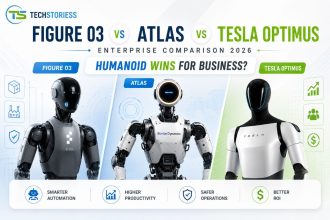



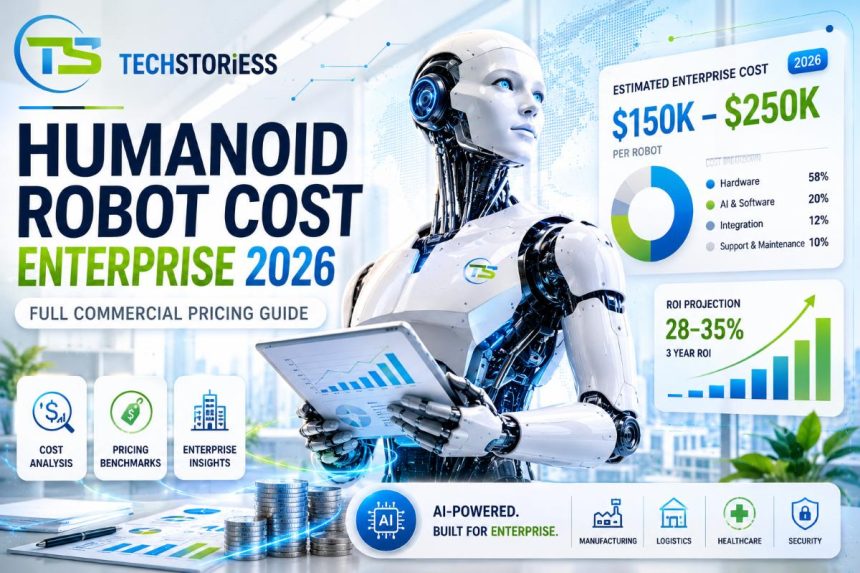
Enterprise procurement teams evaluating humanoid robots in 2026 face a pricing landscape that spans nearly two orders of magnitude: entry-level platforms from Unitree start at $13,500, while Boston Dynamics Atlas commands $150,000–$250,000 per unit before deployment costs are factored in. Understanding where your use case falls in that range — and what lies beneath the sticker price — is the decision that separates a successful automation pilot from an expensive write-off.
- The 2026 Humanoid Robot Market at a Glance
- Understanding Commercial Humanoid Robot Pricing
- Unitree Models: The Affordable Entry Point
- Tesla Optimus: Targeting Mass-Market Scale
- Boston Dynamics Atlas: Premium Enterprise Performance
- Agility Robotics Digit: Logistics Specialist
- Total Cost of Ownership: Beyond the Purchase Price
- ROI and Real-World Value
- Factors Driving Humanoid Robot Costs
- Which Humanoid Robot Offers the Best Value in 2026?
- Challenges and Considerations for Enterprise Buyers
- Future Pricing Trends for Humanoid Robots
- Conclusion: The Right Humanoid Robot Investment in 2026
- Frequently Asked Questions
- Ready to Evaluate Enterprise Robotics?
This guide maps the full commercial pricing landscape for humanoid robots in 2026. We cover the four platforms seeing the most enterprise traction — Unitree G1/H2, Tesla Optimus, Boston Dynamics Atlas, and Agility Robotics Digit — and break down acquisition costs, total cost of ownership (TCO), and realistic ROI timelines based on operational data from the earliest commercial deployments.
One clarification before we begin: “cheapest” and “best value” are not the same thing. A $16,000 Unitree G1 is not the right choice for an Amazon-scale logistics operation, and a $250,000 Digit deployment is not overkill for a high-throughput warehouse with consistent tote-handling tasks. Platform selection is a matching problem, not a budget-minimisation exercise. The sections below give you the data to make that match correctly.
The 2026 Humanoid Robot Market at a Glance
The global humanoid robot market reached an estimated $2.92 billion in 2025 and is projected to exceed $15 billion by 2030, according to separate forecasts from Goldman Sachs Global Investment Research and IDC’s Worldwide Robotics Tracker. TrendForce projects 2026 shipments will surpass 50,000 units — a roughly 700% increase over 2025 — driven primarily by volume production from Chinese manufacturers operating at scale.
China leads by unit volume, and the gap is significant. Unitree shipped over 5,500 units in 2025, with AgiBot close behind at approximately 5,168 units, according to TrendForce’s May 2026 production report. This volume advantage stems from vertically integrated domestic supply chains, government-backed automation incentives under the Made in China 2025 programme, and hardware iteration cycles that run roughly twice as fast as comparable Western firms.
Western manufacturers are generating commercial proof points rather than volume. Agility Robotics’ Digit has been in active use inside Amazon fulfilment centres since late 2024; Figure 02 completed a pilot programme at BMW’s Spartanburg, South Carolina plant in early 2025; and Boston Dynamics Atlas is in formal evaluation with several automotive and aerospace clients under enterprise NDA. These deployments matter because they produce the operational uptime, error-rate, and labour-substitution data that procurement teams need to justify capital expenditure internally.
The underlying economic case has sharpened. A US manufacturing worker carries $60,000–$80,000 in total annual compensation costs, per Bureau of Labor Statistics data for production occupations (BLS.gov, 2025). A Unitree H2 at $90,000, amortised over five years and operating across two shifts, implies a hardware-only cost roughly equivalent to six months of that same human labour cost — before considering productivity multipliers for tasks where robots outperform humans in consistency and throughput. That arithmetic is why 2026 is the year enterprise procurement teams stopped treating humanoid robotics as future-state planning and started running line-item analysis.
This flexibility makes them attractive for:
- Warehousing
- Manufacturing
- Distribution centers
- Retail operations
- Healthcare logistics
- Facility management
- Industrial inspections
With technology advancing, the use of humanoid robots has become a viable option for augmenting existing workers, rather than a science experiment.
Understanding Commercial Humanoid Robot Pricing
Before comparing models, it’s important to understand how enterprise robotics pricing works. The advertised robot price is often only one component of the total investment.
Initial Purchase Cost
This includes:
- Hardware
- Sensors
- Cameras
- Battery systems
- Basic operating software
The price of the robots varies from $4,900 to well over $250,000 per unit, depending on the robot.
Software Licensing
Most enterprise robotics vendors sell software on a subscription basis.
These subscriptions may include:
- AI updates
- Fleet management
- Cloud connectivity
- Security updates
- Performance monitoring
Annual software fees can add thousands of dollars per robot.
Integration Costs
Enterprises rarely deploy robots out of the box.
Integration often requires:
- Workflow mapping
- ERP connectivity
- Warehouse management system integration
- API development
- Testing and validation
For large organisations, integration costs may exceed hardware expenses.
Maintenance and Support
Humanoid robots, too, like all other industrial equipment, need maintenance.
Typical expenses include:
- Battery replacement
- Sensor calibration
- Software support
- Component repairs
- Remote diagnostics
These costs should be factored into any commercial deployment budget.
Unitree Models: The Affordable Entry Point
Unitree leads on accessible pricing and is currently the only humanoid manufacturer shipping at volume to international buyers without enterprise contract requirements. The G1 starts at $13,500–$16,000 — a compact 1.27m frame weighing approximately 35kg, with 23 degrees of freedom, a 2kg payload capacity, and a 2-hour battery runtime on standard tasks. The larger H1 and H2 models, priced at $29,900–$90,000 depending on configuration, move to a full 1.8m frame with higher payload (up to 30kg for the H2) and more capable dexterous hands. Unitree’s strategy prioritises rapid iteration and volume production; they have released three major hardware generations since 2023, driving per-unit costs down faster than most analysts projected.
Best Use Cases
The Unitree G1 is best suited for use cases where task complexity is low, iteration speed matters, and the organisation wants to build internal robotics competency before committing to a premium platform. Proven applications include:
- Research and university labs needing a programmable, ROS-compatible humanoid at under $20,000
- Security and facility patrol in structured indoor environments
- Warehouse picking pilots where payload requirements stay under 2kg
- Industrial inspection in confined or elevated spaces where human ergonomics are a constraint
- Developer ecosystem projects building on Unitree’s published SDK and simulation tools
Strengths
Unitree also offers one of the most active open-source developer communities of any humanoid platform, with over 1,200 SDK contributors on GitHub as of Q1 2026.
- Lowest entry cost
- Rapid deployment
- Growing developer ecosystem
- Affordable experimentation platform
Limitations
- Lower payload capacity
- Less enterprise maturity
- Limited large-scale deployment history
For price-sensitive first deployments, Unitree represents the clearest path to getting a humanoid on the floor within 60 days of purchase.
Tesla Optimus: Targeting Mass-Market Scale
Tesla is targeting a commercial price point of $20,000–$30,000 per unit for Optimus Gen 2, with an internal cost target below $20,000 at full production scale — a figure Elon Musk reiterated during Tesla’s Q4 2025 earnings call. Current production is limited and prioritised for internal Tesla factory deployment, where Optimus units have been performing battery cell handling and component sorting tasks since mid-2024. Limited external commercial availability is expected to expand through 2026, initially restricted to selected manufacturing partners under production agreements.
Why Businesses Are Watching Optimus
Tesla’s competitive advantage in humanoid robotics is structural, not incremental. The company brings purpose-built advantages that no pure-play robotics firm can replicate at launch: the world’s largest real-world autonomous driving dataset (used to train Optimus’s vision systems), proprietary 4680 battery cells enabling higher energy density at lower cost than off-the-shelf solutions, and manufacturing infrastructure already running at automotive scale. These inputs mean Optimus is the only humanoid platform that could plausibly reach $20,000 per unit by 2028 — a price level that would shift the ROI calculation for mid-sized manufacturers who cannot justify today’s $100,000–$250,000 enterprise deployments.
With Tesla’s mass-production goal in sight, Optimus has the potential to drastically cut the average cost of commercial humanoid robots across industries.
Potential Enterprise Applications
- Manufacturing assembly
- Material handling
- Factory logistics
- Inventory movement
- Repetitive industrial tasks
Goldman Sachs projects Optimus could represent a $6 billion annual revenue line for Tesla by 2030 if production ramp targets hold — a figure that underscores why competitor roadmaps are now explicitly designed around the assumption Tesla reaches mass production.
Boston Dynamics Atlas: Premium Enterprise Performance
What Is Atlas?
The latest version of Atlas from Boston Dynamics showcases some of the most advanced humanoid mobility capabilities in the industry.
Atlas is known for:
- Dynamic movement
- Advanced balance
- High-performance navigation
- Industrial-grade engineering
Estimated Commercial Cost
Atlas pricing is not publicly standardised, but industry estimates suggest:
| Cost Component | Estimated Cost |
|---|---|
| Robot Platform | $150,000–$250,000 |
| Full Enterprise Deployment Package | $250,000–$500,000+ |
| Annual Support & Maintenance Contract | $25,000–$60,000/year |
Note: Boston Dynamics does not publish public pricing. Estimates above are based on procurement disclosures from enterprise buyers in the IEEE Spectrum robotics procurement survey (March 2026) and industry analyst briefings.
Why Atlas Costs More
Atlas carries a cost premium driven by three compounding factors. First, the sensor suite: Atlas uses a combination of LIDAR, stereo vision, and proprietary force-torque sensors at each joint — a hardware bill of materials significantly higher than vision-only competitors. Second, the motion control stack: Boston Dynamics has invested over 20 years of proprietary research into Atlas’s whole-body dynamics and predictive balance control, which enables the robot to operate in unstructured environments that would defeat other platforms. Third, enterprise-grade reliability engineering: Atlas is designed to industrial duty-cycle standards, with component lifetimes rated for continuous multi-shift operation — the same reliability bar that justified its initial $2+ million research price tag, now being amortised across a larger unit volume.
These capabilities increase acquisition costs but may provide greater productivity in demanding environments.
Ideal Industries
- Industrial inspections
- Hazardous environments
- Advanced manufacturing
- Infrastructure operations
Boston Dynamics has confirmed active enterprise pilots with Hyundai Motor Group (which acquired Boston Dynamics in 2021) for manufacturing line inspection and Dow Chemical for hazardous facility operations. These are among the only publicly disclosed Atlas enterprise deployments outside of research contexts.
Agility Robotics Digit: Logistics Specialist
What Is Digit?
Agility Robotics’ Digit is the only humanoid robot with a confirmed, scaled commercial deployment as of mid-2026. Amazon began deploying Digit units across multiple US fulfilment centres starting in late 2024 under a commercial partnership with Agility, making it the first humanoid to move from pilot to multi-site operation in a real logistics environment.
Digit is 1.75m tall, weighs 64kg, and is purpose-designed for tote handling: its arm configuration and proprioceptive foot design are optimised for the specific motion patterns of warehouse pick-and-place workflows, rather than generalised humanoid dexterity.
Digit’s purchase price is approximately $250,000 per unit for enterprise buyers committing to fleet contracts. For organisations preferring predictable opex over capex, Agility offers a Robot-as-a-Service (RaaS) model priced at roughly $2,000–$4,000 per month per unit — equivalent to $10–$20 per hour at full utilisation, which compares directly to US warehouse labour costs of $18–$22 per hour including employer-side costs. The RaaS model includes software updates, remote diagnostics, and defined uptime SLAs, shifting maintenance risk from the buyer to Agility.
Key Commercial Advantages
Digit focuses on:
- Tote handling
- Warehouse workflows
- Material movement
- Existing facility compatibility
Digit’s primary limitation is its specialisation: it is highly capable within warehouse tote-handling workflows and less suited to unstructured or variable-task environments where generalist platforms like Atlas or Unitree H2 offer more flexibility.
| Model | Approx. Price (2026) | Height/Weight | Best For | Availability |
| Unitree G1 | $13,500–$16,000 | 1.3m / 35kg | Research, light tasks | Widely available |
| Unitree H1/H2 | $29,900–$90,000 | 1.8m / 47-70kg | Enterprise pilots | Available |
| Tesla Optimus | $20,000–$30,000 (target) | ~1.73m / 57kg | Manufacturing, general | Limited 2026 |
| Boston Atlas | $150K–$320K | ~1.9m / 89kg | Heavy industrial | Enterprise pilots |
| Agility Digit | ~$250K or RaaS | 1.75m / 64kg | Warehousing & logistics | Commercial deployment |
Total Cost of Ownership: Beyond the Purchase Price
The hardware purchase price is typically 55–65% of the true five-year cost of deploying a humanoid robot at enterprise scale, based on procurement data aggregated by the Association for Advancing Automation (A3) in their 2025 Enterprise Robotics Cost Benchmarking Report. The remaining 35–45% is divided across four operational cost categories:
Maintenance and Parts (10–15% of hardware cost per year) Actuators, sensors, and battery systems are the primary wear items. Electric linear actuators — the most common joint mechanism in current humanoids — typically require inspection at 2,000 operating hours and replacement at 8,000–12,000 hours. Battery packs degrade to 80% capacity in approximately 500–800 full charge cycles, depending on operating temperature. Budget $12,000–$22,000 per year for a $100,000-class robot under two-shift operation.
Integration and Setup ($10,000–$30,000, one-time) Deployment costs cover workflow mapping, ERP or WMS API integration, safety system certification, and operator training. For a greenfield warehouse integration with a clean WMS, $10,000–$15,000 is realistic. Retrofitting an existing facility with multiple legacy systems typically pushes this to $25,000–$30,000+.
Software Subscriptions ($3,000–$8,000/year) All major humanoid platforms charge annual software fees covering AI model updates, fleet management dashboards, cloud telemetry, and security patches. Agility’s RaaS model bundles these; standalone platform buyers pay separately.
Energy and Facilities (relatively minor: ~$800–$1,200/year per unit) A humanoid robot operating two 8-hour shifts draws approximately 1–2 kWh per hour at typical task load. At US commercial electricity rates (~$0.12/kWh), annual energy costs per unit run $700–$1,400.
Five-Year TCO Example: $100,000 platform
| Cost Item | Year 1 | Years 2–5 (each) | 5-Year Total |
|---|---|---|---|
| Hardware | $100,000 | — | $100,000 |
| Integration & Setup | $20,000 | — | $20,000 |
| Maintenance & Parts | $15,000 | $15,000 | $75,000 |
| Software | $5,000 | $5,000 | $25,000 |
| Energy | $1,000 | $1,000 | $5,000 |
| Total | $141,000 | $21,000/yr | $225,000 |
Against this, a single US warehouse employee earning $20/hour with standard employer-side costs (benefits, payroll tax, turnover) represents approximately $52,000–$58,000 in total annual cost. Over five years: $260,000–$290,000 — before accounting for absenteeism, training, and peak-season hiring premiums.
For risk-averse buyers, Agility’s RaaS model restructures this calculation entirely: at $3,000/month ($36,000/year), a Digit deployment costs roughly 60–70% of a single human employee in equivalent logistics roles, with predictable monthly billing and no capex.
ROI and Real-World Value
Documented enterprise deployments suggest payback periods of 18–36 months for humanoid robots deployed in high-frequency, well-defined tasks — a range consistent with the broader industrial automation ROI benchmarks published by McKinsey’s Manufacturing Practice (2025). The key variable is utilisation: a robot running 16 hours per day across 300 operating days generates roughly 5x the annual output of the same robot running a single 8-hour shift, with proportionally faster payback.
Real-world deployment data, where available:
Agility Digit at Amazon: Amazon has not disclosed per-unit productivity figures, but confirmed in a 2025 press briefing that Digit units are performing tote-movement tasks continuously across multi-hour blocks with uptime exceeding 85% in steady-state operation. Industry analysts at Interact Analysis estimate the deployment’s effective hourly cost — including RaaS fees, integration amortisation, and support — at $12–$15 per robot-hour, compared to $18–$22 for human labour performing the same tote-handling workflow.
Figure 02 at BMW: BMW confirmed in a March 2025 investor presentation that Figure 02 completed vehicle chassis inspection tasks in a Spartanburg pilot at a cycle time within 15% of trained human technicians, with zero quality escapes over the pilot duration. BMW has not disclosed whether the programme has moved to full commercial deployment.
Factors that most strongly affect ROI in 2026:
- Task repeatability — the more consistent the task, the faster the training time and the fewer errors during ramp-up. Tote handling, component sorting, and structured inspection all qualify. Unstructured pick-and-place, customer interaction, and complex assembly do not yet reliably qualify.
- Labour market conditions — deployments in markets with high turnover, seasonal spikes, or safety-driven vacancy rates (cold storage, hazardous environments) see the shortest payback periods.
- Shift coverage — robots do not require overtime premiums. Deployments that cover evening and weekend shifts where human labour is most expensive compress payback timelines significantly.
- Component cost trajectory — actuator and sensor prices are falling roughly 15–20% per year as production volumes increase, meaning a robot purchased in 2026 will have a lower maintenance cost per hour by year 3 than its purchase-year spec implies.
When to be cautious: Avoid over-specifying. Deploying a $250,000 Digit for tasks a $30,000 Unitree H2 can perform adds cost without proportional benefit. Similarly, deploying any humanoid in an environment with high variability, frequent layout changes, or irregular task structures will extend payback periods well beyond the 36-month benchmark.
Factors Driving Humanoid Robot Costs
Four elements dominate pricing: actuators (biggest share), sensors, onboard compute, and materials. Custom designs and scale reduce these over time.
Security certifications, software ecosystems, and regulatory compliance add to the costs of enterprise versions. In China, firms such as Unitree benefit from a home-market advantage, but the ability to make changes more quickly offsets this advantage, compelling Western firms to focus on value.
Which Humanoid Robot Offers the Best Value in 2026?
A straightforward blueprint to platform match for use cases:
Research and education ($16,000 – $70,000): The Unitree G1 and H2 are indisputably the stars of the show. Full programmability, active developer communities, and real deployment history make them legitimate research tools rather than demonstration units.
Warehouse and logistics ($200,000 – $250,000): Agility Digit is the only commercially proven solution as of mid-2026. The premium is warranted with the only valid operational data in the industry.
Automotive manufacturing (enterprise pilot programs): Figure 02 and Boston Dynamics Atlas are the reference platforms. Both are available only as enterprise pilot programs and can be accessed through direct supplier engagement.
Budget-constrained first deployment: 1X NEO is currently pre-ordered and will be available in 2026, with an up-front cost of only $20,000 or $499 per month.
Future planning ($20,000 – $30,000, 2027–2028): Tesla Optimus. If your timeline allows, the scale production economics Tesla is targeting would make this the dominant commercial platform at mid-decade.
Challenges and Considerations for Enterprise Buyers
The capacity to invest on a large scale is still a major challenge for small businesses. Planning for integration with legacy systems is needed. A well-informed human factors risk assessment is essential. In dusty and variable environments, battery life and maintenance require attention.
Topics such as the impact on jobs, ethical issues and Data Security are also important considerations. These are addressed through clear pilots and support programmes provided by leading companies.
Future Pricing Trends for Humanoid Robots
Enterprise humanoid robot pricing is likely to fall sharply over the next five years, following the same cost curve that drove down industrial robotic arms and autonomous mobile robots in the previous decade.
Several factors are driving price reductions:
- AI model improvements
- Battery advancements
- Sensor cost declines
- Manufacturing scale
- Increased competition
Conclusion: The Right Humanoid Robot Investment in 2026
The humanoid robot pricing landscape in 2026 is genuinely complex, but the core decision framework is not. Enterprise buyers in 2026 are choosing between three fundamentally different commercial models: buy a research-grade platform like Unitree at $13,500–$90,000 to build internal competency, commit capital to a commercially proven specialist like Agility Digit at $250,000 or via RaaS, or wait 18–24 months for Tesla Optimus to reach volume production at a potential price point that reshapes the entire category.
What has changed in 2026 is that none of these choices is hypothetical any longer. Humanoid robots are handling real tote volumes in Amazon warehouses, performing real inspection tasks at BMW, and generating real operational data that procurement teams can stress-test against their own labour cost structures. The question is not whether humanoid robotics works — it is whether it works for your specific operation, at a cost that makes sense against your five-year labour and automation budget.
Humanoids augment human workforces in 2026 — they do not replace them wholesale. The deployments generating the clearest ROI are those pairing robots with human supervisors: humans handle exceptions, retraining, and edge cases; robots handle high-frequency, structured, physically demanding tasks continuously. Organisations that plan for this hybrid model will outperform those chasing full automation at a point when the technology is not yet ready to deliver it.
The right humanoid robot investment in 2026 is the one matched precisely to a task your workforce finds expensive, dangerous, or difficult to staff reliably. Start there, measure carefully, and scale what the data supports.
Frequently Asked Questions
What is the average humanoid robot cost for enterprises in 2026?
Enterprise humanoid robot costs typically range from $20,000 to more than $250,000, depending on the robot’s capabilities, software, and deployment needs.
Is Tesla Optimus available for commercial purchase in 2026?
Commercial deployments are expected to expand with Tesla, but may depend on industry, region, and production capacity.
Which humanoid robot is best for warehouse operations?
Given its focus on material-handling workflows, Digit is the best available solution for warehouse and logistics applications at present.
What hidden costs should enterprises consider?
Costs to consider include software subscriptions and maintenance, integration, employee training, cybersecurity, and infrastructure upgrades.
How long does it take for a humanoid robot to deliver ROI?
Labour savings, utilisation rates, and gains in operational efficiency are the primary factors contributing to ROI; most enterprise deployments are projected to achieve ROI within 2–5 years.
Ready to Evaluate Enterprise Robotics?
As humanoid robots move from prototypes to commercial reality, understanding pricing, deployment requirements, and realistic ROI timelines is now a core part of any enterprise automation strategy.
Identify the latest advancements in robotics, automation methods, and enterprise technology trends to make informed investment decisions and stay ahead of the next Industrial Revolution.