


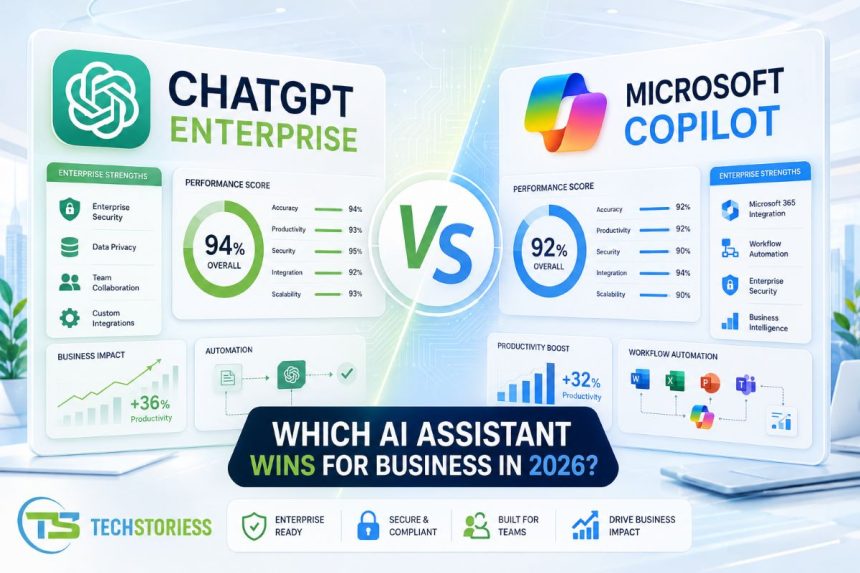
With the fast-moving AI assistant market, the gap between a smart enterprise decision and a disastrous mistake has become much narrower.
In 2026, enterprise AI productivity is dominated by two platforms: OpenAI’s ChatGPT Enterprise, and Microsoft 365 Copilot, the AI layer integrated across the Microsoft 365 productivity suite. Both players promise to transform the way organizations write, analyze, communicate, and automate. Backed by extensive capital and engineering resources, both players represent architectural choices that produce entirely different products solving the problem from opposite directions.
The stakes are confirmed by the numbers. ChatGPT registers 5.5 billion monthly visits as of April 2026, contributing 82% of all AI platform referral traffic. It serves 900 million weekly active users – a significant jump of 125% year-over-year not yet replicated by any enterprise software product in history. Though a later entrant in AI productivity, Microsoft Copilot is also gaining serious ground. Over the last year the platform registered 25.2x growth and operates in over 200 countries. It sits within the Microsoft 365 ecosystem that is trusted by over 430 million users globally. The third entrant is a quiet but formidable Claude. During the same period, Claude grew 12.8 times, quietly claiming 29% of enterprise AI assistant market share in terms of revenue. It is a strong reminder that this race is being run by not two but three players.
For organizations seriously evaluating these platforms, there is a more consequential consideration worth naming: compared to organic search traffic, visitors arriving from LLMs convert to sign-ups and subscriptions at 4.4 times the rate, as revealed by Microsoft Clarity data. More than just a productivity tool, AI is becoming an enterprise distribution channel. The platform that gives greatest visibility to your organization – and the one your teams are most comfortable with – is a strategic decision with compounding consequences.
In this guide we cut through the marketing narratives and offer you an honest architectural review covering all the key questions: what each platform is built for, what their strengths and weaknesses are, and most importantly how the best enterprises are combining both.
The Fundamental Architecture Divide: Integration vs. Flexibility
Jumping directly to comparison without understanding the fundamental differences between these products produces misleading conclusions. So let us first understand the foundational difference in philosophy, which will shape almost every other conclusion that follows.
Microsoft 365 Copilot is an integrated, context-aware, and governance-native enterprise execution system. It lives inside Word, Excel, PowerPoint, Outlook, Teams, SharePoint, and OneNote. It efficiently accesses your organizational data – emails, documents, meeting transcripts, org chart structure, and file permissions – through Microsoft Graph, the intelligence layer with a deep understanding of your company’s information topology. So when a user asks Copilot to summarize a project, it is already aware of meetings you attended, the documents you have accessed, and even the colleagues you directly report to. It frees you from pasting or uploading the context you need. Copilot already knows it.
ChatGPT Enterprise, on the other hand, is a general-purpose reasoning platform operating as a standalone interface. It is a dedicated interface or API without a built-in context-aware system. You bring context to it. It excels at cognitive flexibility – think complex document analysis, multi-step reasoning, code generation and debugging, structured content creation, and creative synthesis across any domain. Rather than being built around any specific software ecosystem, it optimizes for the quality and flexibility of the reasoning itself. That serves as its greatest strength as well as its greatest limitation, depending on your organization’s specific needs.
The critical implication is this: when working inside Microsoft 365, Copilot is the better tool. On the other hand, ChatGPT is the stronger choice when the task requires deep reasoning, original synthesis, or work that lives outside the Microsoft ecosystem. In 2026, for most enterprise organizations the answer to “which platform is best” is not a specific name – it is “for what task, for whom, and under what governance model?”
Market Position and Adoption: What the Data Actually Shows
While the headline traffic numbers are real, the enterprise story is more nuanced than raw user counts suggest.
ChatGPT claims staggering consumer dominance: 5.5 billion monthly visits, 900 million weekly active users, and an annualized revenue of $25 billion. OpenAI has built the fastest-growing software product in history. Globally, ChatGPT processes approximately 2.5 billion prompts every day – reflecting usage that makes it the default first point of contact for a generation of knowledge workers seeking instant help with an immediate problem.
Equally impressive is the enterprise penetration story. More than 92% of Fortune 500 companies now use ChatGPT Enterprise products in some capacity, with 9x year-over-year growth in enterprise seats and 88% retention after 12 months. As of February 2026, OpenAI reported 920,000 business accounts across Team and Enterprise tiers – a remarkable number for a product at this stage of maturity. It indicates a remarkable trajectory for an enterprise product that launched at meaningful scale only in 2023.
Microsoft Copilot’s enterprise story has a different narrative. More than 600,000 organizations have activated Copilot licenses. Microsoft reports that over 90% of Fortune 500 companies use Microsoft 365 Copilot. An average enterprise deployment covers around 2,300 licensed seats. The challenge – internally acknowledged by Microsoft – is active usage. Around 47% of licensed seats reach daily active usage, and a Gartner Q1 2026 survey found 74% of companies have yet to demonstrate tangible business value from their Copilot deployments. The promotional $18/user pricing Microsoft introduced through June 2026 reflects the competitive pressure to grow seats and address that adoption gap.
Feature-by-Feature Comparison
Let us dive deeper into the topic by comparing both options based on their specific features:
Document Creation and Content Generation
For document work inside the Microsoft ecosystem, Microsoft 365 Copilot is the stronger choice. Copilot can directly draft inside Word using your organization’s templates, references relevant SharePoint documents automatically, enforces compliance with sensitivity labels, tracks changes in OneDrive, and supports real-time co-authoring. While drafting a client proposal, it can reference the last three client emails, the relevant project plan in SharePoint, and your company’s standard proposal template – all without requiring you to paste a single thing.
ChatGPT Enterprise can create exceptional standalone content – often of higher creative and structural quality – but it requires you to manually provide all context through uploads or prompt engineering. For tasks where you need to turn ideas into content, or where you are producing original analysis rather than synthesizing internal documents, the reasoning depth of ChatGPT typically produces superior output. As a practical workflow breakdown: ChatGPT for thinking through problems and generating original drafts; Copilot for refining and executing inside the Microsoft ecosystem.
Verdict
Copilot for executing document work inside M365. ChatGPT Enterprise for creating original content and deep reasoning.
Meeting Intelligence and Organizational Context
This is where Copilot’s architectural advantage plays the most decisive role. Copilot reasons over Teams meeting transcripts in real time and post-meeting – generating meeting summaries, surfacing action items, and attributing commitments to specific participants. It is familiar with your organization’s structure, knows who reports to whom, and personalizes responses based on your role and your team’s context. In head-to-head testing by Microsoft, ChatGPT could not reason over Teams meetings and was unable to surface action items from them.
ChatGPT does not have native access to your calendar, meeting transcripts, or your organizational structure. You need to explicitly provide that data through uploads or API integration. It is technically possible to connect SharePoint or OneDrive through OpenAI’s connectors, but it requires configuration overhead and generally fails to replicate the depth of Microsoft Graph integration.
Verdict
Copilot is decisively superior for any workflow involving Microsoft Teams, Outlook, or organizational data.
Reasoning, Analysis, and Complex Problem-Solving
ChatGPT excels in this territory. Powered by GPT-5 and its variants, ChatGPT’s reasoning engine delivers quality, depth, and flexibility that consistently exceeds what Copilot offers for analytical tasks requiring work from first principles, synthesizing ambiguous information, or building structured frameworks from scratch. ChatGPT delivers excellent performance in multi-step analysis, hypothesis generation, strategic scenario modeling, and converting messy, unstructured inputs into coherent frameworks.
Post Wave 2 and Wave 3 updates, Copilot’s reasoning has significantly improved, and the integration of Claude Opus 4.1 in Copilot’s Researcher agent has meaningfully raised the ceiling. But it remains constrained by a fundamental architecture optimized to execute within Microsoft’s ecosystem, rather than freely reason across arbitrary problem spaces. For complex strategic analysis, legal document review, financial modeling, and research synthesis, ChatGPT Enterprise is the stronger cognitive tool.
Verdict
ChatGPT Enterprise for deep reasoning, strategic analysis, and general-purpose intellectual work.
Security, Governance, and Compliance
This dimension matters most to CISOs and is the one where the platforms diverge most sharply in both capability and risk posture.
Microsoft 365 Copilot’s security model natively integrates with Microsoft’s enterprise governance stack. It works under existing file permissions, enforces data sensitivity labels, operates within Microsoft 365 tenant boundaries, and integrates with Microsoft Purview for compliance monitoring, data loss prevention, and audit logging. Copilot never trains on your organizational data. All interactions take place within your tenant. Regulatory certifications include GDPR, ISO 27001, HIPAA, and ISO 42001. This compliance-by-design architecture is a genuine differentiator for enterprises in regulated industries – financial services, healthcare, government, and legal.
The honest caveat
the reliability of Copilot’s governance is shaped by the quality of your Microsoft 365 governance. For poorly maintained SharePoint permissions – and in most large organizations, they are – Copilot can surface content that users have technical access to but should not be seeing: HR compensation data, M&A documents, board materials. Enterprises that deploy Copilot without first completing thorough governance preparation consistently experience 40–60% pilot abandonment within 90 days. The governance work is not optional – it is mandatory.
ChatGPT Enterprise offers SOC 2 compliance, guarantees that business data is not used to train OpenAI models, and provides advanced security controls including SSO, domain verification, and admin analytics dashboards. However, it does not natively enforce your organization’s sensitivity labels or data governance policies. Security depends significantly on users not pasting the wrong things. For organizations lacking mature data classification programs, this can lead to meaningful exposure. ChatGPT Enterprise is appropriate for enterprises with strong security cultures and policy discipline; in environments where information handling varies widely across user populations, it is not appropriate as a default tool.
Verdict
Copilot is the stronger choice for regulated industries and governance-heavy environments. ChatGPT Enterprise is more appropriate for organizations with mature security cultures and flexible governance frameworks.
Conclusion
In 2026, the enterprise AI assistant market is increasingly about selecting the right cognitive infrastructure to support different categories of enterprise decision-making. When it comes to contextual execution inside the Microsoft ecosystem, Microsoft 365 Copilot is the default choice, while ChatGPT Enterprise excels in reasoning flexibility and general-purpose intelligence. However, rather than picking one, the best approach is to strategically combine both to maximize productivity, governance, and competitive advantage.