


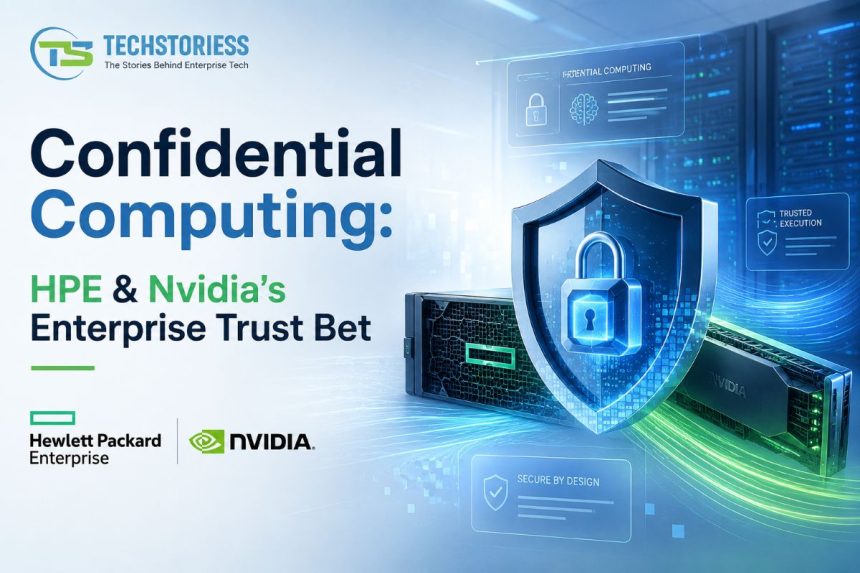
LAS VEGAS – The most important part of the latest AI infrastructure announcement from HPE and Nvidia may not be a GPU, server or networking product.
It may be trust.
At HPE Discover in June, HPE announced that NVIDIA Confidential Computing would be integrated into its AI Factory architecture for at-scale and sovereign deployments. This technology is intended to protect private data and AI models while they are actually being processed, using hardware-based isolation and cryptographic attestation. HPE says the capability will be available for its AI Factory with Nvidia in the fourth quarter of 2026.
From a distance, this looks like another security feature being added to an increasingly elaborate AI infrastructure stack.
However, a different story emerges when you look closer.
HPE and Nvidia may be building a proposition that could matter as enterprises move AI from experimentation into production:
Instead of just giving customers strong AI infrastructure, give them infrastructure they can cryptographically verify and trust.
That distinction is important right now.
The security problem AI created
Conventional enterprise security has largely revolved around protecting data at rest and in transit.
AI introduces a third problem: data in use.
An enterprise may encrypt its database and secure communications across the network, yet the moment sensitive information is processed by a workload, conventional encryption protections can disappear.
Confidential computing attacks that gap.
Nvidia describes its confidential-computing architecture as protecting GPU execution, memory and register states, while using hardware-rooted attestation to establish whether the underlying computing environment can be trusted. Its Blackwell architecture extended confidential computing into GPU workloads, while Nvidia says its newer Rubin architecture represents the third generation of the technology.
That becomes particularly interesting for AI.
The asset being protected isn’t necessarily just a customer’s database. It could be proprietary model weights, prompts, fine-tuning data, customer records, intellectual property or the context accumulated by an autonomous AI agent.
And agents raise the stakes further.
A recent academic survey of confidential computing for agentic AI highlights that agents can hold credentials, persistent memory and sensitive context while interacting with external tools and other agents. It argues that software-only controls can be insufficient against a sufficiently privileged infrastructure attacker, while confidential computing provides a hardware-rooted trust boundary and remote attestation.
That is a fundamentally different security proposition.
HPE isn’t simply adding Nvidia GPUs anymore
The more interesting development is how far the HPE-Nvidia relationship has expanded.
In 2025, the companies introduced an AI Factory portfolio combining Nvidia Blackwell accelerated computing, Spectrum-X networking, BlueField DPUs, Nvidia AI Enterprise software and HPE’s servers, storage, services and software.
By March 2026, HPE was describing the stack in even broader terms: Private Cloud AI systems, networking, storage, confidential computing, AI software and security capabilities, with configurations scaling to 128 GPUs and options for air-gapped deployments. HPE also announced certification work around Fortanix Confidential AI using Nvidia Confidential Computing.
Then came June.
The HPE AI Factory gained Nvidia Vera CPUs, Nvidia Agent Toolkit and expanded Confidential Computing. HPE also integrated Nvidia BlueField and DOCA technologies for zero-trust policy enforcement, runtime threat detection and encrypted networking.
This is beginning to look less like a server vendor putting Nvidia cards into its machines.
It looks more like an infrastructure stack being assembled around Nvidia’s architecture, with HPE increasingly owning the enterprise integration layer around it.
And that distinction is strategically important.
The Juniper piece may be more important than it first appears
There is another development worth connecting.
HPE completed its $14 billion acquisition of Juniper Networks in July 2025, explicitly describing the combination as creating a comprehensive, cloud-native, AI-driven portfolio and a full modern networking stack.
That gave HPE something significant: substantially greater control over the networking layer surrounding AI infrastructure.
Now consider the architecture taking shape:
Nvidia: GPUs, CPUs, DPUs, networking silicon, AI software and confidential-computing capabilities.
HPE: servers, storage, networking, private cloud, services, management and enterprise integration.
The resulting proposition is more than merely “AI compute.” It is increasingly compute + networking + storage + software + security + sovereignty + management.
And confidential computing potentially sits across that stack as a mechanism for establishing trust.
That is where the strategy gets interesting
Enterprises don’t necessarily want to purchase AI infrastructure because it contains the fastest GPU.
Banks, governments, pharmaceutical companies and other highly regulated organizations increasingly need to answer a harder question:
Can I prove what happened to my data while the AI was processing it?
Nvidia’s answer increasingly involves attestation – cryptographically verifying the state of the hardware and software environment. HPE is now incorporating that capability into infrastructure intended for on-premises and sovereign deployments.
That could become a powerful sales proposition.
Instead of asking an enterprise to trust the infrastructure operator, the architecture attempts to let the enterprise verify the computing environment itself.
This is particularly relevant to sovereign AI.
HPE has already been pushing air-gapped and sovereignty-focused configurations, while its partnership with Nvidia includes an AI Factory Lab in Grenoble designed to help European customers validate infrastructure within EU boundaries.
Confidential computing adds another dimension:
Where the data resides becomes only one part of the sovereignty question. Who can technically access it while it is being processed becomes another.
But there is a catch
The technology is not yet a magic security layer.
Nvidia’s own zero-trust architecture documentation acknowledges that confidential computing does not solve every problem. Application vulnerabilities, availability attacks and network-security issues remain outside the protection provided by the TEE itself.
Performance is another unresolved question.
Independent research in 2026 has found measurable overhead in some confidential GPU configurations. One May benchmark using Nvidia H100 GPUs with Intel TDX reported throughput reductions in confidential mode, while a June study examining Blackwell found that the GPU itself could approach non-confidential performance but identified the CPU-GPU confidential bridge as a significant source of overhead in some workloads.
So the industry still has work to do.
But there is another signal that may matter more.
In July, the CNCF accepted Confidential Containers as an incubating project. The project is explicitly designed to protect data in use inside cloud-native environments using hardware-based trusted execution environments.
That suggests confidential computing is moving beyond being a specialized hardware capability.
It is becoming part of the cloud-native software conversation.
And that changes the competitive battlefield
Nvidia is not alone here.
Intel has been developing Trust Domain Extensions and publishing work specifically examining confidential AI performance with Nvidia GPUs. AMD has its own confidential-computing architecture. Cloud providers have been developing confidential VM offerings.
The battleground, therefore, is unlikely to be “who invented confidential computing?”
It is more likely to become: Who can make trusted AI easiest to deploy at enterprise scale? That is where HPE has a potentially interesting position.
Its value is not simply another GPU design. Its value could be making a complicated combination of compute, networking, storage, security, private cloud and sovereignty controls consumable as an enterprise platform.
Nvidia, meanwhile, increasingly controls the underlying AI acceleration ecosystem.
The two positions complement each other unusually well.
The real bet
The most provocative interpretation of the HPE-Nvidia relationship is therefore not that the companies are betting on confidential computing as another security product.
They may be betting that trust itself becomes an infrastructure primitive for enterprise AI.
If that happens, confidential computing could eventually occupy a role somewhat analogous to encryption in modern networking: initially a specialized capability, eventually something enterprises simply expect to be present.
There is still a long way to go.
HPE’s Nvidia Confidential Computing integration isn’t even scheduled to be generally available across the AI Factory until Q4 2026. And the broader research community is still identifying performance, attestation and multi-component trust challenges.
But watch what happens next.
If HPE begins attaching confidential-computing capabilities not just to sovereign AI deployments but to mainstream Private Cloud AI, if Nvidia makes attestation increasingly native across its rack-scale architectures, and if enterprise software vendors start requiring cryptographically verifiable execution environments, the significance of today’s announcements will look very different in hindsight.
The AI infrastructure race may have started with who has the most compute.
It may ultimately be decided by who can convince enterprises that the compute can be trusted.