


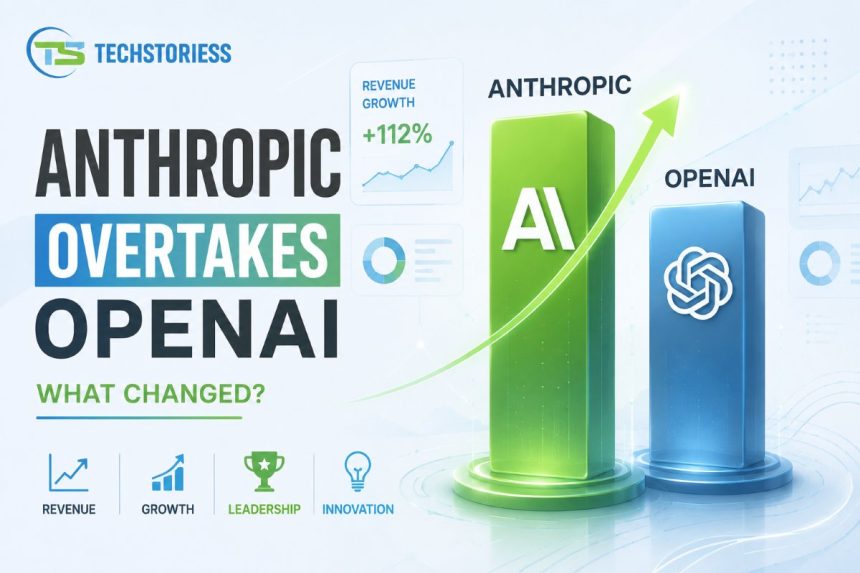
Anthropic’s annualized revenue run rate — a projection of yearly revenue based on the current month’s pace — reached $47 billion as of its Series H funding announcement in late May 2026. That surpassed OpenAI’s reported run rate of roughly $24–25 billion for the same period, a comparison TechCrunch also drew in its coverage of the round. See the full revenue timeline later in this piece for how that gap opened up.
It is the first confirmed revenue crossover between the two companies since ChatGPT’s 2022 launch made OpenAI the category leader. The disclosure, released alongside Anthropic’s funding announcement, points to a broader shift: enterprise contracts, not consumer subscriptions, now generate the larger share of revenue in commercial AI.
The Crossover at a Glance
| Metric | Anthropic | OpenAI |
|---|---|---|
| Annualized revenue run rate (May 2026) | $47B | ~$24–25B (some estimates as high as $33B) |
| Latest valuation | ~$965B (Series H) | ~$852B |
| Profitability status | First profitable quarter projected for Q2 2026; sustained profitability projected around 2028–2029 [3] | Not yet profitable; no timeline before 2029–2030 [4] |
| Growth rate since reaching $1B ARR | ~10x/year initially, cooling to ~7x/year by mid-2025 | ~3.4x/year |
The crossover didn’t come out of nowhere. Analysts had flagged it as plausible well before it happened. Epoch AI’s tracking of both companies found that, comparing growth rates from the moment each first hit $1 billion in annualized revenue, Anthropic was compounding at close to 10x per year against OpenAI’s roughly 3.4x [5]. That gap was wide enough to make a crossover look like an inevitability, not just a possibility — assuming neither company’s trajectory bent sharply. By July 2025, Anthropic’s pace had cooled to roughly 7x annual growth [5]. It didn’t need to sustain the original pace. It just needed to stay ahead long enough.
Enterprise IT departments weren’t surprised by the news. They had already voted with their contracts, and the market had been pricing this in for months. What changed wasn’t the outcome — it was confirmation of a thesis enterprise buyers had been acting on since early 2025.
The Numbers Behind the Crossover
In December 2024, Anthropic reported roughly $1 billion in annualized revenue — a rounding error next to OpenAI’s established lead. Seventeen months later, that figure had climbed to $47 billion. For comparison, Salesforce needed roughly two decades to reach $30 billion in annual revenue. Anthropic covered similar ground in under three years, starting from near zero.
The growth compounded in visible steps:
| Date | Anthropic Annualized Revenue Run Rate |
|---|---|
| December 2024 | ~$1B |
| Late 2025 | ~$9B |
| February 2026 | ~$14B |
| March 2026 | ~$19B |
| April 2026 | $30B+ |
| May 2026 | $47B |
OpenAI’s own figure for the same window has been reported inconsistently, with some estimates placing it as high as $33 billion depending on how consumer subscriptions and enterprise contracts are counted [2][8].
How Consumer Built the Category
For three years, the AI industry measured itself against one metric: who owned the consumer conversation. OpenAI built that scoreboard. ChatGPT became a household name — the fastest consumer software product in history to reach mass adoption.
Consider the pace: Instagram took roughly two and a half years to reach 100 million users. TikTok took about nine months. ChatGPT reached 100 million monthly active users in barely two months — a pace nothing in consumer technology had matched before it.
That dominance created an industry-wide assumption: consumer scale would determine revenue leadership in AI, the same way it had in social media and search. The past eighteen months have complicated that assumption considerably.
Why Enterprise Beat Consumer
Anthropic made a strategic call when it had far less room to maneuver than its rival. It couldn’t compete with OpenAI’s consumer brand recognition or its head start with ChatGPT. Chasing that same audience would have meant competing for lower-margin, subscription-driven revenue.
So it chose a less visible but more durable route: large enterprise contracts. Anthropic focused on code generation, customer service automation, document analysis, and other high-volume, mission-critical workloads — the kind of engagements that renew automatically, scale with usage, and are expensive for a company to unwind once its systems depend on them.
Consumer AI, meanwhile, hit a ceiling many analysts didn’t expect this early. ChatGPT’s user growth was explosive through 2023, then slowed considerably. By the end of May 2026, ChatGPT’s share of the global AI-assistant market had fallen to 46.4%, dipping below the 50% mark for the first time since launch, per Sensor Tower’s tracking [9]. That reflects how quickly consumer appetite for chatbot subscriptions leveled off, even as the underlying technology kept improving. Consumers turned out to be far less willing to pay recurring fees for AI assistance than enterprises were willing to pay for AI infrastructure embedded in their operations.
The scale of that enterprise commitment now shows up clearly in Anthropic’s published numbers:
- Over 300,000 businesses use its Claude models globally
- More than 1,000 customers now spend over $1 million annually with the company — a figure that roughly doubled in under two months as of April 2026, up from a small handful of such accounts just two years earlier
- Roughly 70% of Fortune 100 companies use Claude in some capacity, and 8 of the Fortune 10 are active customers
- Deloitte’s rollout across 470,000 employees stands as the largest single-provider enterprise AI deployment recorded to date [10]
The Profitability Divide
Revenue alone doesn’t tell the full story. How that revenue was earned matters more — and this is where the comparison becomes most useful for anyone allocating enterprise technology budgets.
Anthropic hasn’t grown its top line by chasing scale at any cost. That discipline reflects a different theory of how AI companies become durable businesses. Anthropic told investors it expects to post $10.9 billion in revenue for Q2 2026 — more than double Q1’s $4.8 billion — with roughly $559 million in operating profit, which would mark its first profitable quarter since founding [3]. The company isn’t projecting profitability every quarter going forward; sustained, full-year profitability is generally projected around 2028–2029 [3][12]. OpenAI, despite years of scale advantages, has neither reached profitability nor offered a public timeline before 2029–2030 [4].
This distinction carries weight beyond the headline figures. Sustainable profitability insulates a company from market uncertainty. It can reinvest earnings, weather a funding downturn, and make long-term infrastructure decisions without depending on the next capital raise. An unprofitable company — regardless of brand strength — stays structurally dependent on outside capital to keep operating at its current scale. For a CFO building a five-year vendor roadmap, that difference in financial footing carries more weight than which company has the larger user base.
Anthropic’s capital position has strengthened alongside its revenue. A $65 billion Series H round pushed its valuation to roughly $965 billion , narrowly ahead of OpenAI’s $852 billion following its own $122 billion round in March 2026 [8]. Anthropic has since confidentially filed an S-1, reportedly targeting a potential listing as soon as October 2026 — though nothing has been confirmed on timing .
What This Means for Enterprise Buyers
None of this settles the broader competition between the two companies. OpenAI still holds a commanding lead in consumer mindshare and continues to report strong growth of its own, including a monthly revenue figure that has climbed sharply since ChatGPT’s launch. Consumer mindshare still carries commercial value beyond direct subscription revenue — it feeds distribution, brand trust, and future product adoption in ways enterprise contracts alone cannot. A shift in consumer sentiment could still reshape the competitive picture in either direction.
For now, though, the revenue crossover marks a genuine shift in how the market values two different approaches to building an AI business.
For enterprise technology leaders, the practical takeaway isn’t which company posted the larger quarterly revenue number. It’s what the underlying data reveals about where durable AI revenue actually comes from: not a single breakout consumer product, but hundreds of thousands of contracts embedded deep enough into business operations that switching costs become a genuine barrier to churn. That’s the same pattern enterprise software vendors have relied on for decades. The difference is how quickly Anthropic managed to build it.
Whether OpenAI can replicate that enterprise depth — or whether Anthropic can keep compounding at anywhere near this rate as its growth inevitably matures — will be the more interesting question over the next eighteen months. For now, the numbers say something enterprise buyers have quietly understood for a while: in AI, the largest audience and the largest revenue base no longer belong to the same company