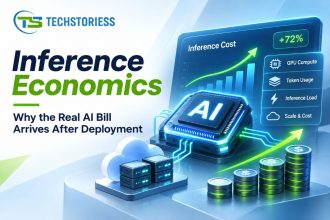



Training gets the headlines and licensing gets the budget line. Running the system every day, at scale, is where the money goes.
When a company approves an AI initiative, the numbers on the table usually cover three things: the licence or API commitment, the build or integration effort, and sometimes a training or fine-tuning cost. They are visible, one-time or contractual, and easy to approve.
The expense that follows is different. Every query, summary, agent step and customer chat triggers a model to run. That activity is called inference, and it is the cost of actually using AI. It grows with success, it is hard to cap, and it often shows up on someone else’s budget line months after the pilot celebration.
For CXOs, the question has changed from “what does it cost to build?” to “what will it cost to run, and what happens to that number when it works?”
Why inference behaves differently
Software costs have traditionally been fixed or nearly so. You paid for a licence or for servers, and extra users added little. AI inference is metered. Cost rises with usage, and usage rises with adoption.
That produces an unusual pattern. A pilot with fifty users looks cheap. A rollout to five thousand users is a hundred times larger, and the real surprise comes when those users find new ways to use the tool. Success is the thing that inflates the bill.
Three features make this harder to forecast than other IT spending:
- Usage is unpredictable. Employees and customers invent new uses nobody planned for.
- Cost per task is not constant. A short question and a long document analysis can differ in cost by a factor of fifty or more.
- Hidden multipliers exist. One user request can trigger many model calls behind the scenes, especially in agentic systems.
The cost drivers most budgets miss
1. Calls per task. A simple chatbot makes one model call per question. An AI agent that plans, searches, checks its work and retries may make ten or twenty. Moving from assistant to agent can multiply cost per task several times over, even if the user sees no difference.
2. Context length. Models charge for what they read as well as what they write. Feeding in long documents, full conversation history or large knowledge bases raises the cost of every call. A system that quietly grows its prompts will quietly grow its bill.
3. Model choice. Larger models cost much more per query than smaller ones. Using the biggest model for every task, including simple ones, is one of the most common and avoidable sources of overspending.
4. Utilization. If you run your own infrastructure or reserve capacity, idle hardware still costs money. Low utilization raises the effective cost of every query you do serve.
5. Reliability and oversight. Retries, guardrails, human review, logging, monitoring and security controls all consume resources. They are necessary, and they are rarely in the original business case.
6. Hardware and memory prices. If you buy or lease capacity, the supply chain matters. Counterpoint reported that global DRAM revenue rose 369% year over year in Q3 2026 on AI data center demand, and TrendForce expects price pressure to continue into early 2027. Infrastructure costs are not guaranteed to fall.
A simple way to forecast: cost per outcome
The most useful shift a leadership team can make is to stop forecasting spend by tool and start forecasting cost per business outcome: per resolved ticket, per processed claim, per qualified lead, per drafted contract.
A basic model looks like this:
Monthly run cost ≈ number of tasks × model calls per task × tokens per call × price per token, plus the overhead of oversight, monitoring, security and support.
Here is an illustrative example. The numbers are made up to show the mechanics, not to reflect any particular vendor’s prices.
Suppose a customer-support assistant handles 500,000 conversations a month. Each conversation triggers 6 model calls averaging 4,000 tokens each, and the blended price is $2 per million tokens.
- Tokens per month: 500,000 × 6 × 4,000 = 12 billion
- Monthly cost: about $24,000
Now change two things without adding a single user. The assistant becomes more agentic and makes 12 calls per conversation. Its prompts grow to 8,000 tokens each because more context is included.
- Monthly cost: about $96,000
That is a fourfold increase from design decisions alone. Neither decision looked dramatic when it was made, and nobody who approved the original budget would have predicted it.
Build scenarios, not a single number
Because usage and design are uncertain, a single forecast will almost certainly be wrong. Finance teams do better with three scenarios:
- Base case: expected adoption and current design.
- Success case: adoption two to three times higher, because the tool works and people use it more.
- Drift case: the same adoption, but with longer prompts, more agent steps and more complex tasks.
The success case is the one boards tend to ignore, and it is the one that causes surprise overruns. If a project would be unaffordable at three times its expected volume, that is worth knowing before launch rather than after.
Controls that keep the bill predictable
Cost forecasting only helps if you can act on it. The most effective levers are practical:
- Route by difficulty. Send simple tasks to smaller, cheaper models and reserve large ones for hard problems.
- Cache repeated work. Many queries and prompts repeat. Reusing answers or prompt components can cut cost significantly.
- Batch non-urgent work. Jobs that don’t need an instant answer can often run at lower prices or at off-peak times.
- Set budgets and limits. Apply per-team or per-application spending caps, rate limits and alerts, so a runaway process cannot spend unnoticed.
- Trim context. Send the model what it needs, not everything available.
- Measure unit cost continuously. Track cost per outcome weekly, not quarterly. Trends show up long before the invoice does.
Who should own the number
One reason inference costs surprise organizations is that nobody owns them. Engineering controls the design, the business controls the usage and finance sees only the invoice. Each group sees a piece.
A workable approach is to assign a single owner for the run cost of each AI system, usually the same person accountable for its business value. Pair engineering and finance in regular reviews, and make unit cost a standard part of the dashboard alongside accuracy and adoption.
Questions every CXO should ask before approving a deployment
- What is the expected cost per outcome, and how was it calculated?
- What happens to that cost if usage triples?
- How many model calls does a typical task trigger, and could that grow?
- Which model is used for which task, and why?
- What caps, alerts and kill-switches are in place?
- Who owns the run cost, and how often is it reviewed?
- At what unit cost does this project stop making business sense?
The last question matters most. Every AI initiative should have a break-even cost per outcome, and teams should know how far they are from it.
The takeaway
AI economics are not a one-time purchase. They are an operating cost that scales with success, and the organizations that handle it well will be the ones that planned for that before launch. Treat inference as a core part of the business case, forecast it by outcome, test it against optimistic scenarios, and put someone in charge of it.
The training bill and the licence fee are the ones you can see coming. The inference bill is the one that decides whether the project is worth running.