


For fifteen years, Siri was considered a punchline. It was the assistant people asked for the weather and then quietly gave up on. Just like a distracted clerk, it couldn’t hear you properly, shrugged, and handed you a web search you could have opened yourself. Soon it became a running joke in the industry, and Apple, a company that takes its reputation for polish seriously, kept quiet about it.
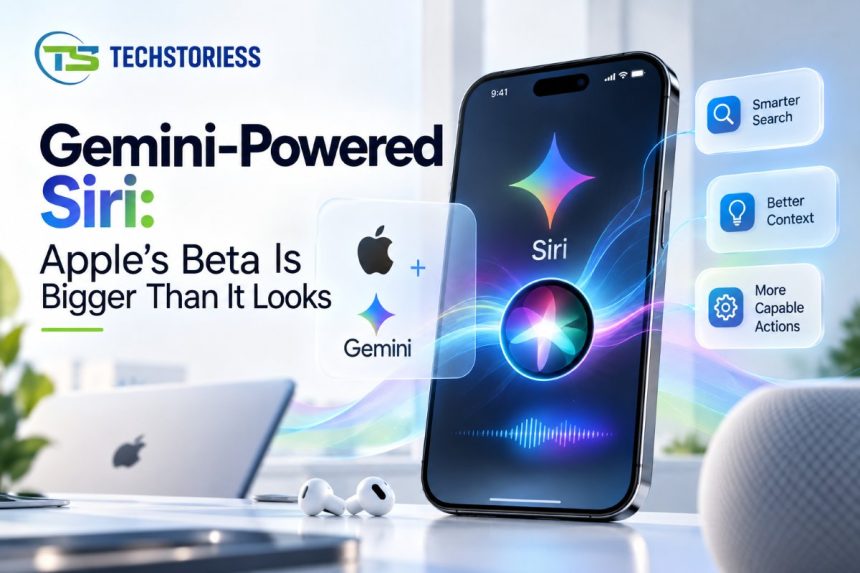
On September 14, 2026, Apple opened a public beta of a new, AI-driven Siri, built to understand personal context and act across apps. The interesting part is where the brain came from.
The rival in the engine room
Apple reveals that behind the new Siri AI sit custom-built models developed in collaboration with Google’s Gemini. In practice, Apple employed Gemini to create smaller, efficient models tuned for Apple Silicon and able to run on the device itself, with heavier requests handled by Apple’s Private Cloud Compute servers. According to reports, the arrangement is worth roughly $1 billion a year, though neither company has confirmed the figure.
For a brand that has always been proud of its “we make it ourselves” ethos, that is a striking admission. Apple looked at the timeline for building a frontier-grade model from scratch and chose to partner with the competitor it has spent years trying to out-innovate.
What you actually get
The pitch is personal context. The new Siri can draw on your messages, emails and photos, and act inside third-party apps including WhatsApp, Audible, Microsoft Outlook, Notability and Tripsy. The developer testing reveals practical, everyday gains: it found specific photos, summarised group chats, and turned an appointment buried in a text into a calendar entry. You can reach it the old way, with “Hey Siri” or the side button, or by swiping down from the Dynamic Island.
None of these tasks would impress a user of today’s chatbots. What is new is where it lives: inside the operating system, next to your actual data, on a device you already carry.
The fine print
The launch is deliberately small and tightly staged. English comes first, and French, Japanese, Korean, Portuguese and Spanish follow a month later. It will not ship on iOS, iPadOS or watchOS in the EU at launch, and China is on hold pending regulatory approval. Two of the world’s most demanding regulatory regimes are missing on day one, and for a company that sells one product to the whole planet, that is a real cost.
Why a CXO should care
There are three reasons.
First, scale. Apple has roughly 2.5 billion active devices, so even a modest share of them on the beta makes this the largest live test of an AI assistant anywhere. Any enterprise pilot looks tiny beside it.
Second, the privacy claim. Apple says that when Private Cloud Compute is used, personal data is not stored by Apple or made accessible to anyone else. That is an architectural promise. Security teams should treat it as a hypothesis to test, especially before staff let it read work email.
Third, the lesson in the partnership. If the most vertically integrated technology company in the world decided to buy capability rather than wait to build it, every leadership team planning an AI stack should ask the same build-versus-partner question, and answer it honestly.
The practical bit
Employees will run this on their phones regardless of IT approval. Now is the time to update the mobile device policy, decide what corporate data an on-device assistant may read, and test how it handles regulated information.
For fifteen years, Siri kept struggling to keep the promise it made in 2011. It may finally keep it, but only because Apple chose not to do it alone.