


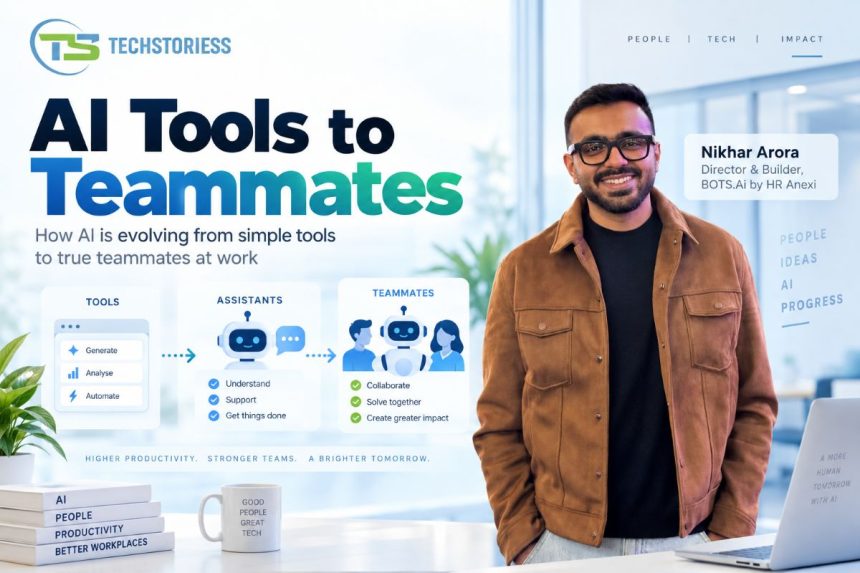
Every conference deck this year carries some version of the same line: AI is moving from tool to teammate. It is a seductive phrase, and like most seductive phrases, it flatters the listener into thinking the hard part is over. Buy the subscription, switch on the agent, and somewhere between the demo and the invoice, a colleague appears. It does not work that way, and India’s own numbers are the clearest evidence of why.
A Big Number That Hides a Small Story
India is routinely described as the world’s second-largest AI market by usage, trailing only the United States. It is the kind of statistic that gets applause at a summit and does little else, because it is mostly a story about population, not proficiency. Measured per person, India falls far down the global table, and even that modest average is generous: the actual usage is concentrated in a narrow band of urban, English-fluent, technology-adjacent professionals. Scale has been mistaken for depth. A billion-plus people downloading an app is not the same as an economy that has learned to think alongside one.
The more interesting data point is not how many Indians use these systems but how well the ones who do use them write to them. Indian professionals who engage seriously with AI tend to instruct it with unusual precision, and their output quality tracks that precision closely. In other words, where the skill exists, it produces results as good as anywhere in the world. The gap is not aptitude. It is distribution.
Why “Teammate” Is a Trap as Much as a Promise
The teammate metaphor is not wrong, but it is dangerous if taken at face value, because a teammate is not something you acquire. It is something you build a working relationship with over time, through friction, correction, and repetition. Nobody expects a new hire to be fully productive on day one; we expect a ramp-up period, mistakes, feedback, recalibration. Yet organisations routinely expect an AI agent to behave like a seasoned employee the moment it is switched on, and then blame the technology when it doesn’t.
This expectation gap gets more dangerous, not less, as these systems become more capable. A chatbot that gives a bad answer to one question is a nuisance you catch and discard in seconds. An agent that plans and executes across five or six steps on a vague brief carries that vagueness through an entire chain of actions before a human ever looks at the output. The more autonomous the system, the more expensive a sloppy instruction becomes. Autonomy does not remove the need for human judgment; it relocates that judgment to the two moments that matter most — the framing of the task before the work begins, and the honest scrutiny of the result once it’s done. Both of those are skills. Neither arrives pre-installed.
The Family Business Blind Spot
Nowhere is this gap more visible than in India’s family-run enterprises, which form the backbone of the country’s private economy. The generational pattern here is almost paradoxical: younger family members are often more enthusiastic about AI than their global counterparts, more willing to talk about it, more curious to try it. Yet fewer of these same businesses actually describe themselves as early adopters in practice. Enthusiasm is concentrated in the boardroom and the family dinner table; it rarely survives the walk down to the shop floor or the back office. Someone senior reads an article, sends a WhatsApp message about “using AI more,” and nothing structurally changes about how work actually gets briefed, checked, or handed off. Instruction travels down the hierarchy easily. Capability does not travel at all, because capability was never built into the system — it lived in one enthusiastic person’s head.
Curriculum, Not Campaign
The instinct in most organisations is to treat this as an awareness problem: run a workshop, invite a vendor, show a demo, declare AI adoption underway. That instinct is the mistake. A workshop is an event with a start time and a certificate at the end. What’s actually required behaves more like language acquisition — something learned inside real, ongoing work, corrected in the moment, repeated until it becomes unconscious. Nobody becomes fluent in a language from a single afternoon session, no matter how good the instructor. The same is true here. Briefing a system precisely and checking its output honestly has to become part of how a role is done, not a separate module bolted onto it.
This is a harder thing to sell than a workshop, because it cannot be finished in a day and it cannot be photographed for a press release. It requires picking real tasks a team already does, running them through an AI system deliberately and repeatedly, and treating the early failures as the curriculum rather than as proof the technology doesn’t work yet.
The Winners Won’t Be the Ones Who Bought First
Every company in India currently has access to roughly the same tools everyone else in the world has access to. Buying an agent, a copilot, or a subscription is no longer a source of advantage, because it is no longer scarce. What remains scarce, and what will actually separate winners from the rest over the next few years, is a workforce that has practiced the specific discipline of directing a system that acts on its own — framing its goals tightly, and refusing to accept a confident-sounding answer without checking it.
India has proven, at the level of the individual power user, that this discipline is entirely achievable and that the results are excellent when it exists. The task now is not to buy more AI. It is to stop treating fluency with it as something that happens automatically, and start treating it as something that has to be taught, practiced, and earned — one team, one task, one corrected mistake at a time.
Article Contributed By Nikhar Arora, Director & Builder, BOTS.Ai by HR Anexi