


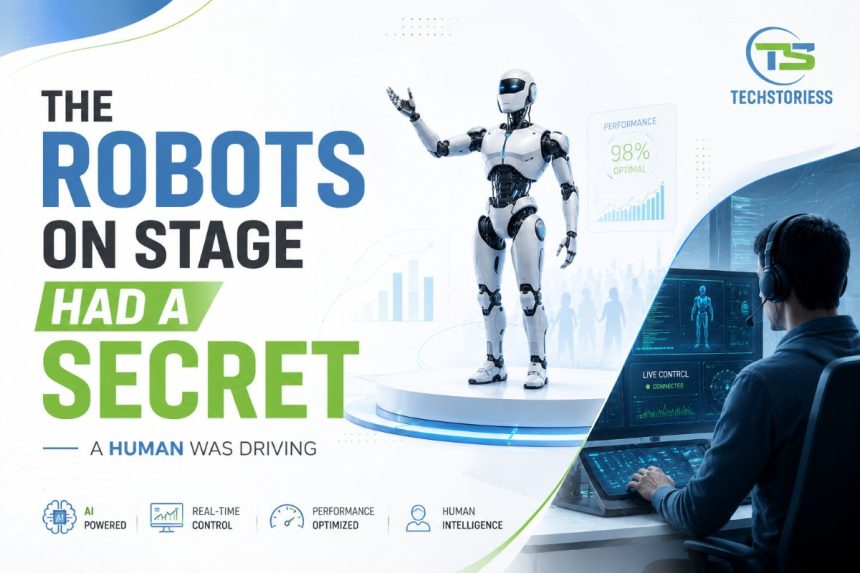
For years, the humanoid robot industry let audiences believe they were watching autonomy. What they were mostly watching was a very good remote-control operator – and the cracks finally started to show.
There’s a moment that keeps happening, over and over, at humanoid robot demos: the crowd gasps, the robot does something uncannily fluid – pours a drink, folds a shirt, plays charades – and for a few seconds, everyone in the room genuinely believes they’ve watched a machine think for itself. Then, weeks or months later, someone quietly confirms what a few sharp-eyed observers already suspected. A human was driving the whole time.
This isn’t a one-off scandal. It’s become close to the industry’s open secret, and 2026 was the year it stopped being deniable.
The Tell: A Hand Reaching for a Headset That Isn’t There
The clearest, most widely circulated version of this story involves Tesla’s Optimus. At the company’s “We, Robot” event, Optimus units mingled with guests, poured drinks, and generally performed with a smoothness that impressed even skeptical onlookers. It later emerged that the robots were being remotely operated by humans the entire time. Tesla didn’t exactly hide this after the fact, but it also hadn’t volunteered it upfront, and the gap between what the audience assumed and what was actually happening became the story.
It happened again. A video of an Optimus folding a shirt drew admiration online – until Elon Musk himself later confirmed it had been remotely controlled. Then, at a Tesla showroom event in Miami, a robot handing out water bottles missed its grab, knocked the table, and stumbled. In the middle of the malfunction, it raised its hands to its head and made an unmistakable motion: lifting an invisible pair of goggles off its face. Commentators immediately recognized the gesture for what it looked like – an operator pulling off their own VR headset in frustration, with the robot mirroring the motion in real time.
A near-identical moment played out on the other side of the world. During a martial-arts robot performance at China’s 2026 CCTV Spring Festival Gala, a robot with no visible headset of its own suddenly raised its right hand and performed the same precise “headset removal” gesture, live on national television. Speculation pointed to an overheating device or a rushed disconnect, but the effect was the same: a machine seemingly reaching up to take off a piece of equipment it shouldn’t know exists, because a person elsewhere was wearing one.
Once you know the gesture, you can’t unsee it.
Teleoperation Isn’t the Scandal – Pretending It’s Not There Is
Here’s the part that gets lost in the “gotcha” framing: teleoperation itself isn’t dishonest, and much of the industry is entirely open about using it. It’s a legitimate, widely used bridge technology, and arguably a smarter one than chasing full autonomy before the hardware and models are ready.
1X uses teleoperation to deploy its NEO humanoid into homes and everyday environments, with human operators guiding its movements while the sessions themselves generate the exact training data needed to make future versions more autonomous. Mentee Robotics runs a leaner version of the same idea in warehouses, where a single operator can oversee several MenteeBot units at once, stepping in only when a robot hits a genuinely uncertain situation. Sanctuary AI has gone a step further, adding tactile sensors to its Phoenix humanoid so operators can actually feel what the robot is touching, which both improves precision and produces richer data for future autonomy training.
At CES 2026, this became a showcase rather than a secret: attendees watched a robot on the exhibition floor being driven, transparently, by an operator sitting in Beijing. Nobody pretended otherwise, and the demo was arguably more impressive for it – real-time, long-distance human control is genuinely hard engineering, even if it isn’t the AGI narrative some companies would rather sell.
That’s the real dividing line in this story. It isn’t “teleoperated robots bad, autonomous robots good.” It’s transparency versus theater. A company that says “this robot is remotely piloted right now, and here’s how that data trains its future autonomy” is doing something legitimate. A company that lets a stage full of gasping investors assume they’re watching independent machine intelligence – and only quietly corrects the record later – is doing something else.
Why the Industry Keeps Doing It Anyway
The uncomfortable answer is that it works. China’s Spring Festival Gala moment – where Unitree, MagicLab, Noetix, and Galbot robots performed backflips, martial arts routines, and precision stunts in front of a national television audience – didn’t just generate viral clips. According to industry observers, it triggered a wave of capital interest, with investors suddenly treating stage performance as a more compelling signal than years of factory-floor pilot programs. Trade shows, celebrity concerts, and viral demo videos have proven, again and again, to be far more effective at generating funding momentum than the slower, less photogenic work of getting robots to reliably do useful tasks in real warehouses and real homes.
That incentive structure explains a lot. A flawless, camera-ready performance raises the next round. A robot that occasionally drops a box in a warehouse pilot does not. So long as investors and audiences reward the illusion of autonomy more than they reward disclosed teleoperation, companies will keep having a reason to blur the line – right up until a hand reaches for a headset that was never supposed to be there.
What CTOs and Enterprise Buyers Should Actually Watch For
For technology leaders evaluating humanoid robotics vendors – whether for warehouse automation, service roles, or research partnerships – this pattern has direct procurement implications, not just entertainment value:
Ask directly what percentage of a demo is teleoperated, and get it in writing. Several credible vendors will answer honestly; treat evasiveness itself as a data point.
Distinguish “teleoperation as a bridge to autonomy” from “teleoperation as permanent architecture.” The former, done transparently, is a legitimate and often smart engineering path. The latter changes your total cost of ownership and staffing assumptions substantially, since a fleet that needs constant human piloting doesn’t scale the way an autonomous one does.
Treat viral stage demos as marketing, not diligence. The gap between a 12-square-meter choreographed stage routine and unstructured real-world deployment remains wide, and vendors know exactly which one photographs better.
Ask what data teleoperation sessions actually feed back into the model. The vendors doing this well – 1X and Sanctuary AI among them – treat every remotely piloted session as training data for future autonomy, which is a meaningfully different value proposition than piloting purely for show.
The Bigger Picture
None of this means humanoid robotics is a con. The underlying hardware – balance control, high-dynamic motion, tactile feedback – has genuinely advanced fast, and teleoperation is a sensible, even necessary, part of getting there. Robots performing best when a human stays somewhere in the loop isn’t a failure of the technology; for now, it may be the most honest path toward eventual autonomy that actually exists.
But the industry has a trust problem it built for itself, one headset-removal gesture at a time. Every time a company lets an audience believe they’ve witnessed independent machine intelligence, and lets the correction arrive quietly, weeks later, buried in a follow-up report, it spends a little more of the credibility the next genuinely autonomous breakthrough will need. The robots on stage had a secret. Increasingly, so does everyone selling them.