


Alongside cloud data centers, the network’s edge is another area where an intelligence revolution is happening. Be it inside cameras, robots, factory sensors, drones, and medical devices – every connected endpoint is becoming a site of local computation and real-time decision-making. This is made possible by edge AI chips: purpose-built accelerators capable of running complex neural networks locally, with minimal power, zero cloud round-trips, and sub-millisecond response times that cannot be simply matched by an internet connection.
This momentum is reflected by statistics as well. The total value of the global edge computing market is approximated at $39.6 billion in 2026 and by 2035 it is projected to exceed $500 billion. By 2030, 75 billion IoT devices are expected to be online and 5G will enable sub-1ms latency at the edge. It creates an urgent demand for capable, efficient on-device inference hardware to sustain competitive advantage.
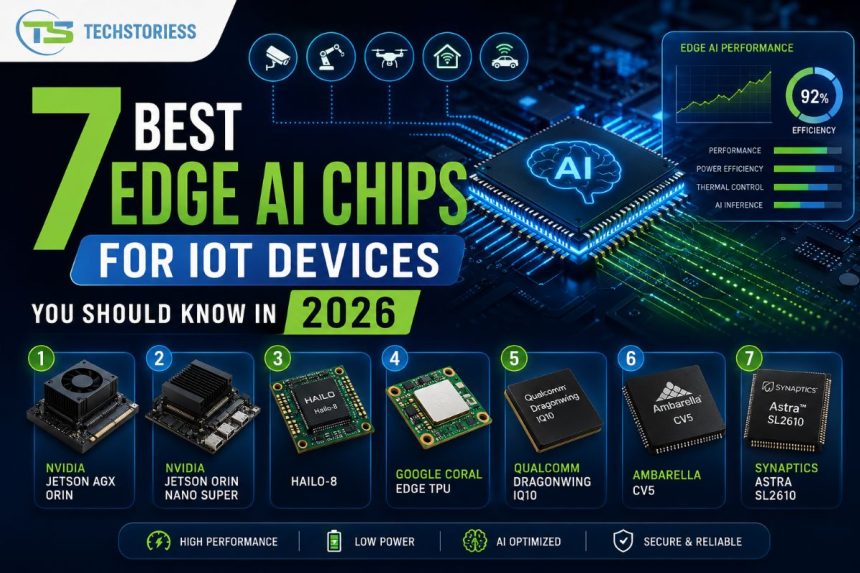
In this guide we cut through the noise to land on the chips that actually matter. Based on deep evaluation of architecture, benchmark data, power profiles, ecosystem maturity, and real-world deployment track records, we have compiled a list of seven edge AI chips that genuinely create value for IoT builders in 2026.
The key question here is which chip gets you production-ready inference fastest, cheapest, and most reliably – without inflating your battery budget.
NVIDIA Jetson AGX Orin
Best Overall Performance, Best for Robotics and Industrial AI
If benchmark dominance is your priority, the NVIDIA Jetson AGX Orin presents itself as the undisputed leader of the embedded AI computing hierarchy, delivering up to 275 TOPS of AI performance. It is a figure that substantially outperforms its predecessors and rivals entry-level data center accelerators deployed just three years ago. It is establishing the benchmark against which every serious edge AI alternative is measured.
The Jetson AGX Orin’s architecture can be compared to a scaled-down version of NVIDIA’s data center DNA: an Ampere-generation GPU strategically combined with dedicated deep learning accelerators and vision processing hardware. More importantly, it runs the same CUDA-X software stack that is utilized across NVIDIA’s full product line. That is a crucial advantage, as it means models trained in the cloud can be deployed at the edge with minimal friction. It dramatically speeds up the production process for developers already invested in TensorRT, CUDA, or NVIDIA’s Isaac robotics platform.
NVIDIA’s leadership claims are confirmed by real-world MLPerf Inference Edge benchmarks. The Jetson AGX Orin consistently ranks at the top of submission tables for image classification, object detection, and medical imaging inference workloads. It offers reliable support for generative AI inference – including large language models with transformer-based architectures. This elevates it to a capability tier that is unreachable for any other embedded module at comparable power envelopes.
The flip side is price and power. AGX Orin consumes 40–60W at the high end of its power profile. It is manageable in a wired or vehicular deployment, but rules out battery-powered field devices. For teams building autonomous mobile robots, smart city cameras, industrial inspection systems, or drone platforms without surging their power budgets, this is possibly the best chip to consider.
Verdict
The chip positions itself as an undisputed edge AI performance champion with unmatched ecosystem depth. It is an ideal solution for use cases where raw capability and NVIDIA software compatibility are non-negotiable.
NVIDIA Jetson Orin Nano Super
Best Developer Entry, Best Value
The “Super” designation is not a marketing gimmick – it is a confirmed firmware-level upgrade. After updating to NVIDIA Jetson Orin Nano Super, the platform delivers AI performance from 40 to 67 TOPS and memory bandwidth from 68 to 102 GB/s – a 1.7× leap achieved without changing the hardware. In the embedded space, that kind of software-unlocked upgrade is exceptionally rare. It indicates how much headroom remains in the Orin architecture.
For IoT, its power profile is genuinely compelling: 7W at minimum mode, up to 25W under full MAXN Super load, with practical single-stream inference workloads consuming 8–12W.
Generative AI support is one of its key differentiating features that sets the Super apart from its predecessor. The Orin Nano Super is capable of running Llama-3.1-8B, vision-language models, and Vision Transformers locally – capabilities that would have required a server rack two years ago.
Verdict
Remarkable generative AI capability at a reasonably affordable price. It can justifiably be called an ideal entry point for serious edge AI development.
Hailo-8
Best Efficiency , Top TOPS/Watt
Hailo-8 is among the finest chips for significantly improving inference efficiency. Rather than following the conventional processor-memory bus design, it is built on a proprietary dataflow architecture that routes data directly through the neural network processing pipeline, eliminating the memory bottleneck that limits conventional chip designs. At as little as 2.5W of typical power consumption, Hailo-8 delivers 26 TOPS, yielding a TOPS-per-watt ratio that is way beyond the capabilities of any general-purpose GPU. This ensures a strategic advantage for always-on vision applications in enclosures with limited thermal headroom or battery constraints.
However, limited ecosystem depth compared to NVIDIA is a major drawback. Though growing rapidly, Hailo’s developer community is still smaller. Teams accustomed to NVIDIA’s extensive pre-trained model library and application frameworks will need to invest effort in building the integration scaffolding required for production deployment. Nonetheless, Hailo-8 is one of the top choices for production deployments where the defining requirement is efficiency per watt.
Verdict
Hailo-8 ranks highest when it comes to inference efficiency. It delivers the best TOPS-per-watt ratio in its class and is especially ideal for always-on vision workloads where power consumption is the major decisive factor.
Google Coral Edge TPU
Best for Ultra-Low-Power Vision , Best TFLite Deployment
Instead of focusing solely on peak TOPS figures, Google’s Coral Edge TPU is purpose-engineered for running TensorFlow Lite int8 models on battery-powered devices with maximum operational life and minimum friction. It delivers 4 TOPS at just 2W of power draw. Capable of executing MobileNet V2 at approximately 400 frames per second, it achieves a throughput figure that sounds like a GPU benchmark and yet runs off a power budget cheaper than many LED indicators.
The Coral USB Accelerator variant can be plugged directly into existing Linux systems via USB 3.0, making it the fastest path to adding ML inference capability to existing platforms like a Raspberry Pi, industrial controller, or existing embedded platform. It doesn’t require any board re-spin, custom firmware, or kernel module compilation. Its plug-and-play simplicity is genuinely valuable for rapid prototyping and field retrofits.
The M.2 A+E key version and the dual Edge TPU (8 TOPS) variant offer additional deployment options for permanent embedded designs. The dual-TPU configuration allows running separate detection and classification networks simultaneously at 8 TOPS combined, enabling multi-model inference parallelism without proportionally spiking thermal or power load.
One of the key restrictions is that the Coral TPU requires TensorFlow Lite models with int8 quantization. Teams working in PyTorch, ONNX, or JAX must invest in conversion and validation before deployment. Compared to NVIDIA, the model zoo available for Coral is narrower, and larger foundation models – particularly generative architectures – cannot be fitted within the Edge TPU’s on-chip memory constraints. If you can accept these limitations, Coral is a relevant option that delivers exceptional value for conventional vision inference on battery power.
Verdict
The go-to for ultra-low-power IoT vision. Unbeatable ease of entry and deployment simplicity make it essential for teams prioritizing rapid integration. Essential for battery-operated deployments that rely on TFLite int8 models.
Qualcomm Dragonwing IQ10
Best 5G Integration , Best for Autonomous Systems
In 2026, Qualcomm introduced its statement product: the Dragonwing IQ10, explicitly positioned as a power-efficient alternative to Jetson for applications not demanding hundreds of TOPS. It reflects a clear strategic logic – you don’t need 275 TOPS for most IoT deployments. What they actually demand is an efficient, well-integrated, connectivity-native compute platform capable of handling multi-sensor fusion, real-time inference, autonomous decision-making, and communication management in a single thermal envelope.
One of the distinguishing characteristics of the Dragonwing IQ10 is its native 5G connectivity. Unlike NVIDIA Jetson, which requires an external 5G modem module, Qualcomm’s platform combines AI compute with high-bandwidth wireless connectivity from the ground up. This is crucially important for applications where the edge device must both process sensor data locally and relay insights upstream in real time – for instance, connected inspection drones, autonomous mobile robots, smart traffic nodes, and vehicular AI systems.
Its heterogeneous architecture – combining the full range of compute elements like Arm CPU cores, an Adreno GPU, Hexagon DSPs, and an image signal processor – enables simultaneous processing of diverse sensor inputs. The platform accommodates up to seven concurrent camera inputs, an important specification enabling 360-degree perception systems for autonomous mobile robots without external multiplexing hardware. Moreover, Qualcomm is continuously expanding its capabilities to become a full-stack platform through its broader acquisition strategy – Arduino, Edge Impulse, and Foundries.io among others.
The Dragonwing IQ10 can be positioned as a viable alternative to the Jetson paradigm for teams building 5G-connected industrial IoT systems or autonomous platforms where both communication and compute are equally important. Having a trusted brand like Qualcomm – which is deeply established across wireless, automotive, and industrial markets – definitely lowers procurement and integration risk.
Verdict
The 5G-native edge AI platform ideal for connected autonomous systems that require unifying communication and compute. For connectivity-first deployments, it is a serious NVIDIA challenger.
Ambarella CV5
Best Computer Vision , Best Automotive ADAS
Ambarella started its journey as a chip designer inside GoPro cameras. Later, the company entered the computer vision SoC market with its proprietary architecture called CVflow, designed from first principles to run neural networks at extreme efficiency per watt. Its most capable CV5 SoC is steadily gaining traction in two demanding verticals: automotive ADAS and high-performance smart cameras.
CVflow didn’t adapt a graphics processor to AI workloads; instead, Ambarella developed a dedicated network processing pipeline fine-tuned for the data flow patterns of convolutional neural networks. For vision-centric workloads, it delivers exceptional inference performance – precisely the tasks needed by most cameras and automotive systems – at low power levels. It makes EV integration viable without compromising range efficiency.
Automotive-grade certification is increasingly decisive in ADAS selection. It is a rigorous and time-consuming process that most embedded AI platforms have not completed. Ambarella’s CV5 comes with the requisite certifications and temperature range specifications for vehicle-grade deployment. That is a qualification not historically met by NVIDIA’s Jetson family, which is designed primarily for industrial and robotics markets, in the automotive domain. For smart city camera systems, the CV5’s image signal processing capability facilitates high-fidelity video analytics at lower power than competitive GPU-based solutions.
Compared to NVIDIA’s broad ecosystem, Ambarella’s software stack is more specialized. For enterprises and teams building dedicated computer vision pipelines rather than general-purpose AI inference platforms, that specialization represents a positive feature rather than a limitation.
Verdict
For computer vision-centric IoT and automotive ADAS, it is the definitive choice. Equipped with its proprietary CVflow architecture, it is highly efficient at delivering exceptional vision inference. In this lineup it claims the strongest automotive credentials.
Synaptics Astra SL2610
Best IoT-Native SoC , Best Smart Appliances
Unlike other chips on this list that focus on robotics, automotive, or industrial infrastructure, the Synaptics Astra SL2610 is designed for a fundamentally different purpose: bringing capable, multimodal AI to the vast middle tier of IoT products like smart appliances, consumer drones, retail point-of-sale terminals, and similar mass-market connected devices that primarily struggle with engineering constraints like cost, integration simplicity, and power efficiency.
Built around dual Arm Cortex-A55 cores, the SL2610 is a purpose-designed IoT processor enhanced by an NPU subsystem for augmented AI inference. It results in a genuinely IoT-native SoC rather than a data center chip squeezed into a smaller package: instead of scaling down from server-class silicon, the architecture starts from the IoT power and cost envelope and builds outward.
Astra is loaded with multimodal capabilities – audio, vision, and touch input processing on a single device – making it the preferred choice for consumer products requiring intelligent user interfaces without cloud dependency. A smart home appliance capable of interpreting spoken commands, reading and interpreting QR codes, and efficiently detecting anomalous states on a single low-power chip represents meaningful product differentiation.
The Synaptics Astra family spans application-processor-class to MCU-level parts, assuring product designers extended flexibility across complexity and cost tiers within a consistent software environment. For teams building consumer IoT products with high-scale manufacturing feasibility at competitive costs, Astra SL2610 is worth evaluating alongside other alternatives.
Verdict
Astra SL2610 is an IoT-native specialist, highly relevant for consumer and commercial products that need multimodal AI within strict cost and power constraints. Purpose-built for the products most people will actually use.
Conclusion
The projected $500 billion edge computing market by 2035 will not be dominated by a single player alone. It will be shaped by specialists with a keen understanding that a surveillance camera, a surgical robot, and a smart refrigerator fundamentally require different compute architectures – and thus probably different edge AI chips. The seven chips covered above don’t compete across the same tier but cover different points along that spectrum.