
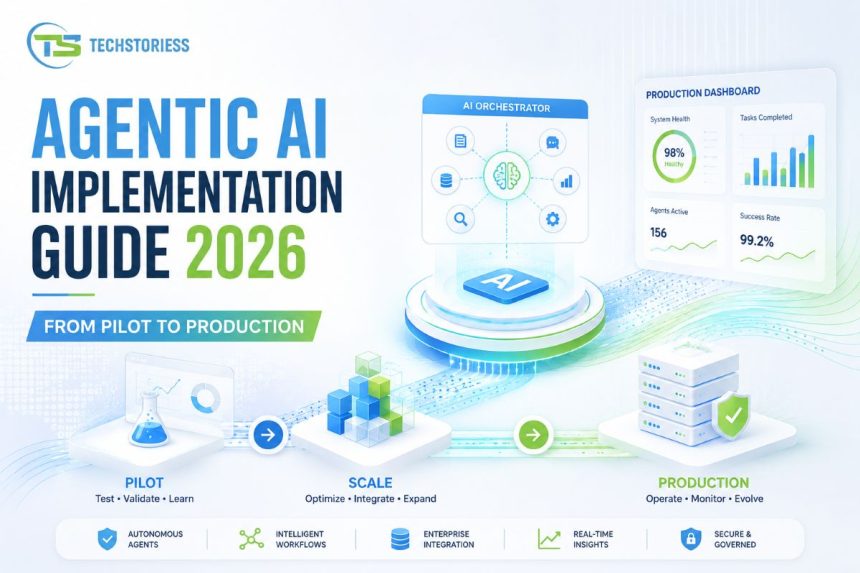
Agentic AI Implementation Guide 2026: From Pilot to Production

Srikanth
By
Srikanth
Srikanth is the founder and editor-in-chief of TechStoriess.com — India's emerging platform for verified AI implementation intelligence from practitioners who are actually building at the frontier....

Key Takeaways

  • Data reveals that 79% of enterprises have adopted AI agents in some form. Out of this, just 31% run the AI agents in production. Gap between experimentation and scale is the defining enterprise technology challenge this year, in 2026.
  • Data also reveals that 88% of AI agent pilots fail to reach production ever. Some of the root causes are scoping and governance failures, and not model failures.
  • Enterprises usually report average ROI of 171% from the deployed agents. The figure is 192% in the US. However, the given ROI is reported only when success criteria, tool access and governance are defined before building begins.
  • Median enterprise underestimates 3-year total cost of ownership by 57%. It is suggested to about 40 to 60% to any vendor quote ahead of finalising a budget.
  • Prompt injection lately is being executed against production AI systems in the wild. It isnot executed just in research papers. Governance is not optional.
  • FAQpage, HowTo page and DefinedTerm page schemas are not made available in every current competitor guide. It is suggested to implement these for an immediate structured-data advantage.
  • Build vs Buy vs Partner decision is supposed to be more nuanced in 2026 compared to that of 2024 or 2025. Platform maturity is not even. This guide is equipped with 12-dimension framework for making the call.
  • It is true that EU AI Act compliance for high-risk agentic systems and this has a hard deadline of August 2026. It is also simultaneously true that most enterprises are not yet ready for it.

What Is Agentic AI? Agentic AI Implementation Guide?

Agentic AI is a software combining large language model with memory, tools as well as a planning loop to get through multi-step tasks autonomously. Generative AI assistant responds to a single prompt and thereafter stops. AI agent, on the other hand, sets sub-goals, selects as well as calls external tools. It evaluates its own results and iterates. All these are done without the need of a human instruction.

The distinction of course matters. This is due to it changes what you are building. GenAI assistant answers questions. AI agent completes workflows. A support chatbot drafts response. Support agent reads ticket, queries CRM, checks account history, applies entitlement rules, drafts resolution, escalates if policy limits are reached and also logs the outcome. All these are done in a single task execution cycle.

Key Fact: According to Gartner, 40% of enterprise applications are to include task-specific AI agents by 2026-end. The figure in 2025 was not even 5%.

Five Capabilities That Define True AI Agent Compared to Chatbot

CapabilityStandard GenAI AssistantEnterprise AI Agent
Natural language understanding✅ Responds to prompts✅ Interprets goals and ambiguity
Tool calling❌ No external system access✅ APIs, databases, SaaS platforms
Multi-step reasoning❌ Single response✅ Plans and executes sequential sub-tasks
Context persistence⚠️ Within session only✅ Across sessions via memory architecture
Autonomous action❌ Waits for each user prompt✅ Acts within governance boundaries until goal is met

How Agentic AI Works: Four-Layer Architecture

It is to note that every production enterprise AI agent runs on four layers. The layers to name are reasoning model, retrieval/memory system, secure tool layer and governance/ policy layer. Removing or under-investing even in one layer means probably production failure.

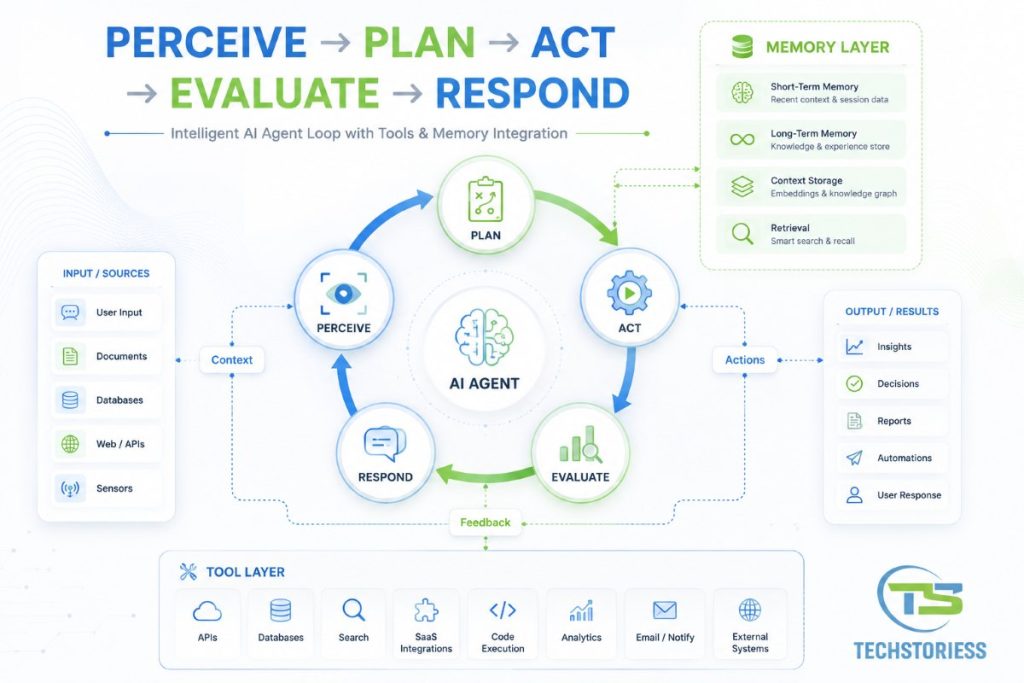
Enterprise AI agent decision loop revealing five phases equipped with tool calling and memory integration

Agent loop is consistent across implementations. Agent perceives an input. It is basically user query, event trigger or scheduled task. It plans by decomposing request into sub-tasks with the help of chain-of-thought reasoning. It acts by calling appropriate tools in sequence. It evaluates whether output really satisfies actual goal. If not, it understands whether reformulating is required. It responds with final answer as well as citation of sources and tools which were used.

The Reasoning-Memory-Tool-Policy Stack

LayerFunctionEnterprise RequirementExample
Reasoning modelInterprets goals, plans steps, generates outputsAccuracy at multi-step reasoning; latency within SLAGPT-4o, Claude 3.5, Gemini 1.5 Pro
Retrieval / memoryProvides current business contextGoverned access; vector DB with access scopingPinecone, Weaviate, Azure AI Search
Secure tool layerExecutes actions across enterprise systemsLeast-privilege permissions; audit trail per callMCP servers, REST APIs, RPA connectors
Governance / policy layerEnforces boundaries, approvals, escalationMandatory before production; not an add-onHITL checkpoints, kill switches, audit logs

What Is MCP? Why Every Enterprise Agent Needs MCP?

MCP stands for Model Context Protocol. It comes from the house of Anthropic and was released in 2024. It is basically an open standard and defines how AI agents communicate with external tools as well as with data sources. It can be considered as USB-C for agent integrations. It is a single protocol and connects an agent to any compliant tool. It does not require a custom integration per system.

MCP matters not because of its protocol for enterprise deployment. It in fact matters because of what governed MCP implementation requires. These are authentication, authorization, rate control, audit trails and durable failure handling. A report by GitGuardian in 2026 found that more than 24,000 unique secrets were exposed in MCP configuration files on public GitHub platform. Over 2,100 in it were confirmed to be valid credentials. Hence, it is a reminder that protocol adoption creates risk without security engineering.

Agent Memory Architecture: Component Most Deployments Get Wrong

Most of the agent failures which are attributed to hallucination are in fact memory architecture failures. The agent does not lack capability. The agent lacks required context to act correctly. Getting memory right is the difference between an agent that scales and on the other hand one that loops, forgets or fabricates.

Enterprise AI agent memory operates across three distinct layers. These layers serve a different function in production:

Short-Term, Long-Term, Episodic Memory. What Each Does in Production?

Memory TypeHow It WorksProduction RoleCommon Failure Mode
Short-term (in-context)Information held in the active LLM context window (8K–200K tokens depending on model)Immediate task context — instructions, current data, this session’s tool resultsWindow fills during long tasks; agent “forgets” earlier context and loops or contradicts itself
Long-term (vector DB)Embeddings stored in a vector database; retrieved via semantic similarity searchPersistent domain knowledge, customer history, policy documentsRetrieval returns irrelevant chunks if embedding quality or chunking strategy is poor; agent acts on stale data
Episodic (interaction history)Structured records of past agent sessions and outcomesLearning from prior interactions; avoiding repeated errorsOften absent entirely — agents repeat mistakes across sessions because no episodic store was implemented

Key Fact: Most prevalent cause of AI agents operating incorrectly in production is data pipeline failures. It is not model capability gaps (OneReach.ai, 2026).

Tool Calling, Orchestration: How Agents Connect to Enterprise Systems

Agent equipped with broad permissions and weak orchestration is not a productivity tool. It is in fact an attack surface. Capability meets risk at tool calling. The design decisions made here determine what an agent can do and simultaneously also what an attacker can make it do.

Tool registry very well defines which external systems an agent can access. Enterprise tool registries should follow similar discipline as IAM systems contain. It is to note that every tool is explicitly permitted and not made implicitly available. Customer service agent requiring to query a CRM does not require write access to billing database. A code review agent requiring GitHub repositories does not require deployment credentials.

Orchestrator-subagent pattern applies to more complex workflows. Orchestrator agent simply breaks down high-level goal into sub-tasks as well as simultaneously delegates each to a specialized subagent. Orchestrator does not execute directly. In fact, orchestrator coordinates, monitors completion and aggregates results. The separation very well provides natural governance checkpoint. Orchestrator can be configured to require human approval before delegating high-risk sub-tasks.

Function calling, which is API format of OpenAI, and MCP servers represent the two main tool integration approaches this year, in 2026. Function calling is documented in a good way and it is widely supported of course. MCP, on the other hand, provides a richer as well as stateful connection model equipped with better support for multi-turn tool use. The standardized interface of MCP reduces cost of adding or replacing tool integrations over time. This is for enterprises building against multiple models or those which are planning to evolve their tool ecosystem.

Multi-Agent Coordination: Architecture Patterns That Scale in Production

Multi-agent systems are not experimental anymore. Multi-agent systems represent 66.4% of enterprise agentic AI deployments in 2026. The figure is claimed by Landbase. Move from single agents to coordinated agent teams cannot be avoided for any workflow spanning multiple business functions. The chosen architecture pattern determines how well the coordination survives production load, edge cases as well as governance audits.

Comparison of hub-and-spoke, peer-to-peer, hierarchical and evaluator-optimizer multi-agent patterns for enterprise deployment

Four patterns have proven production-viable in enterprise contexts:

PatternHow It WorksBest Enterprise FitGovernance Complexity
Hub-and-spoke orchestratorCentral orchestrator delegates to specialized subagentsComplex cross-functional workflows (quote-to-cash, customer onboarding)Medium — centralize controls on orchestrator
Peer-to-peer collaborationAgents of equal status pass work and context between them (CrewAI pattern)Research synthesis, multi-perspective analysisHigh — each agent needs independent guardrails
Hierarchical delegationMulti-level management chain; top-level agent delegates to mid-level, which delegates furtherEnterprise-wide processes with organizational complexityHigh — approval chain matches org chart
Evaluator-optimizer loopOne agent generates; another evaluates and triggers revisionContent quality, code review, compliance checkingLow — contained and auditable

When to Use Single Agent vs Multi-Agent System

Start with single agent. Multi-agent complexity earns cost when workflow requires parallel specialization. This means that when tasks are too long or else these are diverse for one context window. This can also mean when separate specialized capabilities are needed simultaneously.

Decision FactorSingle AgentMulti-Agent System
Workflow lengthFits in one context windowExceeds context window reliably
Specialization neededOne domainMultiple domains simultaneously
Governance requirementSimple — one audit trailComplex — requires coordination logging
Recommended whenLaunching, proving value, internal workflowsCross-functional scale, parallelizable tasks

Key Fact: The guidance of Anthropic on building effective agents states that most successful implementations use simple and composable patterns, and not complex frameworks.

From Pilot to Production: Six Lifecycle Stages (and Where 88% of Deployments Fail)

It is revealed that 88% of enterprise AI agent pilots didn’t ever reach production (Anaconda / Forrester). That is not a model quality problem. It is a scoping, governance as well as ownership problem. Remaining 12% make it to scale and it does three things differently. The three things are that they define success criteria before writing code, they build governance before they need it and they treat production readiness as a gate.

Enterprise AI agent lifecycle showing six stages from scoping to scale with common failure points marked at each transition

Why 88% of AI Agent Pilots Never Reach Production

Root-cause analysis of failed agentic AI deployments from the house of Forrester found three systematic causes. It reveals that 41% of failures trace to unclear success criteria. Teams built something but couldn’t measure whether it worked. Moreover, 33% failed as agent lacked sufficient tool or data access to complete the workflow that it was designed for. Again, 26% failed due to drift in evaluation coverage. The system was tested for narrow conditions but simultaneously also encountered full breadth of production variability. However, none of these are model quality problems. All of them are solvable before building starts.

The Six Lifecycle Stages

StageTypical DurationSuccess CriteriaMost Common FailureDetection Signal
1. Use case selection & scoping2–4 weeksWorkflow mapped; success metric defined; data available confirmedNo measurable KPI agreed before build starts“We’ll know if it works when we see it” in kick-off notes
2. Data and integration readiness3–6 weeksSource systems accessible; data quality validated; permissions scopedData pipelines untested until agent is builtAgent returns null or stale results in first demo
3. Pilot build and controlled testing4–8 weeksAgent completes target workflow with > 90% accuracy on test setScope creep — team adds capabilities mid-buildTimeline doubles; MVP undefined
4. Governance and security review2–4 weeksSecurity controls documented; HITL checkpoints confirmed; audit trail liveSkipped entirely to hit a deadlineSecurity incident within 60 days of launch
5. Limited production rollout4–8 weeks10–20% of target volume; monitoring live; escalation paths testedFull rollout without limited-volume phaseSilent failures accumulate undetected
6. Scale and continuous improvementOngoingVolume targets met; evaluation coverage maintained; model drift monitoredEvaluation set becomes stale; agent degrades unseenUser complaints spike 3–6 months post-launch

Failure Modes Taxonomy — Detection & Mitigation

Failure ModeRoot CauseDetection SignalMitigation
Memory overflowContext window exhaustion during long tasksAgent contradicts earlier steps; loops on completed sub-tasksImplement episodic memory; compress context between stages
Tool permission creepPermissions expanded to fix errors rather than rearchitectedAgent actions outside intended scope in logsQuarterly tool permission audit; least-privilege enforcement from Day 1
Evaluation driftTest set covers 20% of production variabilityAccuracy metrics stable while user complaints riseContinuous evaluation with production samples; monthly test set refresh
Prompt injection entryMalicious instructions in agent-processed contentUnexpected outbound requests; data accessed outside task scopeInput validation at architecture layer; network egress rules; content filters
Governance bypassHITL checkpoints removed for speed; no kill switchHigh-stakes actions executed without approval; audit trail gapsGovernance as code — checkpoints enforced in workflow, not advised in documentation
Unclear ownershipNo designated workflow owner; agent is “owned by IT”No one reviews escalations; agent degrades without responseOne named owner per agent; ownership defined in deployment documentation

Enterprise Architecture Patterns: Five Designs That Survive Production

All the architecture works in a demo. However, all the architecture does not survive in production for 90 days. Below patterns are distinguished by one criterion. These have been deployed at enterprise scale, survived governance audits and continued operating as workflow complexity grew.

Enterprise agentic AI reference architecture with gateway integration layer, federated execution and governance controls

1. Gateway integration model. It is a centralized governance layer that handles authentication, authorization, rate limiting as well as audit logging for all of the agent-tool interactions. Individual agents execute in federated business units. Enforcement point is the gateway. All the tool call passes through it irrespective of which agent is calling. This is pattern Kellton. Similar enterprise integrators use as their default. This is simply because it scales governance without the need of centralizing execution.

2. Agentic RAG. Agent retrieves current business context from vector database ahead of every reasoning step. It is not just at the start of a session. This, in fact, prevents agent from acting on stale knowledge embedded during the trainings. It is effective for any workflow where policy documents, pricing or customer data changes frequently.

3. Microagent mesh. Small as well as single-purpose agents handling one workflow stage are composed into larger processes. Each such microagent is testable, replaceable and governable independently. Research of Anthropic recommends the pattern: It writes that small agents tied to a specific workflow stage are easier to test, govern as well as improve compared to the one that is ‘do everything’ agent with broad permissions.

4. Event-driven agent pipeline. Agents are basically triggered by business events like ticket created, invoice received or threshold crossed. The trigger part is not by user prompts. It is best for high-volume as well as time-sensitive workflows such as fraud detection, supply chain exceptions or IT incident response. It requires robust dead-letter handling and simultaneously also circuit-breaker logic in order to prevent runaway event loops.

5. Human-in-the-loop hybrid. Agent handles routine cases autonomously. The cases are ambiguous, high-value, or high-risk cases. These are routed to human review with full agent context preserved. This is in fact the correct pattern for regulated industries such as banks, insurers and healthcare. Autonomous action creates compliance risk at these regulated industries.

Governance, Security, Compliance: Controls No Enterprise Can Skip

About 41% to 44% of enterprises have not yet implemented basic governance controls for their agents and it also include human-in-the-loop oversight

(Kiteworks 2026 Data Security, Compliance & Risk Forecast). About 55% to 63% lack purpose binding, kill switches or else network isolation. This is not configuration oversight. It is in fact a structural risk.

How Do You Secure & Govern AI Agents to Prevent Prompt Injection & Data Leaks?

Securing enterprise AI agents basically needs five controls. These five controls are least-privilege tool permissions (agents access only what’s required), input validation at architecture level (not just system prompts), runtime content filters for adversarial prompt patterns, network isolation with defined egress rules and complete audit trail for every tool call as well as action taken. NIST AI RMF, ISO/IEC 42001 and other governance frameworks formalize these needs.

Prompt Injection Threat: Why Model-Level Guardrails Are Not Enough

Prompt injection is the top security risk for LLM applications. It has been so positioned in OWASP Top 10 for Large Language Model Applications. It stopped being theoretical in 2026. Researchers at Google and Forcepoint reported that indirect prompt injection is being executed against production systems in the wild.

EchoLeak vulnerability found in Microsoft 365 Copilot demonstrated that a zero-click prompt injection has the capability of accessing as well as silently exfiltrating enterprise data. CVE-2025-53773 revealed that hidden prompt injection in GitHub pull request descriptions enabled remote code execution with GitHub Copilot, carrying a CVSS score of 9.6. This was disclosed in 2026.

Correct response is architectural and not instructional. System prompt that tells an agent “don’t exfiltrate data” is of course not an access control. Regulator asking for proof that the agent was prevented from accessing a specific dataset cannot be answered with a configuration setting. Answer needs to be a logged and enforced boundary such as network isolation, permission scoping and egress rules that prevent unauthorized access physically regardless of what instructions the agent receives.

Direct prompt injection or also commonly known as malicious user instructions is readily understood by most of the security teams. Indirect prompt injection or instructions hidden in content that is processed by the agent autonomously is under-modeled. It usually carries higher enterprise risk.

Enterprise Governance Checklist

Identity and Access Controls

  1. Agent identity registered in enterprise IAM
  2. Treated as privileged service account
  3. Tool permissions scoped to minimum required (least-privilege enforcement)

Tool access reviewed quarterly

Any expansion requires change control

  • Service credentials stored in secrets manager
  • Never in configuration files or code
  • GitGuardian or equivalent scanning on all repositories accessing agent configuration

Audit Trail Requirements

  • Every tool call logged: timestamp, tool name, parameters, result, agent identity
  • Every high-stakes action logged: what was changed, by which agent, authorized by whom
  • Logs immutable and retained per regulatory requirement (minimum 12 months)
  • Log review process defined; anomaly detection configured

Runtime Security Controls

  1. Input validation at architecture layer (not system prompt only)
  2. Runtime content filters for adversarial prompt patterns
  3. Network egress rules: agents cannot make outbound requests to unregistered endpoints
  4. Kill switch: any agent can be paused or stopped without resulting in any production disruption
  5. Purpose binding: each agent has a defined as well as documented scope; action outside scope blocked at infrastructure level

Incident Response

  1. AI-specific incident response playbook created. It basically covers prompt injection, data exfiltration and agent hijacking0
  2. Escalation path defined: who is notified when agent takes unexpected action
  3. Containment procedure: how to isolate compromised agent without disrupting other systems
  4. Post-incident review process includes evaluation set update

Governance Structure

  1. AI governance committee or owner designated
  2. Agent inventory maintained like name, scope, owner, last reviewed
  3. Human-in-the-loop checkpoints defined for all high-risk decision types
  4. Ethics and bias review for customer-facing agents

EU AI Act Compliance for Agentic Systems: What Changes in August 2026

The compliance deadline for high-risk AI systems is August 2026 with respect to EU AI Act. Such agentic systems are classified as high-risk under Annex III which perform biometric identification, influence access to education, employment, credit, insurance or essential services, or else operate in safety-critical environments. High-risk classification is likely for most enterprise deployments such as HR, finance and healthcare.

High-risk classification basically triggers four concrete requirements. The requirements are technical documentation (30-item specification covering purpose, training data, architecture and limitations), conformity assessment before market deployment, post-market monitoring system as well as human oversight mechanism allowing natural person to intervene or stop system. Last requirement is kill switch under legal mandate.

A report by VentureBeat in April 2026 writes that the first procurement question enterprises should prepare for their next vendor renewal is: “Show me your quantified injection resistance rate for the model version I run.” Document refusals for EU AI Act high-risk compliance records.

Enterprise Use Cases by Department: Where Agentic AI Delivers Fastest ROI

Fastest ROI from enterprise AI agents comes from high-volume as well as rule-rich workflows where cost of human handling is measurable and simultaneously quality of agent output is verifiable. Customer service automation delivers ROI in the time period of about 2 to 4 months. Similarly, the supply chain orchestration takes about more than 12 months. It is suggested to start where verification is easy and simultaneously the impact is clear.

Agentic AI use cases across six enterprise departments with ROI benchmarks and deployment timelines
DepartmentPrimary Agent FunctionTime to ROIBenchmark ImpactNamed Example
Customer ServiceTier 1 support automation, ticket routing, resolution drafting2–4 months60–80% ticket deflection; $500K–$2M annual savingsKlarna: 853 FTE equivalent, $60M saved
Sales & MarketingLead qualification, intent scoring, pipeline management3–6 months4–7x conversion rate improvement (Landbase)AI-driven outreach automation
Finance & APInvoice processing, PO matching, approval routing, anomaly flagging4–8 months40–70% cost reduction in AP processing$20K–$60K to implement; 6–12 month payback
IT Service ManagementTicket triage, resolution suggestion, incident routing, change management4–8 months30–50% reduction in mean time to resolutionAI agent resolution in 12-week implementations
HR & TalentPolicy Q&A, onboarding automation, interview scheduling, benefits queries3–6 months25–40% reduction in HR query volumeInternal workforce automation
Supply ChainDemand forecasting, supplier risk monitoring, exception management12–18 months15–25% inventory optimization; SLA improvementComplex integration; longer payback

Key Fact: IBM’s May 2025 CEO study found that 61% of the CEOs are actively adopting AI agents and they are also preparing to implement it at scale.

Five-Phase Implementation Framework: From Strategy to Scale

Do remember this that enterprises that move from pilot to production fastest are obviously not the ones which are equipped with the best models. In fact, they are the ones that completed data as well as implemented governance readiness before model was ever selected. Hence, it can be said that phase sequence matters more than technology choice.

Enterprise agentic AI implementation roadmap showing five phases from strategic assessment to production scale with timeline and cost indicators

Phase 1: Strategic Assessment and Use Case Scoping

Entry criteria: Executive sponsor named; business problem defined in measurable terms.

Identify workflows with three characteristics. These are high volume that is enough to measure, sufficient rule-richness that is enough for agent to succeed and simultaneously also a clear success metric that is defined before development starts. Big mistake at this phase is selecting a use case as it sounds impressive and not that it is tractable.

Typical duration: 2–4 weeks | Cost: Internal time only | Success criteria: Target workflow documented; KPI agreed; data availability confirmed; one workflow owner named.

Phase 2: Data and Integration Readiness

Entry criteria: Use case scoped; data sources identified.

This phase comparatively kills more projects as teams discover it at a very late stage. Every data source that is to be accessed by an agent need to be tested for accessibility, quality as well as permission scoping ahead of the start of agent development. Integration per enterprise system costs somewhere between $5,000 and $20,000. Complex environments see integration costs reach 30% of the total project budget, if believed to report of Acceldata 2026.

Typical duration: 3–6 weeks | Cost: $20K–$80K (integration work) | Success criteria: Agent can read/write all required systems in test environment; data quality validated; access controls documented.

Phase 3: Build, Configure, Pilot

Entry criteria: Data layer ready; governance framework drafted.

Technology choices are made here i.e. Build (LangChain + CrewAI + in-house), Buy (Agentforce, Copilot Studio) or Partner (managed vendor implementation). The Build/Buy/Partner decision framework (OD-1 below) provides 12-dimensional scoring methodology for making the call objectively.

Typical duration: 4–8 weeks | Cost: $30K–$200K depending on tier | Success criteria: Agent completes target workflow with > 90% accuracy on representative test set; failure modes documented.

Phase 4: Governance Review, Security Hardening

Entry criteria: Pilot working; governance checklist in Section 8 initiated.

This phase usually is skipped. However, it is a truth that its absence is most common cause of security incidents within 60 days of launch. Every item in the governance checklist (Section 8) needs to be verified ahead of granting access to production. EU AI Act high-risk assessment need to be completed here.

Typical duration: 2–4 weeks | Cost: $20K–$50K (security engineering, compliance review) | Success criteria: All 39 governance checklist items verified; audit trail live; HITL checkpoints tested.

Phase 5: Limited Production Rollout and Scale

Entry criteria: Governance review passed; monitoring live.

It is suggested to start with 10% to 20% of target volume. It is basically a risk management decision. Silent failures accumulate in this phase. Evaluation set drift is most common reason where metrics of agent look stable on one hand and user satisfaction falls on the other. Plan monthly evaluation set refreshes from the start.

Typical duration: 4–8 weeks (limited); ongoing (scale) | Ongoing cost: $25K–$150K/yr | Success criteria: Volume targets met; error rate within SLA; escalation paths exercised and documented.

The Enterprise AI Readiness Scorecard (5 Dimensions)

Rate each dimension 1–5 before committing to Phase 1.

Dimension1 (Not Ready)3 (Partial)5 (Ready)Your Score
Data readinessData in silos; quality unknownKey sources identified; access partialAll sources accessible; quality validated; pipelines tested/5
Integration depthLegacy systems; no APIsSome API access; manual integration requiredAPI-first architecture; MCP or standard connectors/5
Governance maturityNo AI governance; no policiesAd hoc policies; no formal frameworkFormal AI governance; NIST or ISO alignment/5
Skills and talentNo ML/AI engineering capabilitySome data science; no agent deployment experienceEngineering team with agent deployment track record/5
Executive sponsorshipNo visible C-suite supportIT/ops buy-in; no board visibilityNamed C-level sponsor; board-level KPIs/5

Score interpretation: 20–25: Ready for enterprise deployment. 14–19: Start with a departmental pilot. Below 14: Address foundations first — agents will not fix data and governance problems.

The 5-Stage Maturity Model: Where Is Your Organization Today?

StageLabelCharacteristicsPrimary BlockerNext Step
1AwareExploring AI agents; no deployments; evaluating platformsRisk aversion; unclear ROIRun a scoped 8-week pilot in one department
2Experimenting1–3 isolated pilots; no production deployment; governance absentData readiness; security concernsDefine governance framework; complete Phase 2 readiness
3Scaling1–2 agents in production; dept-level governance; early measurementCross-system integration; change managementExpand governance; add monitoring; second use case
4GovernedMultiple agents in production; formal governance; cross-dept rolloutSkills gap; evaluation rigorInvest in evaluation infrastructure; continuous improvement
5Autonomous EnterpriseAI agents embedded in core operations; continuous learning; board-level metricsRegulatory complexity; multi-agent coordinationMulti-agent architecture; jurisdictional compliance
 Enterprise agentic AI maturity model showing five progression stages with characteristics and transition requirements

Change Management: Why Most Deployments Stall After Go-Live

Change management costs are usually underestimated in enterprise AI agent projects. Technical deployment succeeds; Adoption fails.

AI Champions model — embedding one enthusiastic as well as trained advocate in each affected department and not run a single all-hands training. It is the most consistently cited success factor in enterprise AI adoption after mortems. These are not IT staff. They are basically peer advocates within the business unit. They are those who demonstrate workflows, field questions from colleagues and identify escalation issues.

Design training by role and not rather by technology. Customer service representative using AI agent is supposed to know what agent can do, what agent cannot do, what action to take when agent makes mistake and of course who to contact in such situations. They are not supposed to understand transformer architecture. Communications that answer “what changes for me specifically” before launch reduce resistance materially. The budget is somewhere between $30,000 and $100,000 a year for ongoing change management and training (ssntpl.com, 2026).

Total Cost of Ownership: Budget Reality Every Enterprise Must Face

About 57% of median enterprise underestimates 3-year total cost of ownership for AI agent deployment. Korvus Labs’ 2026 enterprise agent TCO study reveal that mid-complexity customer operations agent costs about €368,000 over the time period of three years when it is fully accounted for — compared to the €158,000 a typical naive estimate produces. Gap does not come from one large hidden cost. It actually accumulates from dozen underestimated line items which are predictable and avoidable with right budgeting discipline.

How Much Does Enterprise AI Agent Implementation Realistically Cost in 2026?

Enterprise AI agent implementation costs somewhere between $10,000 and $50,000 for single workflow. It is a starter tier. The costs may cross $500,000 for enterprise-wide multi-agent systems. Total cost of ownership for three years is 40–60% higher compared to initial build quotes. Korvus Labs‘ 2026 TCO study reveals that the median enterprise underestimates 3-year costs by 57% equipped with ongoing inference as well as governance that adds about $60,000 to $200,000 a year.

Bar chart showing 3-year total cost of ownership across four enterprise AI agent deployment tiers from Starter at $34K to Scale at $2.5M+

The 4-Tier Cost Model

TierScopeUpfront Build CostYear 1 Operations3-Year TCO
StarterSingle workflow; SaaS platform; one department$10K–$50K$8K–$24K/yr$34K–$122K
DepartmentalMulti-workflow; one business unit; platform + custom integration$50K–$150K$25K–$60K/yr$125K–$330K
EnterpriseCustom multi-agent; cross-department; full governance stack$150K–$500K$60K–$150K/yr$330K–$950K
ScaleEnterprise-wide; multi-BU; proprietary model fine-tuning$500K+$150K–$500K/yr$950K–$2.5M+

Hidden Costs That Blow Enterprise AI Budgets

Initial development represents only 25 to 35% of 3-year total costs (Airbyte 2026 framework analysis). Remaining 65 to 75% accumulates in operational costs and this is omitted by most business:

Cost CategoryTypical RangeEnterprise Caveat
Integration per enterprise system$5K–$20K eachComplex environments: integration costs reach 30% of total project
LLM inference / API tokens8–15% of 3-year TCOA ReAct-style agent triggers 5–8 LLM calls per task; a single complex ticket = 30K–70K input tokens
Governance and compliance tooling$10K–$50K/yrRegulated industries cost more; EU AI Act adds technical documentation + conformity assessment
Change management and training$30K–$100K/yrOngoing; not a one-time cost; AI Champions model adds permanent program overhead
Prompt engineering and QA$1K–$2.5K/monthOngoing; model updates require revalidation
Fine-tuning (if required)$10K–$50KCreates maintenance obligation on every model update

Practical rule: Add 40 to 60% to any vendor quote for true 3-year TCO. Vendor quote of $80,000 implies a 3-year budget of $230,000 to $320,000 minimum.

Platform Comparison: Copilot Studio, Agentforce, ServiceNow, CrewAI, Custom-Built

Ther is no single platform that wins on all enterprise evaluation criteria. Right choice obviously depends on your existing stack, governance requirements, integration depth and whether your use case needs customization that configuration layer of a SaaS platform cannot reach.

OD-3 — Platform Evaluation Matrix: Five Platforms Scored Across Ten Enterprise Criteria

Scoring: ★ = 1 (poor) to ★★★★★ = 5 (best-in-class). Scores represent enterprise-context evaluation as of Q2 2026.

Evaluation CriterionMS Copilot StudioSalesforce AgentforceServiceNow AI AgentsCrewAI (open-source)Custom-Built
3-Year TCO★★★★ (predictable SaaS pricing)★★★ (Salesforce licensing compounds)★★★ (ServiceNow seat costs apply)★★★★★ (infrastructure only)★★ (highest labor cost)
Speed to first deployment (weeks)★★★★★ (2–4 weeks)★★★★ (4–8 weeks)★★★ (8–16 weeks)★★★ (4–8 weeks for skilled team)★★ (12–24 weeks)
Enterprise governance depth★★★★ (Microsoft Purview, strong audit)★★★★ (Agentforce Trust Layer)★★★★★ (deepest compliance controls)★★ (framework only; you build governance)★★★★★ (full control; you build what you need)
Multi-agent orchestration★★★ (Magentic-One; improving)★★★★ (Agentforce 2.0 digital labor platform)★★★ (Process automation focus)★★★★★ (designed for multi-agent)★★★★★ (full architectural control)
Integration breadth★★★★★ (Microsoft 365 + 1,000+ connectors)★★★★★ (Salesforce ecosystem + MuleSoft)★★★★ (IT/ITSM systems best-in-class)★★★ (framework; connectors by hand)★★★★★ (connect anything)
Regulatory compliance readiness★★★★ (SOC 2, HIPAA BAA, EU AI Act support)★★★★ (Shield; HIPAA; SOC 2)★★★★★ (GRC native; FedRAMP)★★ (framework only; compliance is yours)★★★★ (if engineered correctly)
Security controls (injection, audit)★★★★ (MSFT investment post-EchoLeak)★★★★ (Trust Layer; Einstein Trust)★★★★★ (IT security native)★★ (no built-in security layer)★★★★ (engineering-dependent)
Customization ceiling★★★ (Power Platform limits)★★★★ (Apex + Flow; limits at edges)★★★ (ServiceNow config model)★★★★★ (code-level control)★★★★★ (unlimited)
Vendor lock-in riskHigh — Microsoft ecosystemHigh — Salesforce ecosystemHigh — ServiceNow ecosystem★★★★★ Low — open-source★★★★★ Low — you own it
Human-in-the-loop controls★★★★ (approval flows native)★★★★ (human escalation built-in)★★★★★ (ITSM approval chain native)★★★ (requires custom implementation)★★★★★ (full design control)
Weighted Enterprise Score38/5038/5038/5032/5038/50

Guidance for regulated industries: ServiceNow AI Agents leads for security and compliance depth. They are particularly known in financial services and government. Microsoft Copilot Studio leads for Microsoft-stack enterprises. Similarly, Salesforce Agentforce leads for CRM-centric workflows. Salesforce platform is of course the system of record. CrewAI and custom builds need engineering maturity. It is to note that governance and security are your responsibility from the ground up.

Question for enterprise technology leaders in 2026 is not whether to deploy agentic AI. The basic question is how to build deployment that compounds in value and not compound in technical debt. Four trends basically will define which enterprises win the compounding advantage and these are as briefed below:

1. Multi-agent orchestration as default architecture. Multi-agent systems represent 66.4% of enterprise deployments as revealed by Landbase 2026. Single-agent deployments will be the exception by 2028. The implication: governance frameworks designed for single agents require multi-agent audit trail and coordination logging designed in now, ahead of retrofit becoming expensive.

2. Agent-to-agent protocols and interoperability. MCP standardization is gradually accelerating. Next evolution is Agent-to-Agent (A2A) protocols. This A2A will allow agents from different vendors as well as different platforms to coordinate without a human-designed integration layer. This creates capability opportunities and simultaneously also security risks. Every external agent communicating with your agent is a potential injection vector.

3. Continuous learning agents replacing static deployment models. The current model is to train, deploy, monitor for drift and retrain. The model is being replaced by such agents which update knowledge on a continuous basis from production feedback. This lowers maintenance cost to a great extent and also improves accuracy over time. However, it requires robust guardrails on what the agent can learn and from whom the agent can learn.

4. Digital labor accounting. Finance teams are to treat AI agent capacity as labor resource. The agent is not a software cost now. Gartner predicts that CFOs will manage AI agent headcount alongside human headcount by 2027. This will change the way ROI is measured, the way agents are governed and also the way output is audited. Organizations that build agent observability now need audit trail for the accounting model.

Original Research and Data: Four Frameworks Enterprise Teams Can Use Today

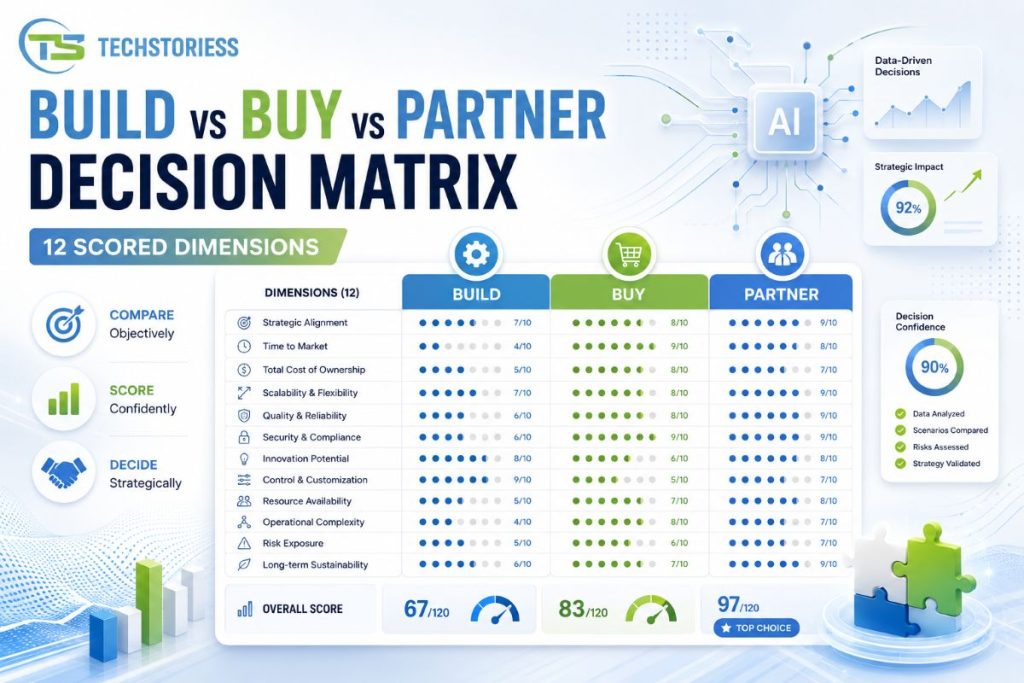
Build vs Buy vs Partner: 12-Dimension Decision Framework

Build vs Buy vs Partner decision in 2026 is more nuanced compared to what it was about two years ago. Enterprise agentic platform market has lately matured to a significant level. However, it has not matured uniformly. Some capabilities have market solutions. Others are still in early-stage or else bespoke. Framework gives technology leaders a replicable scoring methodology for making decision objectively.

Scored comparison matrix for Build vs Buy vs Partner agentic AI deployment approaches across 12 enterprise dimensions

Methodology note: Each dimension is scored 1–5 per option (1 = significant disadvantage, 5 = clear advantage). Weights are set by enterprise priority — adjust to reflect your context.

DimensionBuild (Custom)Buy (SaaS)Partner (Managed)Weighting
3-year TCO★★ (highest labor)★★★★ (predictable)★★★ (labor + license)High
Speed to value (weeks)★★ (12–24 wks)★★★★★ (2–8 wks)★★★★ (4–12 wks)High
Governance depth★★★★★ (full control)★★★★ (platform controls)★★★★ (vendor + custom)High
Scalability★★★★★ (engineering-only limit)★★★★ (platform limits apply)★★★★ (hybrid)Medium
AI risk surface★★★ (you own it)★★★★ (vendor accountability)★★★★ (shared accountability)High
Integration effort★★★★★ (build exactly what’s needed)★★★ (connector gaps exist)★★★★ (vendor handles)Medium
Customization ceiling★★★★★ (unlimited)★★★ (config layer limits)★★★★ (extends platform)Medium
Vendor lock-in★★★★★ (none)★★ (high)★★★ (partial)Medium
Skills requirement★★ (high — ML + DevOps)★★★★★ (low)★★★★ (medium)High
Change management burden★★★ (higher — custom UX)★★★★ (familiar interface often)★★★★ (guided rollout)Medium
Audit trail quality★★★★★ (exactly as designed)★★★★ (platform standard)★★★★ (platform + addenda)High
Regulatory readiness★★★★ (engineering-dependent)★★★★ (vendor-certified)★★★★★ (vendor + advisor)High
Weighted Total (illustrative)41/6047/6048/60

Decision tree:

  • Build when capability represents genuine competitive differentiation and cannot be replicated by a platform — proprietary data models, industry-specific reasoning unique to your operation.
  • Buy when platform solution meets requirements for functionality, governance, integration depth and deployment flexibility. You also need production speed.
  • Partner when use case is of high-value and also of high-complexity. Simultaneously your team lacks engineering depth or governance expertise to execute build safely. You therefore need the speed of a buy.

3-Tier ROI Framework: Calculating Your Return Before You Build

What ROI Can Enterprises Expect from Agentic AI Deployment?

Enterprises report average ROI of 171% from agentic AI deployments. U.S. companies are achieving average ROI of 192% (Landbase 2026). The leap is about three times compared to traditional automation. Time to ROI ranges from two to four months for customer service automation. It is 12+ months for supply chain. It is found that 74% of enterprises achieve positive ROI in just one year of time. It is to note that success depends on clear success criteria and not in model quality.

Full ROI Formula:

Total ROI (%) =

  [(Tier 1 Direct Savings + Tier 2 Productivity Gains + Tier 3 Revenue Impact)

   – Total 3-Year Cost]

  ÷ Total 3-Year Cost × 100

Where:

Tier 1 Direct Savings =

  (Automated FTE-hours × blended hourly rate)

  + Error cost reduction

  + SLA penalty avoidance

Tier 2 Productivity Gains =

  (Developer velocity gain × loaded developer cost)

  + Decision speed improvement value

  + Cycle-time compression value

Tier 3 Revenue Impact =

  AI-driven pipeline additions

  + Churn prevention value

  + Upsell increments from AI-assisted engagement

Assumptions:

  • Blended enterprise FTE cost: $80–$120/hr (US); £50–£80/hr (UK); €40–€70/hr (EU)
  • LLM inference cost: 8–15% of total 3-year TCO
  • Governance overhead: $10K–$50K/yr
  • ROI calculation horizon: 36 months (Year 1 investment-heavy; Year 2–3 return-heavy)

Worked example — mid-market customer service deployment:

VariableValue
Company size500 employees; 12,000 support tickets/month
Agent scopeTier 1 support automation (60% of volume)
Upfront build cost$45,000 (Starter tier — Copilot Studio)
Year 1 operations$18,000
3-Year TCO$99,000
Tier 1 savings: FTE hours automated7,200 tickets/month × 12 min avg × $0.93/min = $80,352/yr
Tier 2: Customer escalation reduction$15,000/yr (senior agent time freed)
Total 3-yr benefits$285,000
Total ROI(285,000 – 99,000) ÷ 99,000 × 100 = 188%

ROI by deployment type:

Deployment TypeTime to ROIAvg ROI at 18 MonthsSource
Customer service automation2–4 months145%Landbase 2026
Sales operations3–6 months198% (US)Landbase 2026
IT service management4–8 months120%OneReach.ai 2026
Finance/AP processing6–12 months110%ProductCrafters 2026
Supply chain orchestration12–18 months87% (Year 1)Korvus Labs 2026
Waterfall chart showing agentic AI ROI accumulation across direct savings, productivity gains, and revenue impact over 24-month deployment horizon

Frequently Asked Questions

What is agentic AI? How is agentic AI different from standard GenAI assistants? Agentic AI is a club of large language model with memory, tools and planning loop. It is capable of completing multi-step tasks autonomously. It does not require human prompt at each step. Standard GenAI assistants, on the other hand, answer one question and stop. AI agent here basically sets sub-goals, calls external systems, evaluates results and iterates until a workflow is complete.

What is difference between AI agent and traditional RPA automation?

RPA follows fixed rules like if X, do Y. An AI agent interprets context, handles ambiguity and adapts when conditions change. UiPath CEO Daniel Dines described agentic automation as “natural evolution of RPA”. RPA handles structured as well as predictable tasks. Agents handle unstructured as well as contextual workflows where judgment is required.

What is multi-agent orchestration? When does enterprise need it?

Multi-agent orchestration coordinates with several specialized AI agents within just a single workflow. An enterprise needs multi-agent orchestration when a task is too long or else too complex for context window of one agent. It may also need when parallel specialization is required. Multi-agent systems represent 66.4% of enterprise deployments in 2026 (Landbase).

What is MCP (Model Context Protocol)? Why it matters for enterprise deployment?

MCP is an open standard and comes from the stable of Anthropic. MCP defines the way AI agents communicate with external tools and also with data sources. It matters for enterprise as it standardizes integrations. Single protocol connects agents to any compliant tool. It reduces integration cost. Enterprises need to simultaneously also implement governed MCP: authentication, audit trails and egress controls as misconfigurations have exposed more than 24,000 secrets on public GitHub (GitGuardian, 2026).

How does agent memory work? Why it fails in production?

Enterprise AI agents basically use three memory types. These are short-term (in-context window — current session), long-term (vector database — persistent domain knowledge) and episodic (interaction history — learning from prior sessions). Most production failures take place when short-term memory fills during long tasks. Agent here loses earlier context. The failures may also occur when long-term retrieval returns irrelevant chunks due to poor embedding strategy.

Cluster B — Enterprise Deployment

How much does enterprise AI agent implementation realistically cost in 2026?

Costs usually range between $10K and $50K for a single-workflow Starter deployment. It is more than $500K for enterprise-wide systems. Three-year TCO runs about 40 to 60% above initial build quotes. Korvus Labs’ 2026 TCO study reveals that median enterprise underestimates 3-year costs by 57%. Ongoing inference, governance and change management add somewhere between $60K and $200K a year.

What ROI to expect from agentic AI deployment by enterprises?

Enterprises report average ROI of 171% from agentic AI (U.S.: 192%). It is about three times compared to traditional automation returns (Landbase 2026). About 74% achieve positive ROI in just one year. Customer service automation reaches ROI in about 2 to 4 months. Supply chain orchestration takes more than 12 months. The success level basically correlates with governance and clear success criteria. It is not based on model sophistication.

How do you secure and govern AI agents to prevent prompt injection and data leaks?

Five controls are non-negotiable. These are basically least-privilege tool permissions, input validation at architecture layer (system prompts are not access controls), runtime content filters, network isolation with egress rules and complete audit trail per tool call. Prompt injection was top-rated in OWASP’s Top 10 for LLMs. It is currently being executed against production systems. The EU AI Act high-risk compliance deadline is August 2026.

Should my enterprise build, buy or partner for AI agent deployment?

Build when capability is genuine competitive differentiation and not replicable by a platform. Buy when speed to value matters and simultaneously also a platform meets your governance as well as integration requirements. Copilot Studio, Agentforce and ServiceNow scores 38/50 in Stage 14 evaluation matrix. Partner when use case is high-complexity and when your team lacks the basic deployment expertise.

How long does enterprise AI agent implementation take from pilot to production?

Starter-tier single-workflow deployment runs somewhere between 12 and 16 weeks from scoping to limited production. Enterprise-tier custom multi-agent system runs about 6 to 12 months. Most common delay is not the build as believed to be, but it is failing Phase 2 (data and integration readiness) and having to loop back again. It is to note that such teams which complete data readiness before agent development starts typically hit timelines.

Glossary: 35 Agentic AI Terms Every Enterprise Team Needs

Agentic AI — Category of artificial intelligence systems combining reasoning model with memory, tools and planning loop for the purpose of completing multi-step tasks autonomously. Used while describing AI systems which move work forward across enterprise systems and not simply answer a bunch of questions.

AI agent — Software entity that accepts goal, reasons over context, selects tools, executes actions, evaluates results and iterates until final goal is ultimately met. It is different from chatbot based on its capacity for multi-step autonomous action.

Multi-agent system — Architecture facilitating collaboration of two or more AI agents on a shared goal. Each handles specialized sub-tasks. it is basically used when workflow exceeds context of single agent or else requires parallel specialization.

Orchestrator agent — Agent coordinating other agents within multi-agent system through assigning sub-tasks, monitoring completion and aggregating results without executing tasks directly.

Subagent — Specialized agent receiving delegated task from an orchestrator agent, executes it and thereafter returns result. Subagents have narrower permissions compared to orchestrators.

Tool calling — Mechanism by which an AI agent invokes external APIs, databases or services while task is being executed. It requires explicit definition of permitted tools and governance of what each tool is to function.

Model Context Protocol (MCP) — Open standard that comes from the stable of Anthropic. It was released in 2024 and defines the way AI agents communicate with external tools and data sources. It is basically used to standardize as well as govern agent-tool integrations across enterprise systems.

ReAct pattern — Agent architecture (Reasoning + Acting) where agent alternates between reasoning steps and action steps in observable loop. It is used to enable traceable as well as debuggable agent behavior.

Chain-of-thought reasoning — Prompting technique causing model to produce intermediate reasoning steps ahead of concluding as an answer. It improves accuracy on multi-step problems and simultaneously also makes reasoning auditable.

Retrieval-Augmented Generation (RAG) — Architecture supplementing language model’s responses equipped with information retrieved from vector database or document store in real time. It is basically used to ground agent outputs in current and domain-specific knowledge.

Vector database — Specialized database storing data as high-dimensional embeddings for semantic similarity search. It is used as long-term memory layer in enterprise AI agent architectures.

Short-term memory (agent) — Information held in active LLM context window during single task execution. It is basically limited by context window size. It expires when session ends.

Long-term memory (agent) — Persistent information stored in vector database. The information is retrieved through semantic search during agent execution. It provides such domain knowledge that persists across sessions.

Episodic memory (agent) — Structured records of past agent sessions as well as outcomes of the sessions. It is used to prevent agents from repeating errors across sessions. It is simultaneously also used to enable learning from experience.

Planning loop — Iterative Perceive → Plan → Act → Evaluate → Respond cycle that constitutes decision-making process of AI agent.

Human-in-the-loop (HITL) — Governance control needing human approval before an agent takes high-stakes action. It is need by the EU AI Act for high-risk AI systems. It is strongly recommended for any agent that can modify financial records, customer data or regulated communications.

Guardrails — Technical and policy controls that limit scope of actions of agent. It includes tool permission restrictions, content filters, egress rules and HITL checkpoints.

Prompt injection — Attack in which malicious instructions are embedded in such content which AI agent processes. It causes agent to take unintended actions. It is top-rated in OWASP Top 10 for LLM Applications.

Indirect prompt injection — Prompt injection attack where malicious instructions are hidden in third-party content such as web pages, documents and emails. Agent retrieves and processes autonomously. It is not entered directly by a user.

Least-privilege access — Security principle needing agent is granted only minimum permissions which are necessary to complete defined task. It limits blast radius of successful prompt injection or agent compromise.

Agent lifecycle management — Structured process of designing, building, testing, deploying, monitoring and retiring AI agents across operational life. It is basically needed for compliance with ISO/IEC 42001 and EU AI Act.

Pilot-to-production gap — Gap between number of enterprises equipped with AI agent pilots and those equipped with agents in production. It is revealed that 79% of enterprises have adopted AI agents in some form in 2026 and just 31% run them in production (McKinsey).

LangChain — Open-source Python framework for building AI agent applications. Provides abstractions for prompt templates, chains, agents and memory. High flexibility; significant engineering overhead.

LangGraph —LangChain extension for building stateful as well as multi-actor applications with complex branching logic. It is used for enterprise workflows which requires persistent state and conditional execution paths.

CrewAI — Open-source framework for role-based multi-agent collaboration. Agents are assigned roles and goals. Framework manages coordination as well as communication between them.

AutoGen —Microsoft Research framework for building multi-agent systems equipped with flexible conversation patterns. It emphasizes conversational agent coordination and simultaneously also integrates with Azure services.

Salesforce Agentforce — It is an enterprise AI agent platform of Salesforce. It was launched as Agentforce 2.0 in December 2024. It is positioned as a “digital labor platform” for building such agents which can act across Salesforce systems and workflows.

Microsoft Copilot Studio — Low-code platform of Microsoft for building as well as deploying AI agents integrated with Microsoft 365 ecosystem. It requires Microsoft Azure as underlying infrastructure.

EU AI Act — European Union regulation establishing risk-based framework for AI systems. High-risk agentic AI systems need to comply with documentation, transparency and human oversight requirements. The compliance deadline for high-risk systems is very near. It is August 2026.

NIST AI RMF —National Institute of Standards and Technology AI Risk Management Framework. Voluntary US framework equipped with four functions for managing AI risk. The four functions are Govern, Map, Measure and Manage. It is widely adopted as baseline governance reference by enterprises outside EU.

ISO/IEC 42001 — International standard for AI management systems (AI-MS). It provides requirements for such organizations which develop, provide or use AI systems, analogous to ISO 27001 for information security.

Digital labor — Framing has been popularized by Salesforce with Agentforce. It treats AI agent capacity as workforce resource analogous to human labor. It is to be allocated, managed and measured in terms of tasks completed as well as the outcomes delivered.

Inference cost — Cost of running LLM inference per task. ReAct-style agent can trigger about 5 to 8 LLM calls in each task. Its inference represents 25 to 40% of monthly operational costs for an enterprise agent.

Token consumption — Measure of input and output text that has been processed by language model and priced per token by API providers. Single complex agent task can consume 30,000–70,000 input tokens as well as somewhere between 2,000 to 4,000 output tokens (Stevens Institute 2026).

Agentic ROI — Return on investment attributable to an enterprise AI agent deployment. It is measured across three tiers. The tiers are direct savings (labor automation, error reduction), productivity (developer velocity, decision speed) and revenue (pipeline, churn prevention, upsell).

Enterprise AI Agent Resource Hub

Internal links organized by enterprise role:

For CISOs and Compliance Officers: [AI Agent Security Guide] · [EU AI Act Compliance Checklist] · [NIST AI RMF Enterprise Implementation Guide]

For CTOs and Enterprise Architects: [Multi-Agent Architecture Patterns Deep Dive] · [Build vs Buy vs Partner Decision Guide] · [MCP Enterprise Integration Guide]

For CFOs and IT Directors: [AI Agent TCO Calculator] · [ROI Modeling Template] · [Vendor RFP Scorecard]

For Technical Practitioners: [LangGraph Enterprise Implementation Guide] · [Agent Testing Pipeline Reference] · [Prompt Injection Defense Patterns]

For Operations Leaders: [Change Management for AI Agent Rollouts] · [AI Champions Program Design] · [Departmental Use Case Library]

Final Perspective

Data from sources reveal that 79% of enterprises have adopted AI agents in some form. 31% of them run in production. Gap is not about technology readiness. The technology is ready. It is about organizational muscle that is needed to move from promising pilot to governed, monitored as well as continuously improving system that creates value reliably at scale.

Enterprises closing gap share one characteristic. They have treated governance as infrastructure and not overhead. They built audit trails in advance, defined HITL checkpoints before an auditor asked for them and simultaneously also named workflow owner before escalations started arriving.

Window in 2026 is real. Gartner’s 40% enterprise application integration figure by end of 2026 means organizations running production agents in 2026 are establishing compounding advantages in operational efficiency, data quality and agent learning that will be difficult to replicate in 2027 from standing start. Cost of late adoption is not just slower ROI. It is the absence of two years of production feedback.

What separates 12% is not just the budget, technical talent or platform choice. It is in fact discipline to scope clearly, govern from start and measure what matters before building begins.

Follow:
Srikanth is the founder and editor-in-chief of TechStoriess.com — India's emerging platform for verified AI implementation intelligence from practitioners who are actually building at the frontier. Based in Bengaluru, he has spent 5 years at the intersection of enterprise technology, emerging markets, and the human stories behind AI adoption across India and beyond.
Leave a Comment