


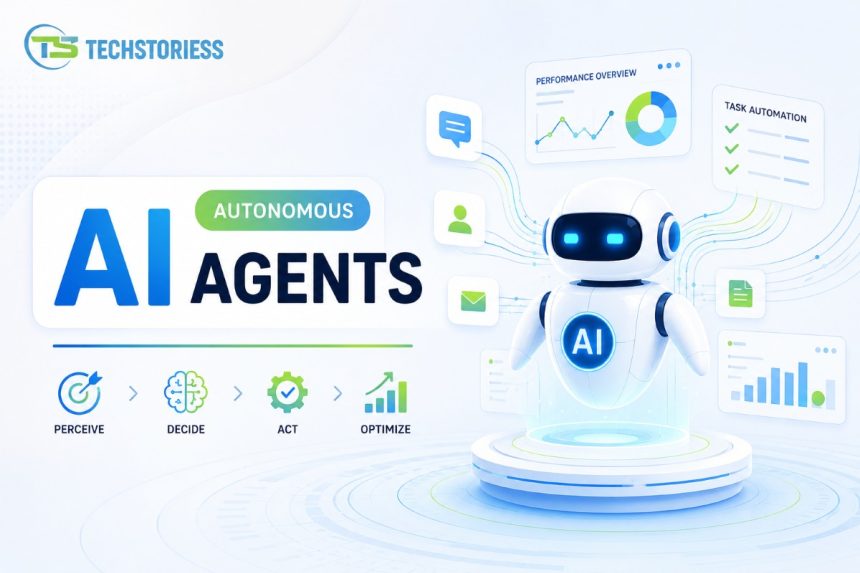
Autonomous AI agents plan, execute, and adapt multi-step enterprise tasks with minimal human input — calling APIs, negotiating between systems, and making bounded decisions without being re-prompted at every step. This article covers how they work in 2026, what the current adoption and ROI data actually shows, and a rollout roadmap for enterprise teams.
- Key Stats at a Glance
- Agentic AI for Enterprise
- Multi-Agent AI Systems
- How Do AI Agents Work?
- AI Agent Frameworks in 2026
- Autonomous AI Agents vs. RPA vs. Copilots
- Why Autonomous AI Agents Matter
- What Enterprises Need to Know
- Organizational Readiness and Change Management
- Top Use Cases of Autonomous AI
- Implementation Roadmap for Enterprises
- FAQ
- Conclusion
Key Stats at a Glance
| Metric | Figure | Source |
|---|---|---|
| Enterprise applications expected to embed AI agents | 40% by end of 2026 | Gartner |
| Agentic AI pilots that reach production | 11% | Deloitte |
| Enterprise workflows automatable via agentic orchestration | 25% by 2028 | McKinsey & Company |
| Year-over-year growth in enterprise AI usage | 282% | Salesforce |
| Customer service cost reduction from AI agents | Up to 30% | IBM |
| Downtime reduction from AI-driven predictive maintenance | Up to 50% | McKinsey & Company |
Agentic AI for Enterprise
For enterprises, agentic AI represents a shift from passive, instruction-based tools to autonomous digital workers driven by specific goals. Unlike conventional AI models that simply respond to queries, agentic systems interpret objectives, plan multi-step actions, access enterprise systems, and execute tasks within defined constraints.
In 2026, agentic AI shows up across HR onboarding, finance reconciliation, IT service management, procurement, and customer operations. Employees increasingly don’t switch between dashboards themselves — agents orchestrate workflows end-to-end, pulling CRM data, triggering approvals, updating ERP entries, and sending follow-up communications (see our CRM automation guide for a deeper look at that specific pattern).
The adoption curve backs this up: Salesforce’s 282% year-over-year usage jump (see stats table above) signals a real shift toward autonomous automation, not just a hype cycle.
More than automation, this is decision autonomy. Instead of following predefined instructions, agents prioritize tickets, select relevant data sources, adapt to exceptions, and escalate to humans when confidence thresholds aren’t met. To keep this in bounds, organizations layer in guardrails — policy constraints, role-based permissions, and audit logging (more in our AI governance and guardrails guide).
Competitive advantage here won’t come from deploying isolated agents. It comes from embedding them into core processes while maintaining governance, security, and observability.
Multi-Agent AI Systems
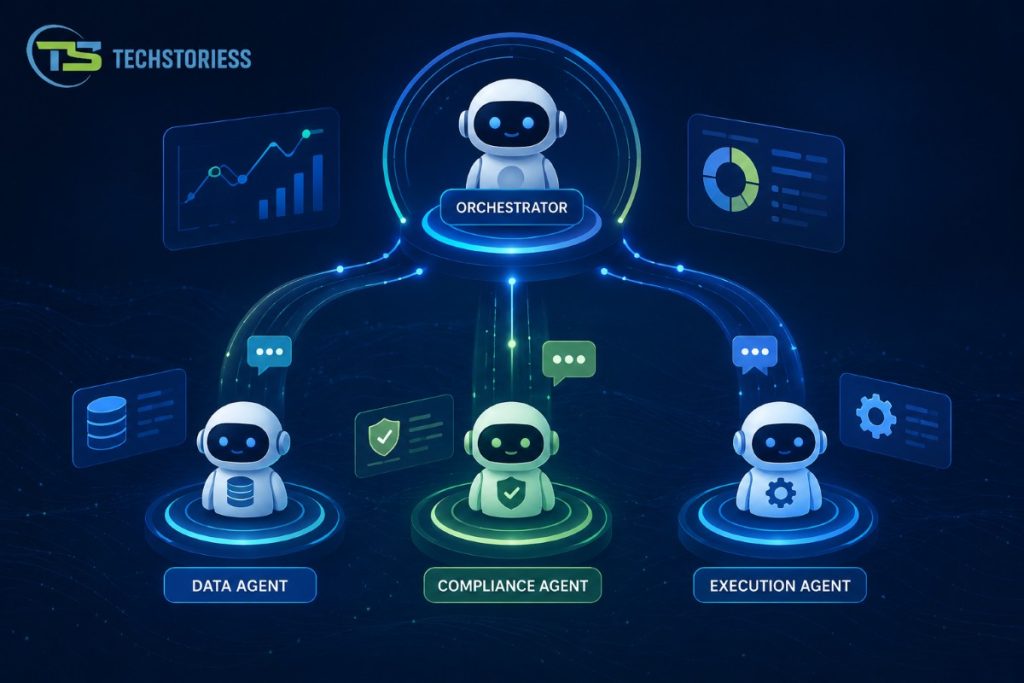
Unlike single agents that execute one task end-to-end, multi-agent systems coordinate complex operations across functions — one agent gathers data, another validates compliance, a third executes transactions, and a supervisory agent monitors performance and exceptions.
This mimics human organizational structure more than it mimics classic software:
- Finance agents reconcile accounts
- IT agents provision infrastructure
- Security agents monitor anomalies
- Procurement agents negotiate supplier terms
Coordination happens through structured message passing, shared memory layers, or centralized orchestrator frameworks (our agent orchestration frameworks comparison breaks down the leading options). Agents delegate subtasks to peers, resolve conflicts using predefined logic, and reassign workloads based on performance metrics or policy changes.
Given that Gartner expects 40% of enterprise applications to embed AI agents by the end of 2026 (see stats table), agents will increasingly interact not just with humans but with other agents across interconnected systems — which is exactly where the pilot-to-production gap shows up. Deloitte’s finding that only 11% of agentic pilots reach production is disproportionately a multi-agent problem: coordinating several agents requires disciplined architecture, including:
- Clear role definition for each agent
- Conflict-resolution logic between agents
- Shared memory governance
- Security boundary enforcement
- Audit traceability across the full chain
Done well, multi-agent architecture moves enterprises from isolated automation scripts to coordinated digital ecosystems that continuously optimize operations — a big part of why multi-agent systems enterprise AI adoption is accelerating faster than single-agent rollouts heading into next year.
How Do AI Agents Work?
At the core, AI agents combine large language models (LLMs), memory systems, planning logic, and tool integrations. A typical cycle looks like this:
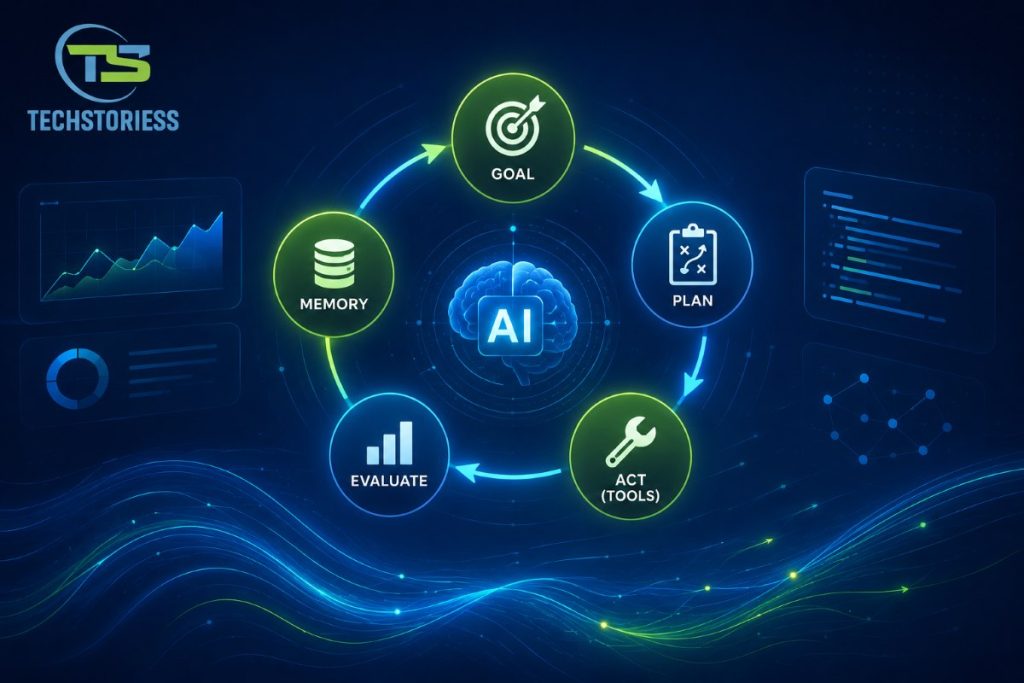
- Goal input — A user gives the agent an objective, e.g., “prepare a quarterly sales summary and notify regional managers.” Instead of generating static text like a chatbot, the agent decomposes this into subtasks: retrieve CRM data, clean datasets, compute KPIs, generate visual summaries, draft emails, and send notifications.
- Plan — Planning logic determines execution order, using an observe → plan → act → evaluate loop that iteratively refines actions until the objective is met.
- Act — The agent calls APIs, queries databases, or triggers workflows, transforming it from a conversational system into something that actually touches enterprise infrastructure.
- Evaluate — The agent checks its output against the original goal and decides whether to continue, retry, or escalate.
- Memory — Context from prior interactions, system states, and past decisions is stored so the agent doesn’t need to be re-briefed each session.
Wrapped around all five steps: governance. Role-based access control keeps the agent inside authorized permissions, and audit logs capture every action for compliance and forensic review.
Illustrative walkthrough (hypothetical, not a real client): Picture a mid-size B2B distributor whose finance team spends three days each month reconciling vendor invoices against purchase orders. An agent scoped to this single workflow would: pull invoices from the AP system (Act), match them against POs in the ERP (Act), flag mismatches above a $500 threshold for human review (Evaluate + Governance), and auto-approve matches below that threshold (Act). Over a quarter, the team’s manual reconciliation work shifts from “check everything” to “review the exceptions the agent already flagged” — the kind of narrow, well-bounded use case that tends to reach production, per the pilot-to-production data above.
This is the core distinction: AI models generate content; AI agents execute tasks. The combination of reasoning, memory, planning, and tools is what enables bounded autonomy — the agent operates independently while staying aligned with enterprise policy.
AI Agent Frameworks in 2026
By 2026, AI agent frameworks have matured into enterprise-grade orchestration platforms. Modern frameworks typically provide:
- Agent lifecycle management
- Secure API connectors
- Memory stores (vector and structured databases)
- Workflow orchestration engines
- Monitoring and observability dashboards
- Policy enforcement modules
Despite this maturity, the pilot failure rate stays high — Deloitte’s 11% production rate (see stats table) traces back mostly to architectural gaps, weak governance, or insufficient integration planning, not to model capability. Experimentation without robust infrastructure doesn’t scale.
Framework evolution in 2026 is converging on a few priorities:
- Interoperability across enterprise applications
- Granular permissioning and identity controls
- Human-in-the-loop escalation workflows
- Version control for agent behaviors
- Real-time risk detection and anomaly monitoring
The dominant design philosophy is governance-first: flexibility and efficiency still matter, but control, auditability, and resilience now carry equal weight. Enterprises get more mileage treating frameworks as strategic infrastructure rather than experimental developer tools. If you’re evaluating platforms directly, our side-by-side breakdown of the best agentic AI tools on the market in 2026 is a good next stop.
Autonomous AI Agents vs. RPA vs. Copilots
In 2026, autonomous AI agents function as bounded decision-makers within enterprise ecosystems — distinct from both traditional automation and conversational AI. For a fuller, ROI-based breakdown of that second distinction, see our guide to agentic AI vs copilots. The short version:
| Dimension | Traditional Automation / RPA | AI Copilot / Chatbot | Autonomous AI Agent |
|---|---|---|---|
| Decision-making | Follows fixed rules | Responds only to prompts | Plans and adapts within guardrails |
| Adapts to new inputs | No — breaks on exceptions | Only within a single conversation | Yes, dynamically |
| Executes multi-step tasks | Limited, pre-scripted | No — generates text/responses only | Yes, via tool and API calls |
| Human involvement | Constant maintenance | Constant prompting | Oversight and exception escalation only |
| Best fit | Stable, rule-based processes | Drafting, search, Q&A | Cross-system, judgment-based workflows |
In practice:
- Customer service: autonomous agents triage requests, verify account data, issue refunds within policy thresholds, and escalate complex disputes.
- IT operations: agents identify anomalies, isolate affected endpoints, open incident tickets, and initiate remediation workflows.
The clearest mental model: an autonomous agent behaves like a junior digital executive — empowered to act, governed by policy, and continuously reviewed through monitoring systems. Autonomy doesn’t mean an absence of control; responsible enterprises still define decision thresholds, escalation triggers, operational boundaries, and compliance controls before turning an agent loose.
Not every workflow belongs at the far right of that spectrum. High-stakes decisions in finance, healthcare, or legal contexts should stay in the supervised-to-bounded tiers; full autonomy is best reserved for high-volume, well-bounded, low-risk work. Our human-in-the-loop design patterns guide covers how to set those checkpoints without recreating the bottlenecks agents are meant to remove.
Why Autonomous AI Agents Matter
Autonomous agents don’t just automate tasks — they change the economics of enterprise operations. Traditional automation reduces the time to complete a task; agentic AI reduces the coordination friction between departments and systems, eliminating the bottleneck between data retrieval, analysis, and execution.
That’s a meaningful difference because coordination friction, not task speed, is usually the real cost center in cross-functional enterprise work. With Gartner projecting agentic capability inside 40% of enterprise applications by the end of 2026 (see stats table), this is fast becoming baseline infrastructure rather than a competitive differentiator — which raises the bar for how deliberately it needs to be governed, not just how quickly it gets deployed.
The business case tends to show up in four places:
- Faster execution cycles — from data retrieval straight through to action, without a human relay step in between
- Reduced operational overhead — fewer manual handoffs per completed task
- 24/7 process continuity — agents don’t wait for business hours
- Compounding efficiency — when multiple agents coordinate across departments, the gains multiply rather than add, unlocking cross-functional optimization that siloed automation can’t reach on its own
McKinsey’s estimate of 25% workflow automation by 2028 (see stats table) is driven largely by this kind of agentic orchestration rather than static, rule-based RPA — and unlocking it depends on treating decision-capable agents as workforce infrastructure, not point-solution tools bolted onto individual apps. (For a walkthrough of how to model this business case internally, see our agentic AI ROI calculation guide.)
What Enterprises Need to Know
Six things determine whether an agentic AI investment actually pays off:
- Pilot-to-production is the primary hurdle. Only 11% of pilots reach production, per Deloitte (see stats table). Governance gaps, unclear architecture, and weak integration planning are the most common causes — not model quality. For the full path from pilot to production, see our guide to agentic AI implementation guide.
- Infrastructure matters more than the model. Planning engines, API security, identity controls, logging, and monitoring determine long-term success far more than which LLM sits underneath.
- ROI depends on process selection. Target high-friction, repeatable workflows with measurable KPIs. McKinsey’s 25%-by-2028 estimate (see stats table) applies to structured processes with well-defined boundaries — not to every workflow indiscriminately.
- Human oversight stays essential. Clearly defined escalation logic and confidence thresholds prevent operational drift and unintended consequences.
- Security and compliance can’t be retrofitted. Build in least-privilege access, continuous validation, activity logging, and policy enforcement from day one — our AI agent security practices guide covers the current baseline, including prompt-injection and MCP-specific risks.
- Leadership alignment is non-negotiable. Agentic AI is an operational redesign strategy, not an IT-only initiative.
Enterprises that treat autonomous agents as governed, measurable digital-workforce infrastructure — rather than isolated experiments — are the ones positioned to compound the advantage over time.
Organizational Readiness and Change Management
Model capability isn’t the bottleneck for most agentic AI programs — organizational readiness is. The real transformation challenge sits in people, processes, and accountability structures, not in APIs or governance frameworks alone.
- Roles and responsibilities shift. As agents take on ticket prioritization, reconciliation, and reporting, human roles move from task execution to supervision, exception handling, and strategic oversight. This requires redefining job descriptions, performance metrics, and decision rights up front — without that clarity, an agent’s mistake becomes an ownership dispute.
- The workforce needs reskilling. Employees need to learn how to define high-quality goals for an agent, interpret its outputs, and know when to intervene. The skill shift is from operational execution toward judgment, validation, and escalation management — best supported by early AI-literacy programs and workflow-redesign workshops.
- Trust has to be calibrated, not assumed. Over-trusting agents leads to complacency and unchecked automation; under-trusting them leads to unnecessary manual overrides that erase the productivity gain entirely. Transparent dashboards — showing agent decisions, confidence levels, and escalation triggers — help employees understand not just what the agent did but why, which is what actually builds calibrated trust.
- Cross-functional governance prevents stalls. Autonomous agents often erase departmental boundaries by automating processes that used to require multi-team coordination. Without executive sponsorship and a cross-functional governance committee, deployments commonly stall on turf conflicts or misaligned incentives.
- Address the psychological impact directly. Introducing autonomous agents can trigger legitimate anxiety about displacement. Framing agents explicitly as augmentation — not replacement — and backing that framing with real role-redesign work (not just messaging) is what actually reduces resistance (see our Playbook for AI agent rollouts for a step-by-step approach).
The enterprises scaling agentic AI successfully in 2026 are the ones redesigning workflows, redefining accountability, reskilling teams, and building cultural readiness for human-agent collaboration — sustainable success here is an organizational outcome, not a model-performance one.
Top Use Cases of Autonomous AI
For a deeper breakdown of each use case with implementation notes, see our agentic AI workflow automation use cases guide.
| Use Case | Reported Impact | Source |
|---|---|---|
| Customer service automation | Up to 30% lower service costs | IBM |
| IT incident response | Reduced mean time to resolution (MTTR) | Gartner |
| Predictive maintenance | Up to 50% less downtime; 10–40% lower maintenance cost | McKinsey & Company |
| Enterprise-wide AI agent adoption | 40% of enterprise apps by end of 2026 | Gartner |
| Pilot-to-production rate | Only 11% of pilots reach production | Deloitte |
| Enterprise AI usage growth | 282% YoY increase | Salesforce |
Customer Service & Support Automation
Autonomous agents can manage end-to-end customer interactions — understanding context, retrieving data, resolving tickets, and escalating to human agents when necessary. IBM’s research puts the potential cost reduction at up to 30%, alongside faster response times. Common deployments include refund processing, record updates, and complaint resolution triggered without human intervention.
IT Operations & Incident Response
Agents monitor infrastructure, detect anomalies, diagnose root causes, and initiate remediation — restarting services, patching vulnerabilities, or scaling cloud resources in real time. Gartner’s research points to meaningfully reduced MTTR as the primary payoff (see our IT agent deployment guide for setup detail).
Predictive Maintenance in Manufacturing
Industrial agents analyze IoT sensor data to predict equipment failures before they cause downtime. McKinsey’s figures — up to 50% less downtime and 10–40% lower maintenance cost — make this one of the more measurable use cases on this list, since the input data (sensor readings) and output metric (unplanned downtime) are both already tracked in most plants.
Financial Services & Fraud Detection
Agents continuously monitor transactions, flag suspicious behavior, and adapt detection models to evolving fraud patterns, letting banks run compliance checks and fraud signal detection at machine speed.
Supply Chain & Logistics Optimization
Autonomous systems forecast demand, optimize inventory levels, and reroute shipments dynamically in response to disruptions — reducing excess inventory while improving on-time delivery.
Across all five, the common thread is the same: autonomous AI works best on workflows that are high-friction, repeatable, and already instrumented with the data needed to measure the result.
Implementation Roadmap for Enterprises
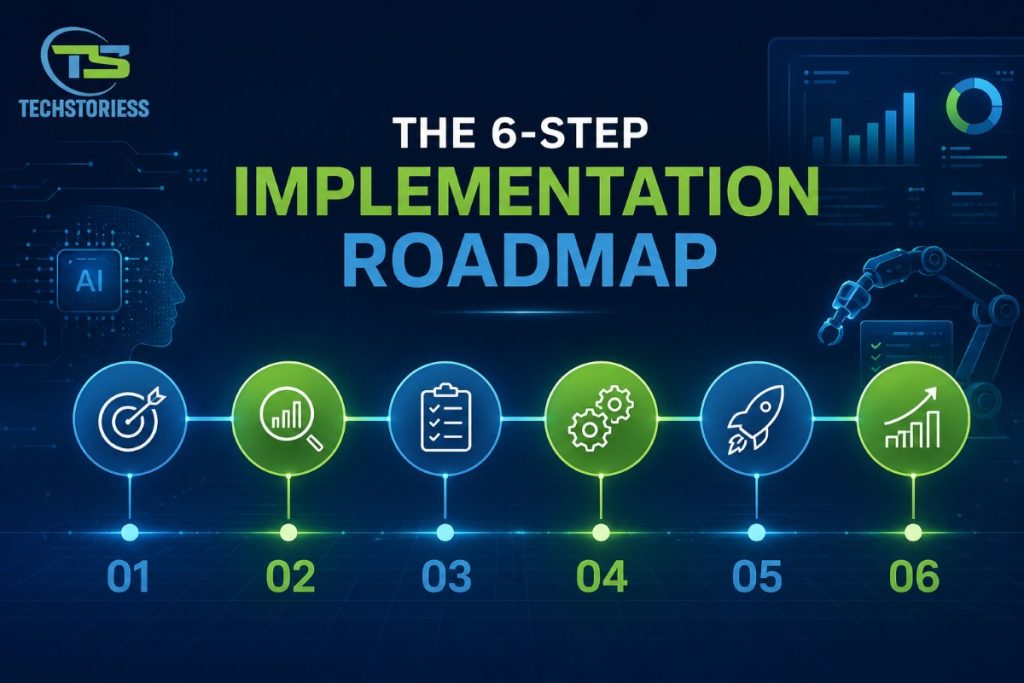
- Start with high-impact, low-risk use cases. Contained workflows — internal service desks, invoice processing, IT ticket resolution — allow tighter control and measurable outcomes. Gartner’s research indicates that enterprises piloting in controlled environments see faster ROI and smoother scaling, which also helps build the internal confidence needed for executive sponsorship.
- Build a strong data foundation. Autonomous AI needs clean, structured, well-governed data. Run data audits, resolve inconsistencies, and define access controls before deployment — poor data quality is the fastest route to unreliable decisions.
- Define levels of autonomy explicitly. Don’t assume full autonomy suits every workflow. Use the autonomy spectrum above as a starting framework, and keep approval checkpoints on critical actions in high-stakes sectors like finance or healthcare.
- Implement governance and guardrails. Set clear policies for monitoring, explainability, and audit trails. McKinsey’s research links strong AI governance directly to higher trust and adoption rates — role-based access control, activity logging, and automated compliance checks are the baseline, not the ceiling.
- Deploy incrementally and monitor continuously. Phase the rollout, measure against defined KPIs, and adjust based on feedback rather than attempting a large-scale launch. Continuous monitoring keeps the system aligned with both business objectives and regulatory requirements as both evolve.
- Invest in workforce enablement. Address uncertainty directly through transparent communication about augmentation, not replacement, then train employees to work alongside agents rather than compete with them.
Enterprises that follow this phased, governance-driven approach are best positioned to capture the efficiency gains of autonomous AI while minimizing operational and reputational risk. Regional rollouts add their own considerations around data residency, vendor maturity, and talent availability — see our guide to agentic AI deployment India if that’s your primary market.
FAQ
What is an autonomous AI agent, in simple terms?
A system that can plan and carry out multi-step tasks on its own — retrieving data, making a decision within policy limits, and taking an action — rather than just answering a question.
How is an AI agent different from a chatbot or copilot?
A chatbot responds to what you type. An agent acts: it can call APIs, update systems, and complete a task end-to-end without a human directing each step.
How is an AI agent different from RPA?
RPA follows fixed, scripted rules and breaks when something unexpected happens. AI agents adapt to new inputs and make probabilistic decisions within defined boundaries.
What’s the difference between a single agent and a multi-agent system?
A single agent handles one task end-to-end. A multi-agent system splits work across specialized agents (e.g., one for compliance, one for data, one for execution) that coordinate toward a shared goal.
How much autonomy should an enterprise give an AI agent?
It depends on the stakes: low-risk, repeatable tasks can run with minimal oversight, while high-stakes decisions (finance, healthcare) should keep human approval checkpoints in place.
Why do most agentic AI pilots fail to reach production?
Deloitte found only 11% do — usually because of governance gaps, unclear architecture, or weak integration planning, not because the underlying model isn’t capable enough.
What’s a good first use case for piloting AI agents?
High-friction, repeatable, well-bounded workflows — like internal IT ticket triage or invoice processing — that give measurable ROI without high downside risk.
Conclusion
Autonomous AI agents in 2026 are a structural shift in enterprise architecture, not just an advanced chat interface. As decision-capable systems embedded directly into applications, they move AI from advisory support into operational execution — changing how work gets coordinated, how processes scale, and how intent becomes action.
The opportunity is real: faster execution cycles, cross-functional optimization, 24/7 process continuity, and compounding efficiency gains. But the persistent pilot-to-production gap (11%, per Deloitte) is the honest reminder that autonomy without governance, oversight, and risk controls doesn’t hold up at scale. Enterprises that treat autonomous agents as governed, measurable digital-workforce infrastructure — not just deployed technology — are the ones who’ll turn this into lasting advantage rather than another stalled pilot.