


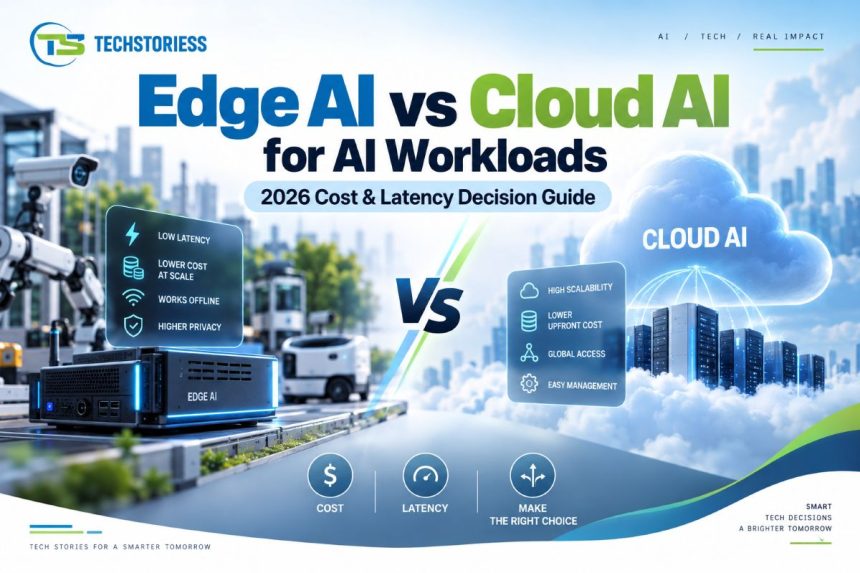
Around half a decade ago, a key AI infrastructure decision was which cloud provider to run on. In 2026, the most important decision is whether to run in the cloud at all. Edge AI has evolved from experimental to production-ready for a rapidly growing category of enterprise workloads – driven by hardware maturation, the emergence of small language models (SLMs) specifically designed for constrained environments, and an economic landscape increasingly favouring local inference at scale over per-call cloud billing.
The stakes are often defined by latency requirements. For locally processed requests, Edge AI inference can operate below 10 milliseconds. In contrast, Cloud AI inference typically runs between 50 and 200 milliseconds for real-time applications, which includes network round-trip latency, queue time, and inference processing at the provider’s data centre. For use cases involving a real-time fraud detection system, a surgical robotics platform, or an autonomous vehicle control system, that 40–190 millisecond gap is more than just a performance preference – it represents a safety and operational viability requirement. However, it is largely irrelevant for a content summarisation workflow running within a back-office document management system.
To make an informed architecture decision, enterprises do not simply need to choose between edge or cloud. They need a structured evaluation framework to determine where each workload belongs, governed by factors such as latency requirements, data sovereignty constraints, inference economics, and connectivity assumptions. In this guide, we provide that framework – a decision methodology applicable to enterprise AI architects, infrastructure leaders, and CTOs building hybrid AI deployment strategies for 2026 and beyond.
The Structural Forces Reshaping the Edge-Cloud Balance in 2026
Since 2024, three developments have materially shifted the edge-cloud equation.
The most consequential is small language model (SLM) maturation. In early 2026, Dell predicted that SLMs will dominate edge AI deployments in 2026 relative to cloud-based LLM usage for many operational workloads. This signals an era of hardware-software co-evolution that is compressing the capability gap between edge-deployable models and cloud-resident large models for task-specific applications.
Models in the 1–13 billion parameter range can now perform effectively on edge hardware. Running on platforms such as NVIDIA Jetson, Qualcomm AI accelerators, Apple Silicon, and Intel NPU-equipped systems, these models can tackle classification, extraction, summarisation, anomaly detection, and domain-specific inference tasks with accuracy levels approaching those delivered by cloud LLMs only a few years ago. For workloads that do not require the broad reasoning capabilities of a 70B+ parameter model, the rationale for sending every inference request to a cloud API has weakened considerably.
IoT data volume economics have reached a tipping point. Approximately 90% of IoT data is now processed locally at the edge before any transmission to cloud infrastructure. This reflects both the bandwidth cost of transmitting raw sensor data and the latency cost of waiting for cloud processing before acting upon it. A manufacturing facility with 10,000 sensors generating continuous telemetry cannot realistically route every data point through a cloud inference pipeline without incurring costs and delays that undermine the objective of real-time process control. Edge AI that filters, classifies, and acts on data locally – transmitting only anomalies, summaries, and structured insights to the cloud – is no longer an optimisation; it is an architectural necessity.
For organisations running AI at production scale, cloud inference cost structure has become a genuine budget consideration. Cloud inference pricing typically ranges from $0.0001 to $0.001 per inference call, depending on model size and provider. While this may appear negligible, the costs become significant at scale. A customer-facing monitoring platform or agentic AI workflow processing continuous data streams may generate millions of inference requests per day, making monthly cloud inference expenditure a meaningful infrastructure cost. By contrast, once edge hardware is deployed, inference incurs near-zero marginal cost at scale. The economics increasingly favour edge deployment at sufficiently high inference volumes.
The Decision Framework: Six Variables That Determine Deployment Architecture
For effective workload placement, AI inference decisions should be evaluated against six variables. Rather than treating any single variable as decisive, organisations should assess how all six interact with the specific requirements of a workload to determine the most appropriate architecture.
Latency Requirement
This is the clearest and often the most important variable. Define the maximum acceptable end-to-end latency for the application’s critical path and then compare it against the realistic latency profile of each deployment option.
Hard real-time applications requiring responses within 10ms must run at the edge. Examples include autonomous systems, industrial control environments, real-time audio processing, and surgical assistance systems. These use cases become technically infeasible under cloud-primary architectures because of typical cloud inference latency ranging from 50–200ms.
Soft real-time applications that can tolerate 50–200ms response times can operate effectively in the cloud. Examples include conversational AI interfaces, document processing systems, and recommendation engines with page-load tolerance. For these workloads, latency alone does not justify edge deployment, allowing other variables to drive the decision.
Batch and asynchronous workloads generally have no strict real-time requirements and are therefore well suited to cloud deployment, where elastic compute scaling and access to large-model capabilities can justify the cost. Examples include model training, large-scale document analysis, periodic reporting, and data pipeline enrichment.
Inference Volume and Cost Economics
Estimate projected monthly inference volume and compare it against both cloud and edge cost structures.
Cloud inference costs are relatively straightforward to calculate: multiply inference volume by per-call pricing and add any applicable data egress charges, along with infrastructure costs for data preparation and result handling. Cloud economics are typically favourable at low to moderate volumes – often below approximately one million inferences per month – where hardware acquisition costs may outweigh operational savings.
For edge inference, hardware procurement and maintenance costs must be amortised over the hardware lifecycle, typically three to five years for enterprise-grade deployments. At sufficient scale – commonly between two and ten million inferences per month for GPU-accelerated edge deployments, depending on pricing and hardware configuration – the marginal cost advantage of edge inference often outweighs hardware amortisation and delivers a lower total cost per inference.
The near-zero marginal cost at scale characteristic of edge inference is particularly valuable for high-volume, low-complexity workloads such as image classification, sensor anomaly detection, and domain-specific text classification.
Data Sovereignty and Privacy Constraints
Regulatory requirements, contractual obligations, and internal governance policies may require certain data to remain within a geographic region, organisational boundary, or physical facility.
Healthcare records, financial transactions, defence-related information, and sensitive industrial process data often fall under such restrictions, making cloud inference impractical or non-compliant regardless of latency or cost considerations.
For data that cannot be transmitted to a cloud environment, Edge AI is often the only viable deployment model. This consideration is becoming increasingly important due to regulatory frameworks such as GDPR, sector-specific compliance requirements, and stricter enterprise governance policies.
Connectivity Reliability
Cloud AI inference requires reliable, low-latency connectivity to cloud infrastructure for consistent operation.
For deployments in environments with intermittent connectivity, bandwidth limitations, or exposure to physical communication disruptions, cloud-dependent AI architectures introduce operational risks that may be unacceptable. Examples include offshore platforms, remote mining operations, maritime vessels, military deployments, and manufacturing environments affected by RF interference.
A major advantage of Edge AI in such environments is its ability to continue operating during connectivity outages through local inference. While capabilities such as model updates, telemetry uploads, and cloud analytics may depend on connectivity, core inference functions can continue autonomously. A well-designed architecture should clearly distinguish between these categories. For mission-critical deployments operating in unstable network environments, full edge inference capability with cloud synchronisation when connectivity becomes available is often the only architecturally resilient approach.
Model Complexity Requirements
Not every AI task requires a large reasoning-focused language model.
The maturation of SLMs demonstrates that task-specific models can achieve performance levels comparable to or better than general-purpose LLMs for narrowly defined tasks while operating efficiently on edge hardware.
Classification, structured data extraction, anomaly detection, speech recognition for constrained vocabularies, and object detection in controlled visual environments are all well suited to edge-deployable SLMs. By contrast, tasks requiring broad world knowledge, creative content generation, complex multi-step reasoning, or general-purpose language understanding are typically better served by large cloud-hosted models whose computational requirements exceed edge hardware capabilities.
Many enterprises are increasingly adopting hybrid edge-cloud AI architectures, routing task-specific inference requests to edge SLMs while reserving cloud LLMs for complex reasoning tasks. Routing decisions are made programmatically based on workload classification, reducing cloud costs and latency while preserving access to advanced reasoning when needed.
Model Update Frequency
One challenge associated with Edge AI is model lifecycle management.
Cloud AI largely abstracts this responsibility because cloud providers manage model updates on hosted services. Applications consuming models through APIs can benefit from model improvements without modifying infrastructure.
Edge deployments, however, require a secure distribution pipeline capable of delivering updated models across potentially thousands of devices. This includes version management, validation, rollback mechanisms, and visibility into deployment status across the fleet.
Architectural decisions should therefore account for update frequency. Workloads that must adapt rapidly to changing threat landscapes, evolving regulations, or shifting data distributions may incur higher operational overhead at the edge. By contrast, workloads with stable requirements and quarterly or annual update cycles are far easier to manage in edge environments.
Hybrid Edge-Cloud Architecture: The Production Standard
IDC projects that 60% of edge computing deployments will incorporate GenAI capabilities by 2029. This does not imply a mass migration away from the cloud. Rather, it indicates that the industry is moving toward hybrid architectures where edge and cloud operate together within the same AI ecosystem, complementing rather than competing with each other.
The production-standard architecture for 2026 is therefore the hybrid edge-cloud AI architecture.
In this model, SLMs operate at the edge layer, handling real-time inference, local sensor and camera processing, privacy-sensitive workloads, and offline-capable decision-making. Large-model inference operates within the cloud layer, supporting complex reasoning, model training, optimisation using aggregated telemetry, centralised observability, and large-scale batch processing.
Between these layers sits an intelligent routing layer capable of classifying requests and directing them to the most appropriate execution environment based on the six variables discussed above.
This architecture combines the strengths of both environments. Edge inference provides decisive latency and cost advantages for high-volume, time-sensitive workloads, while cloud-hosted LLMs deliver the advanced reasoning capabilities required for more complex tasks.
Conclusion
In 2026, the edge AI versus cloud AI debate does not have a universal answer. Each workload category demands its own evaluation.
Enterprises must assess key variables including latency requirements, inference economics at projected volumes, data sovereignty obligations, connectivity assumptions, model complexity requirements, and model update frequency. Together, these factors determine the optimal deployment architecture.
One conclusion is increasingly clear: it is no longer viable to default every AI workload to cloud inference simply because it is the easiest starting point. Edge environments can significantly reduce operating costs while maintaining required performance levels. With sub-10ms latency, near-zero marginal inference costs at scale, and the ability to process up to 90% of IoT data locally, edge AI has crossed an important economic and operational threshold.
The opportunity for organisations lies in developing the discipline to evaluate workloads systematically – one workload and one variable at a time – to build AI infrastructure that is materially more cost-efficient, resilient, and performant.